Complete firstClear boundary
Clarify mandate and decision owner; interview stakeholders about the decision, boundaries, interests, and contested assumptions.
Without a boundary, cases, periods, or variables become mixed.
A practical method guide: clarify prerequisites and materials, understand the complete process, and look up outputs, pitfalls, and stop criteria.
What needs to be finished first
Clarify mandate and decision owner; interview stakeholders about the decision, boundaries, interests, and contested assumptions.
Decision mandate, stakeholder and scope map, objectives, alternatives, uncertainties, evidence sources, and decision log
What needs to be ready before start
Decision mandate, stakeholder and scope map, objectives, alternatives, uncertainties, evidence sources, and decision log
Decision owner · key stakeholders · domain/data experts · facilitator · scribe
Clarify mandate and decision owner; interview stakeholders about the decision, boundaries, interests, and contested assumptions.
120–180 minutes plus pre-interviews where scope is contested.
Prepare a workspace with Decision · Scope · Objectives · Options · Evidence; separate example from live data.
The one question this method answers
What decision is pending now, who owns it, which objectives, alternatives, and uncertainties belong in the frame, and what analysis is needed before deciding?
Phases with goal, actions, output and pitfall
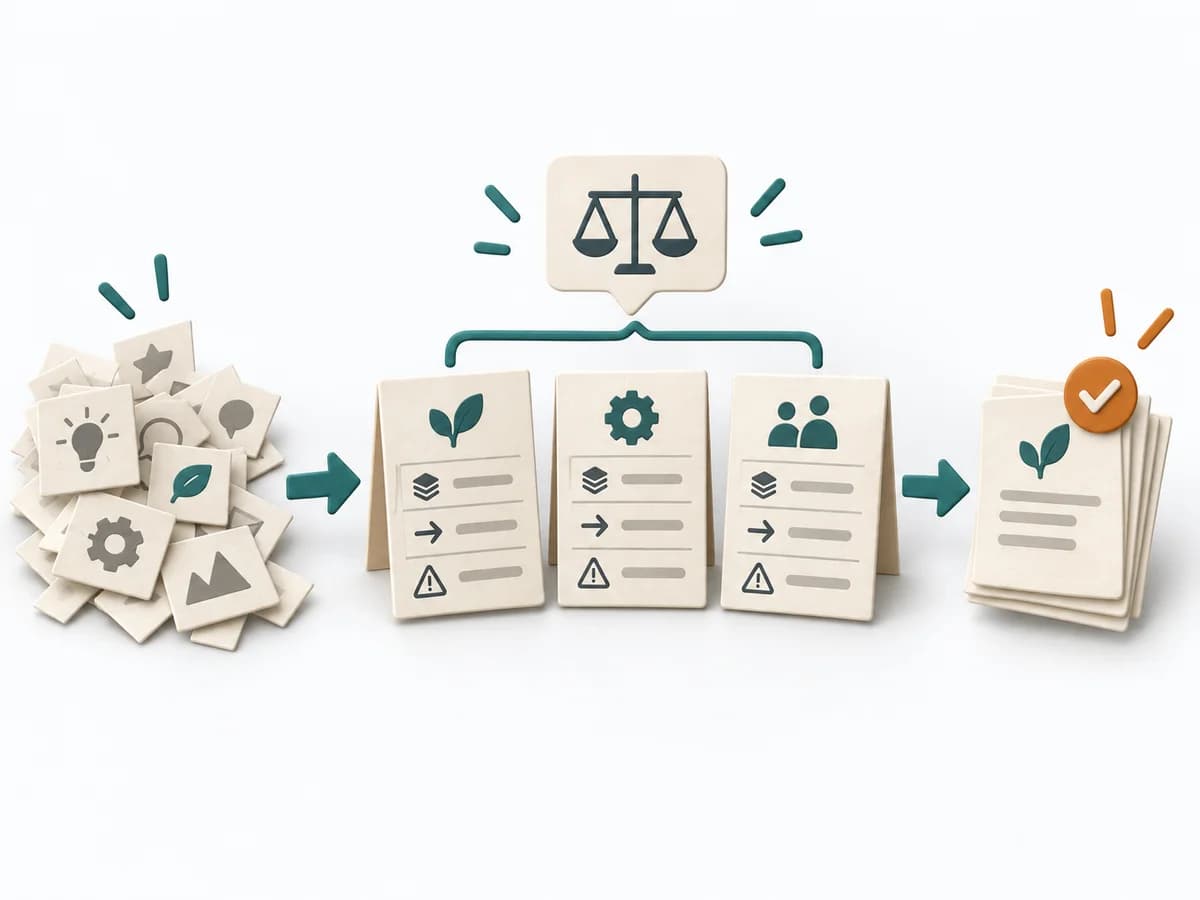
A decision framing workshop turns a decision into a precise question with context, criteria, and constraints. The shared frame reveals missing information, needed perspectives, and a suitable decision mode.
Fictional example
Fictional values show the actual method fields.
| Frame field | Working question | Fictional content | Owner/source | Status |
|---|---|---|---|---|
| DecisionAdd evidence and rationale. | Who decides what by when? | Operations chooses the Saturday model on 28 Oct for January onward. | Operations lead | Approved |
| ScopeAdd evidence and rationale. | What is in, out, fixed, or open? | In: Hamburg/Saturday; out: price/weekdays; fixed: labour/fire code. | Decision owner + stakeholders | Approved |
| ObjectivesAdd evidence and rationale. | Which fundamental values and red lines matter? | p80 wait; errors <1%; warehouse load; emergency access; effort. | Stakeholder group | Approved |
| AlternativesAdd evidence and rationale. | Which real actions include status quo? | A status quo; B fixed slots; C dynamic slots; D slots plus buffer. | Operations + Product | Open for additions |
| UncertaintyAdd evidence and rationale. | Which tipping question changes the choice? | Emergencies/month and achievable p80 flip B versus D. | Lea, four-Saturday pilot | Due 21 Oct |
All values are fictional.
Decision

Goal
Decision statement: Clarify decision owner, choice statement, date, and downstream decision it enables.
Inputs for this step
Actions
Output
Decision statement
Clarify decision owner, choice statement, date, and downstream decision it enables.
Quality check
Does the statement contain a concrete choice and empowered owner?
Pitfall
The workshop is asked to solve the pickup problem. State choice, owner, timing, and downstream use explicitly.
Timing: 20–25 minutes
Scope
Goal
Scope map: Mark in/out, horizon, affected groups, fixed boundaries, and interfaces.
Inputs for this step
Actions
Output
Scope map
Mark in/out, horizon, affected groups, fixed boundaries, and interfaces.
Quality check
Are contested boundaries visible as decisions or assumptions?
Pitfall
Participants use different system boundaries. Jointly mark every boundary as in, out, fixed, or open.
Timing: 20–30 minutes
Objectives
Goal
Objective hierarchy: Derive fundamental objectives, measures, and red lines from stakeholder perspectives.
Inputs for this step
Actions
Output
Objective hierarchy
Derive fundamental objectives, measures, and red lines from stakeholder perspectives.
Quality check
Are objectives independent of preferred solutions and free of double counting?
Pitfall
Means such as introduce slots are listed as objectives. Ask why and move means beneath their objective.
Timing: 20–30 minutes
Options
Goal
Alternative space: Phrase status quo and distinct feasible alternatives at the right decision level.
Inputs for this step
Actions
Output
Alternative space
Phrase status quo and distinct feasible alternatives at the right decision level.
Quality check
Are at least two real actions and status quo comparable?
Pitfall
A preferred solution is compared with a straw option. Specify mechanism and required capabilities for each option.
Timing: 20–30 minutes
Evidence
Goal
Evidence plan: Set key uncertainties, tipping values, sources, owners, and decision process; approve frame.
Inputs for this step
Actions
Output
Evidence plan
Set key uncertainties, tipping values, sources, owners, and decision process; approve frame.
Quality check
Is it clear which uncertainty can change the choice and who resolves it by when?
Pitfall
The frame ends as a poster without a decision path. Record tipping questions, evidence owners, date, decision rule, and revisit triggers.
Timing: 20–35 minutes
What comes out at the end
Sketch: what the artifact looks like
Approved decision frame with decision statement, scope, objectives, alternatives, uncertainties, evidence plan, and revisit rules.
Record date, owner, source state, and review date; preserve prior versions.
Set subject, evidence, roles, flow, and review.
To be confirmed
To be confirmed
Complete run Time: 120–180 minutes plus pre-interviews where scope is contested.
Complete this worksheet on paper or in your own document during the work.
| Frame field | Working question | Fictional content | Owner/source | Status |
|---|---|---|---|---|
| Decision | ||||
| Scope | ||||
| Objectives | ||||
| Alternatives | ||||
| Uncertainty |
The blank worksheet contains prompts only.
Reference · original teaching example
Expected artifact: Decision statement
Clarify decision owner, choice statement, date, and downstream decision it enables.
Entry:
...
Expected artifact: Scope map
Mark in/out, horizon, affected groups, fixed boundaries, and interfaces.
Entry:
...
Expected artifact: Objective hierarchy
Derive fundamental objectives, measures, and red lines from stakeholder perspectives.
Entry:
...
Expected artifact: Alternative space
Phrase status quo and distinct feasible alternatives at the right decision level.
Entry:
...
Expected artifact: Evidence plan
Set key uncertainties, tipping values, sources, owners, and decision process; approve frame.
Entry:
...
...
Method guide: https://methodatlas.meierhoff-systems.de/en/methods/decision-framing-workshop/run-sheet
Concrete filled scenario, fictional example
Fictional example for orientation. Counts and timings describe this case and are not universal requirements.
Concrete filled scenario, fictional example
| Frame field | Working question | Fictional content | Owner/source | Status |
|---|---|---|---|---|
| Decision | Who decides what by when? | Operations chooses the Saturday model on 28 Oct for January onward. | Operations lead | Approved |
| Scope | What is in, out, fixed, or open? | In: Hamburg/Saturday; out: price/weekdays; fixed: labour/fire code. | Decision owner + stakeholders | Approved |
| Objectives | Which fundamental values and red lines matter? | p80 wait; errors <1%; warehouse load; emergency access; effort. | Stakeholder group | Approved |
| Alternatives | Which real actions include status quo? | A status quo; B fixed slots; C dynamic slots; D slots plus buffer. | Operations + Product | Open for additions |
| Uncertainty | Which tipping question changes the choice? | Emergencies/month and achievable p80 flip B versus D. | Lea, four-Saturday pilot | Due 21 Oct |
Recognize symptoms and steer against them
Quick overview, the full text is in the matching phase in the flow
The workshop is asked to solve the pickup problem.
State choice, owner, timing, and downstream use explicitly.
Participants use different system boundaries.
Jointly mark every boundary as in, out, fixed, or open.
Means such as introduce slots are listed as objectives.
Ask why and move means beneath their objective.
A preferred solution is compared with a straw option.
Specify mechanism and required capabilities for each option.
The frame ends as a poster without a decision path.
Record tipping questions, evidence owners, date, decision rule, and revisit triggers.
When to pause, resolve prerequisites, or choose another approach
Go to the profile for purpose, similar methods, and sources or continue to the next method in the catalog.