
Purpose
When a navigation exists but search paths still fail, tree testing checks findability without visual distraction. The method shows whether labels, levels, and paths really lead to the intended destination.
UX Research Research method
Checks whether people can find content in a navigation hierarchy.
Tree testing evaluates search tasks in a labeled, clickable hierarchy without a visual interface. Destination, first click, and path show information-architecture findability; finished-page appearance and interaction are outside the test scope.
Can relevant users find the required content in the proposed hierarchy?
The phase bar connects hierarchy, tasks, paths, and revision.
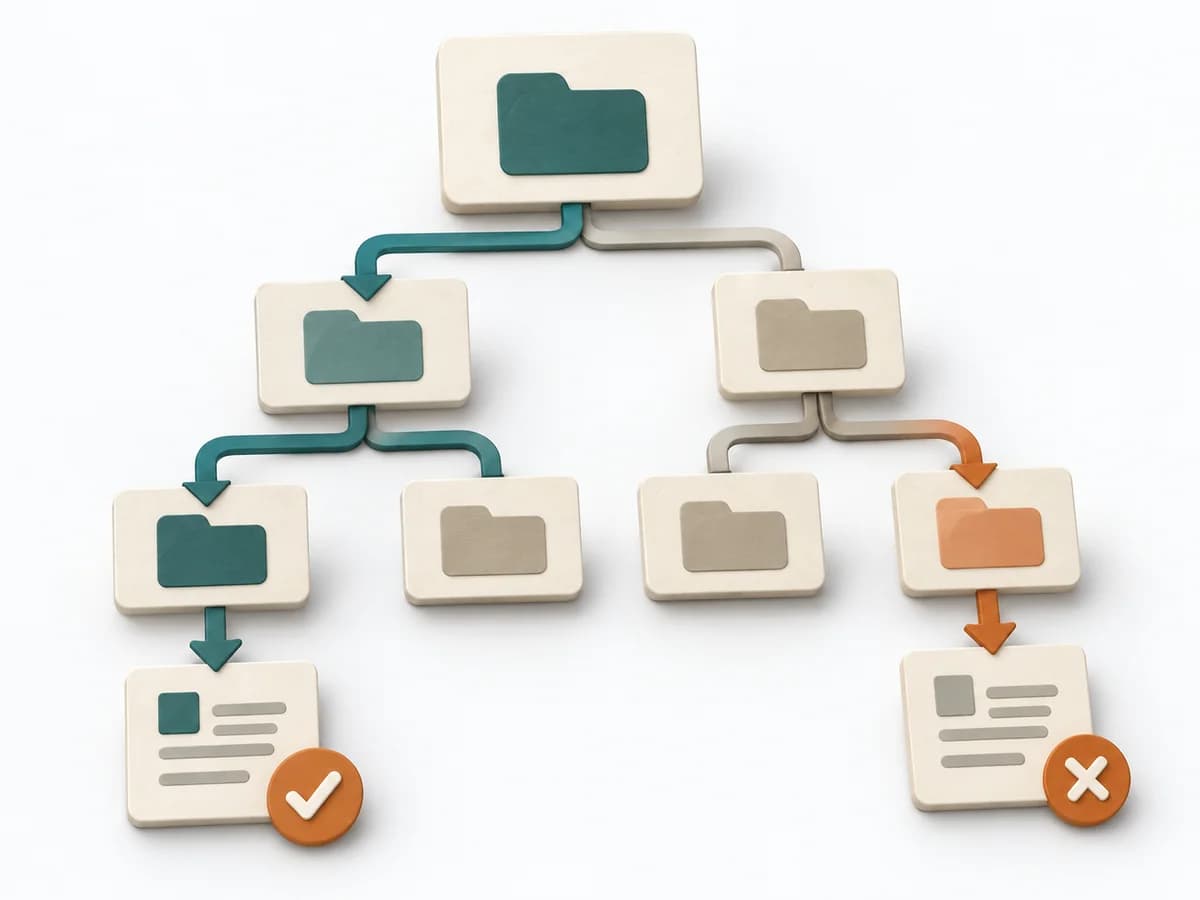
Tree
Set the tree structure and content area to test.
Tasks
Write realistic search tasks with a clearly defined destination.
Paths
Let participants search the tree and capture first choice, path, and final destination.
Interpret
Connect destination success to first click, path directness, and task wording.
Revise problem nodes and labels from task paths; test a changed structure with comparable participants who have not been primed by the prior version when possible.
Use tree testing when a hierarchy and its labels exist and you want to evaluate paths before UI design or independently of it. Card sorting is more suitable for discovering new groupings.

First clicks, selected destinations, and detours by task.

Traceable label or node issues linked to a test task.
Fictional teaching example
Keep expected destination, selected path, and interpretation traceable by task.
| Task path | Search task | Expected destination | First click and path | Finding or follow-up |
|---|---|---|---|---|
| Wrong pathA path ending at the wrong destination. | Fictional T1: Find a suitable tool available for Saturday. | Lending > Reserve | P1: Tools > Availability > Cordless drills | Possible confusion between stock and reservation; check against more paths. |
| Direct pathA path with the expected destination and no detour. | Fictional T1: Find a suitable tool available for Saturday. | Lending > Reserve | P2: Lending > Reserve | Directness is a clue, not proof that every label is clear. |
Keep path data linked to task and tree version.
Name the content people must find and the hierarchy, labels, and levels to evaluate.
When a navigation exists but search paths still fail, tree testing checks findability without visual distraction. The method shows whether labels, levels, and paths really lead to the intended destination.
Participants solve search tasks using only the structure, revealing where they branch off, get stuck, or jump back. The paths show which terms hold up and which structural edges weaken orientation.
Tree testing helps because it checks findability without visual distraction, making the pure structural performance of a navigation visible. The method becomes especially useful when search tasks reflect real goals and paths, backtracks, and wrong turns are read closely. Patterns matter more than single errors, so labels and levels get improved exactly where orientation actually breaks.
Formulate tasks from the perspective of real usage needs and keep the tree structure current enough that results stay meaningful. It matters most on paths that look plausible but regularly lead nowhere; naming or grouping is usually unclear there. In the end, a few prioritized structural problems are enough, so decide what changes before the next test.
The method guide walks execution through 4 phases, timing, 4 pitfalls, and clear stop criteria.
Open method guideYour perspective
Your feedback helps shape the next improvements to methodatlas.
Plan the tree version, search tasks, participant study, and analyzable path data.
To be confirmed
To be confirmed
Evaluate one navigation hierarchy Time: Multi-session study; duration depends on recruitment, format, tasks, and analysis.
Complete this worksheet on paper or in your own document during the work.
| Task path | Search task | Expected destination | First click and path | Finding or follow-up |
|---|---|---|---|---|
| Wrong path | ||||
| Direct path |
Blank template: capture your task, target, path, and finding.
Expected artifact: Versioned navigation tree with traceable destination nodes.
Versioned navigation tree with traceable destination nodes.
Entry:
...
Expected artifact: Versioned task set with expected destinations and rationale.
Versioned task set with expected destinations and rationale.
Entry:
...
Expected artifact: Task-level paths and final selections by participant.
Task-level paths and final selections by participant.
Entry:
...
Expected artifact: Findings about nodes, labels, and tasks with next structural tests.
Findings about nodes, labels, and tasks with next structural tests.
Entry:
...
...
Method guide: https://methodatlas.meierhoff-systems.de/en/methods/tree-testing/run-sheet
Fitting alternatives with decision guidance, followed by other related methods.

Instead of Tree Testing, when you want to use Card Sorting to group terms openly and find fitting categories from the users' perspective.

Collects answers in a scalable format and condenses them into results, charts, and segment insights.

Observes real work in context and pairs it with follow-up questions to capture workflow insights precisely.
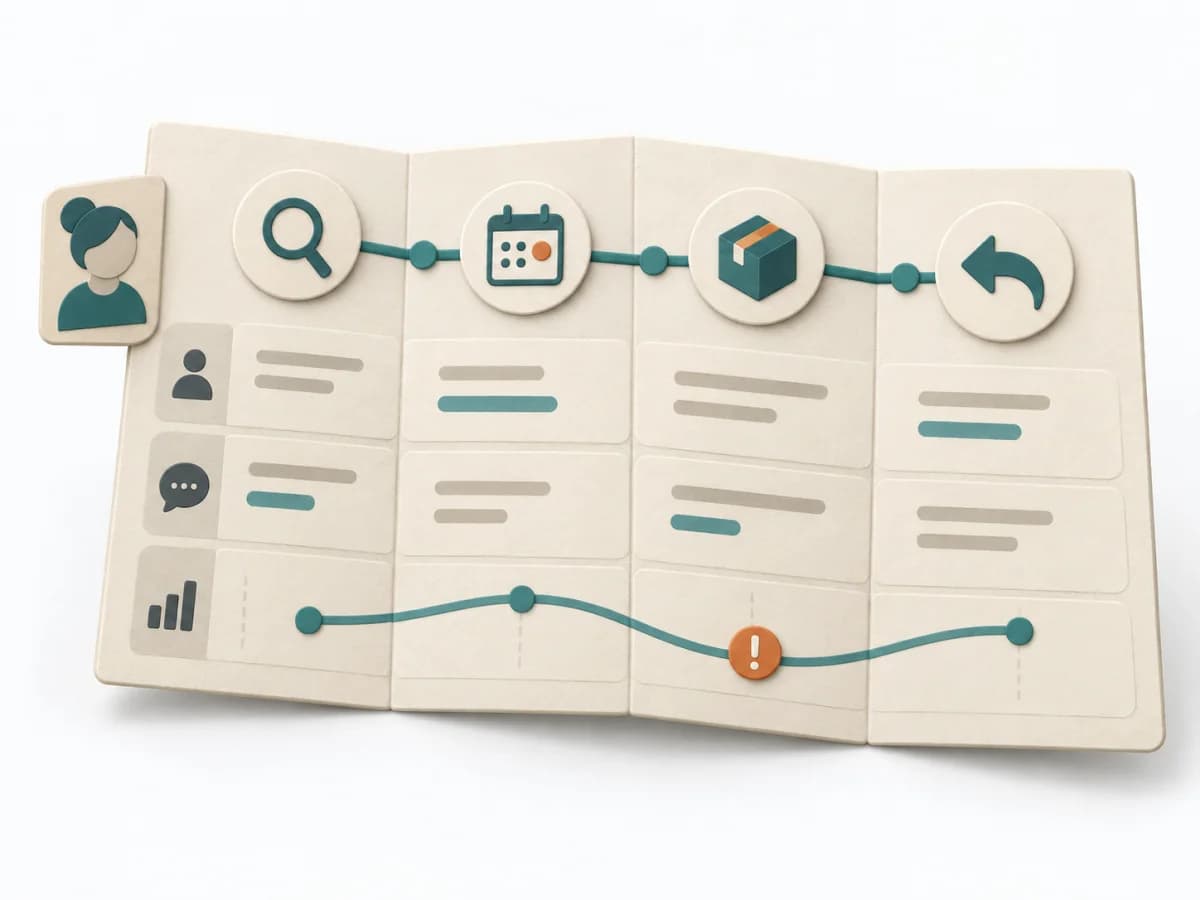
Bundles phases, emotions, and pain points along a journey to prioritize opportunities and critical moments.

Captures experiences over time in diary entries and reveals longitudinal patterns that a single session would miss.
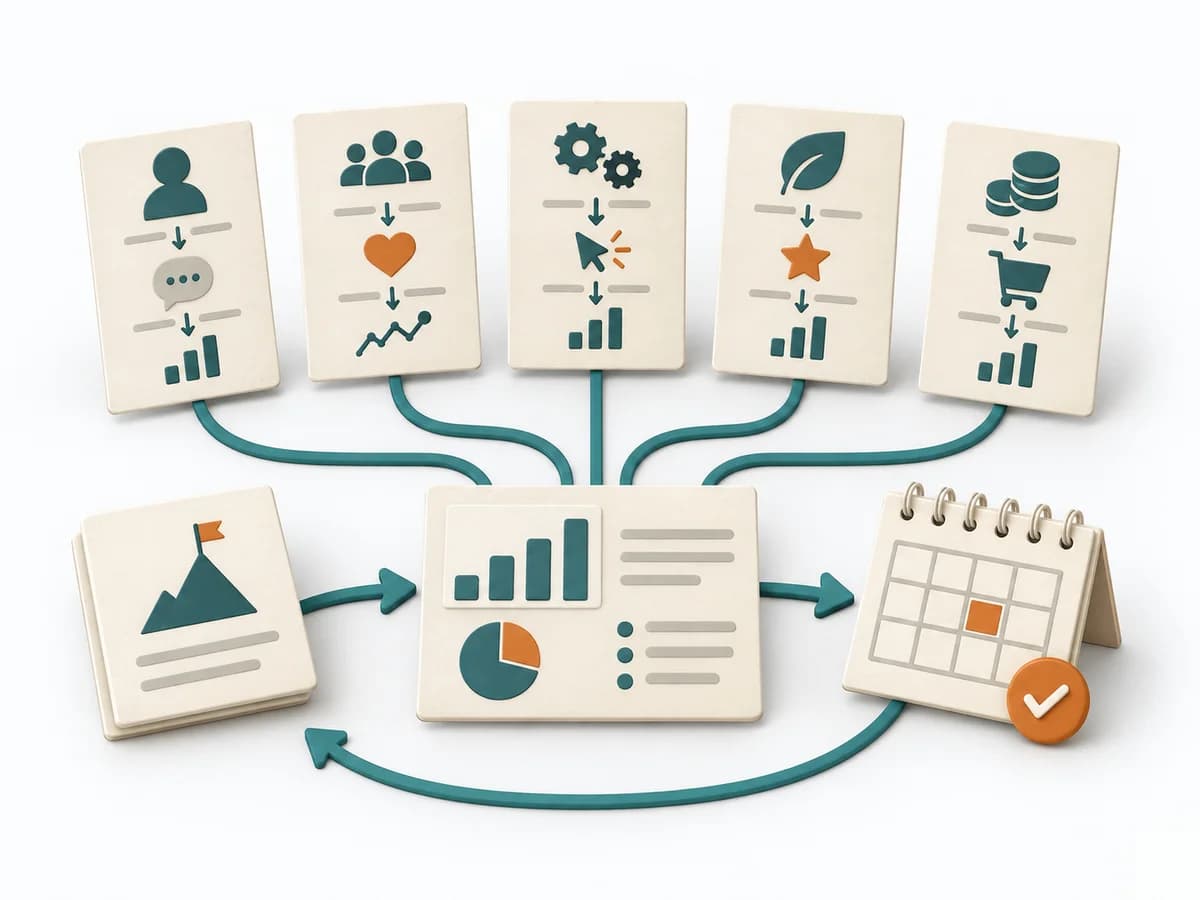
Moves observations, needs, and patterns toward a concrete result through "define a goal for each HEART dimension", "identify signals for each goal", and "agree on a review cadence".