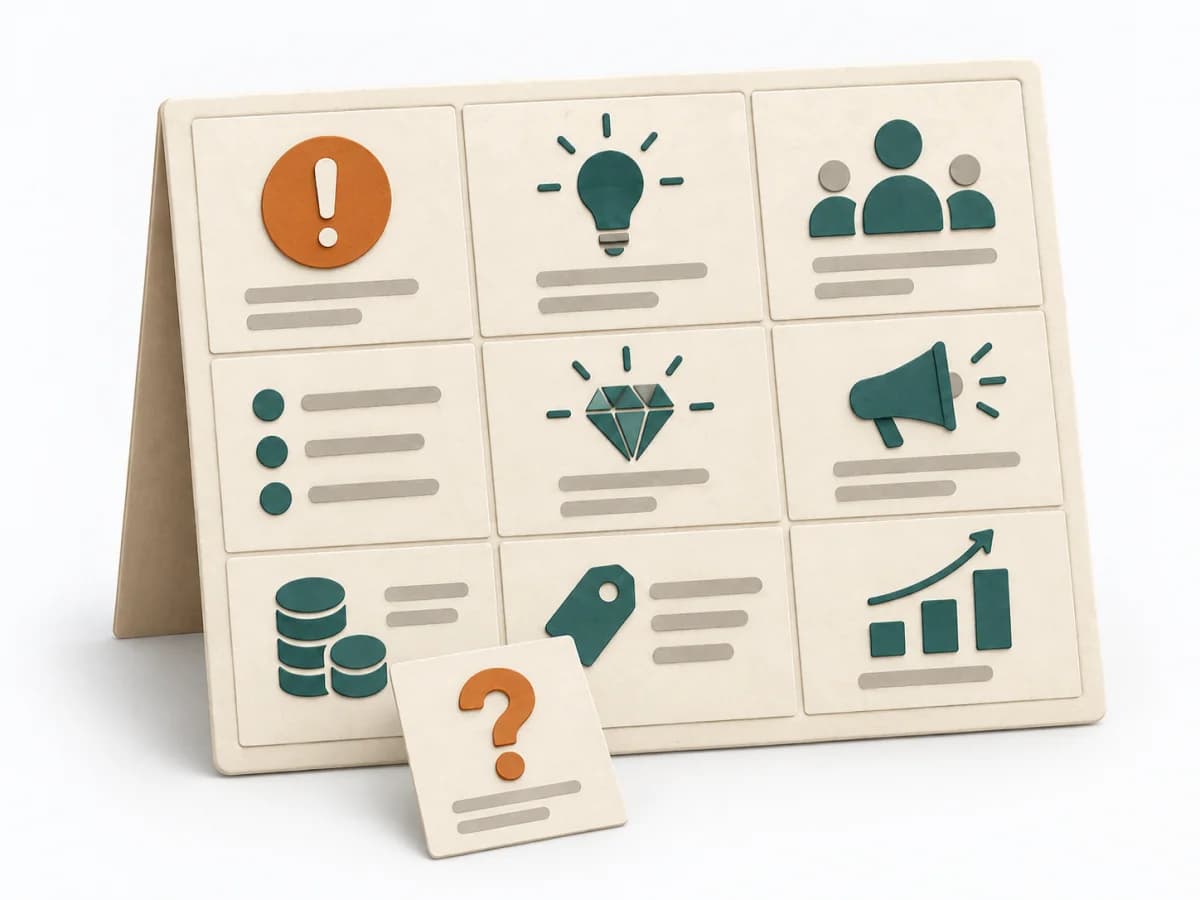
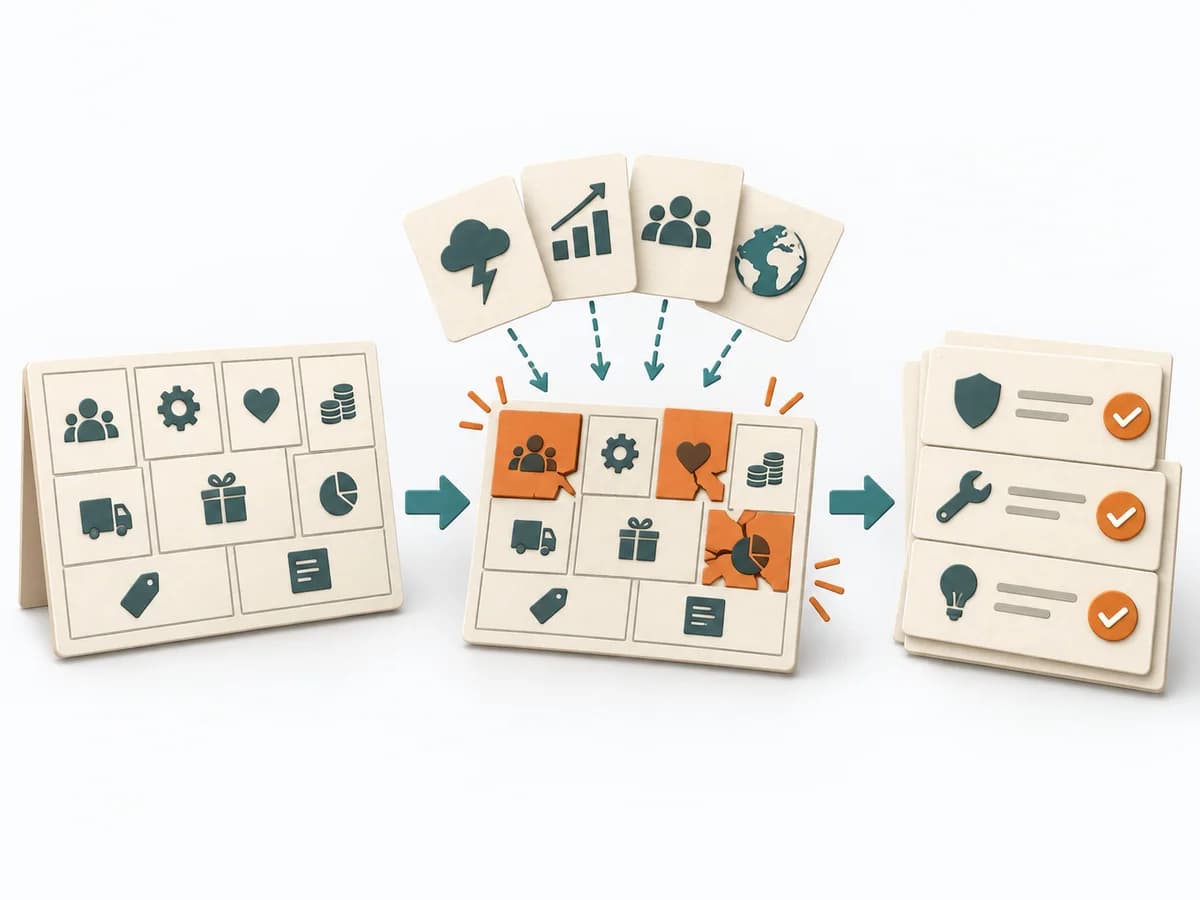
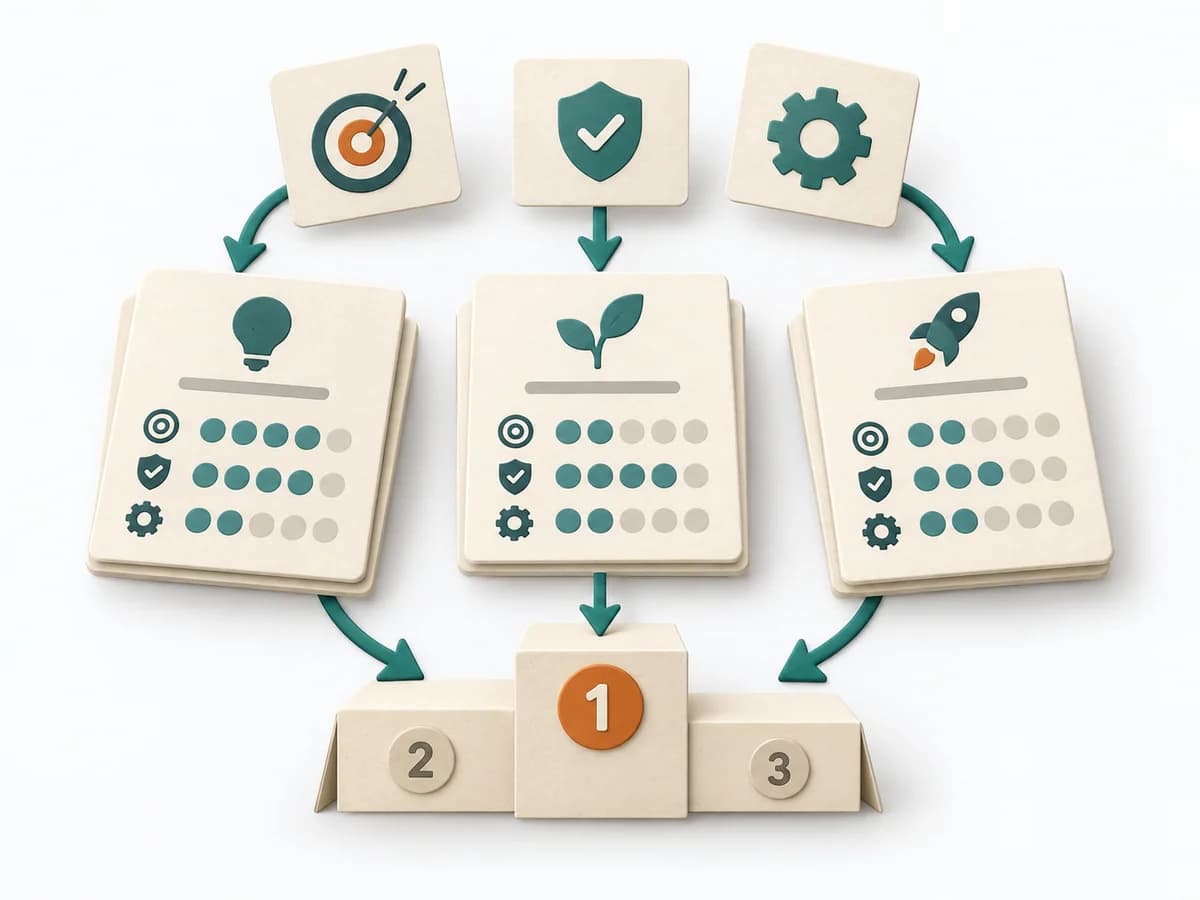
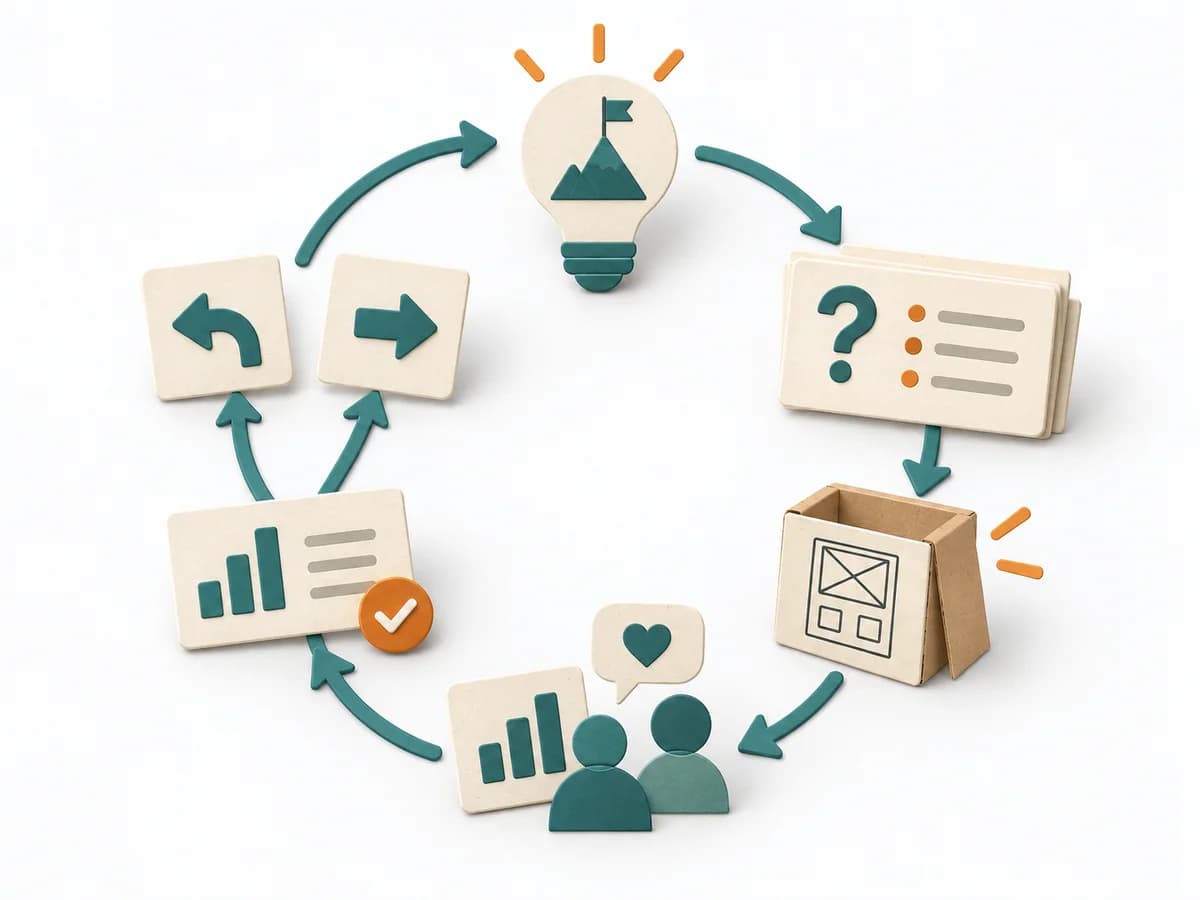
The 5-Minute VC Check clarifies opportunities and strategic options at the earliest idea stage. It compares problem quality, customer willingness to pay, alternatives, differentiation, and market potential, and captures the result as a VC-check note, go/sharpen/park decision, and risk list.
5-Minuten VC-Check
A fast venture-style triage that tests whether an idea has a clear problem, paying customer, differentiated solution, and plausible market.
Is this idea structurally strong enough to deserve a next validation round?
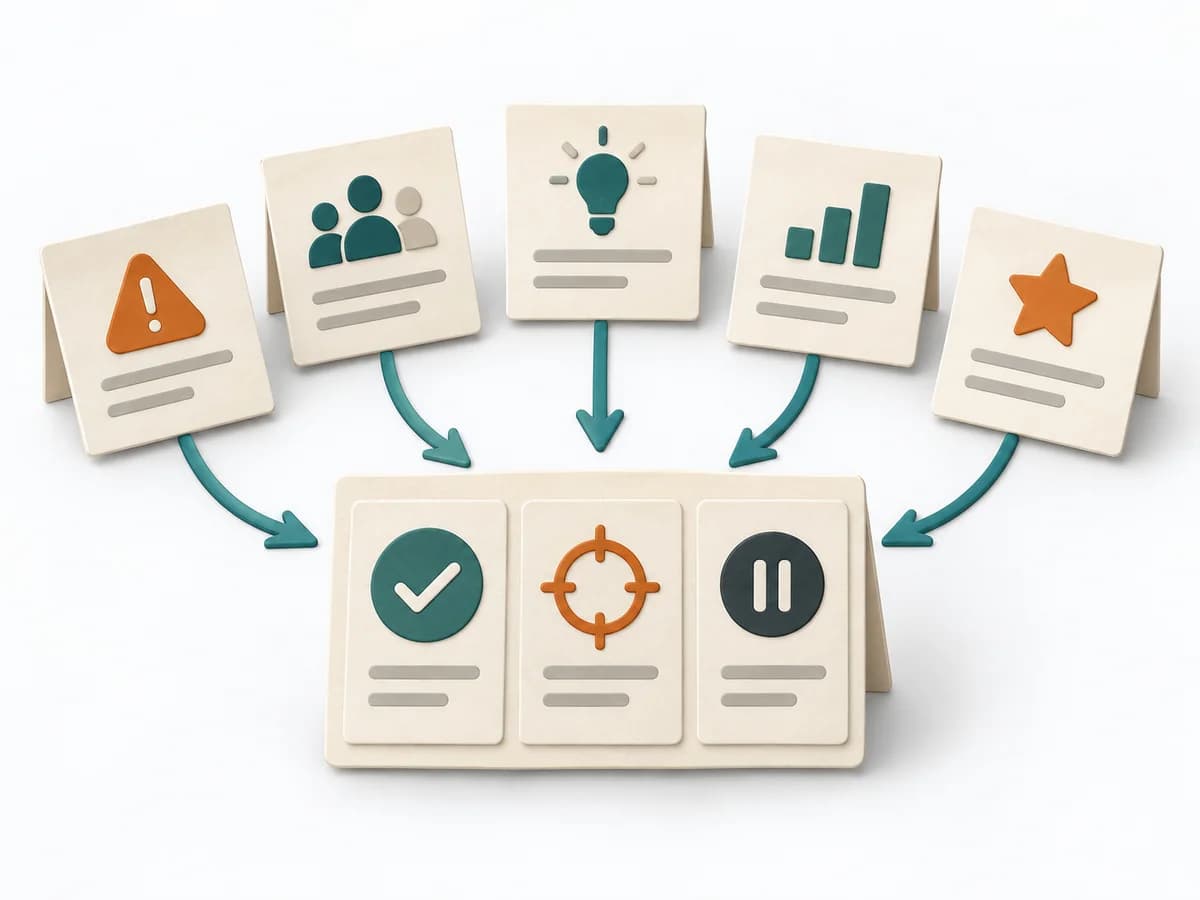
The team states the problem in one sentence, names the target customer and willingness to pay, checks current alternatives and competitors, describes why the new approach would be meaningfully better, estimates market size and growth path roughly, and makes a triage decision.
Visual orientation
Method sketch for a quick mental model.
Flow
- 1State the problem in one sentence
- 2Name the target customer and willingness to pay
- 3Check current solution and competitors
- 4Name the better approach and differentiation
- 5Roughly estimate market size and growth path
- 6Make a triage decision
The runsheet guides execution with 5 phases, timeboxes, 6 pitfalls, and clear stop criteria.
Open runsheetIdeal for
- Startup ideas
- Micro-SaaS triage
- Early product opportunities
- Pitch preparation
Not good for
- Detailed due diligence
- Financial modeling
- Late investment decisions
- Ideas without a concrete target customer
Deep dive
The 5-Minute VC Check compresses the first-pass mental screening used by venture investors and experienced founders. Instead of building a full business model, it asks whether the structural quality of the idea is promising: is the problem clear and painful, is there a paying customer, how is the job done today, why would the new solution be much better, and could the market become large enough? The method does not produce an investment decision; it creates a fast continue, sharpen, or stop signal with the most important open assumptions.
Keep the timebox short and force one-sentence answers. If an answer dodges the question, mark it as a risk instead of solving it immediately. End with exactly one of three decisions: deepen, sharpen, or park.
5-Minute VC Check Working TemplateCompact template for evaluating an early business idea through five investor checklist questions and deriving a triage decision.markdown
five-minute-vc-check-working-template.md
Compact template for evaluating an early business idea through five investor checklist questions and deriving a triage decision.
5-Minute VC Check Working Template
Idea in one sentence
For [target customer], we solve [problem] with [new approach], so that [benefit].
Checklist questions
| Question | Short answer | Signal |
|---|---|---|
| Problem | What concrete pain, effort, loss, or risk exists? | Green/Yellow/Red |
| Customer | Who uses it, who buys it, and which budget pays for it? | Green/Yellow/Red |
| Current solution | How is the problem solved or ignored today? | Green/Yellow/Red |
| Differentiation | Why would the new approach be clearly better or more accessible? | Green/Yellow/Red |
| Market | Can an initial sub-market be large enough and reachable? | Green/Yellow/Red |
Triage
- Decision: Deepen / Sharpen / Park
- strongest open assumption:
- biggest risk:
- most important positive signal:
Next validation step
- Format: problem interview / smoke test / landing page / concierge test / desk research
- Target group:
- Success signal:
- Owner:
- Date:
When to choose differently
Short decision aid for existing alternatives.
Statt 5-Minuten VC-Check, wenn die Idee nach der Triage in Zielgruppe, Problem, Kanäle und Kernrisiken zerlegt werden soll.
Statt 5-Minuten VC-Check, wenn du mit ICE Scoring Ideen schnell nach Impact, Confidence und Ease sortieren willst.
Statt 5-Minuten VC-Check, wenn du mit Decision Matrix Optionen mit klaren Kriterien und Gewichten nachvollziehbar vergleichen willst.
Similar methods
All methodsBuild Measure Learn cycles turn risky assumptions into experiments that support persevere, pivot, or stop decisions.
Turns starting assumptions, opportunities, and strategic options into a tangible result by defining scope, filling the nine blocks, and developing alternatives.
Clarifies starting point, opportunities, and strategic options by defining the industry scope, analyzing the five forces, and formulating strategic options.
Clarifies starting point, opportunities, and strategic options by defining products and markets, collecting growth options, and choosing focus options.
Moves customer problem, solution idea, and evidence toward a concrete result through "clarify the learning goal and the assumption to test", "formulate the hypothesis as an if-then statement", and "define the decision rule after the test".
Aligns business problem, users, outcomes, solution ideas, hypotheses, and experiments on one lightweight canvas.