Fishbowl Discussion: Worksheet
Question
To be confirmed
Desired outcome
To be confirmed
Scope
Complete run
Time: 60–120 minutes.
Complete this worksheet on paper or in your own document during the work.
Preparation for this scope
Method setup
- Materials: Guiding question, visible agenda, work surfaces, timer, and result repository
- Roles: Facilitator · participants · hosts or session owners · scribe
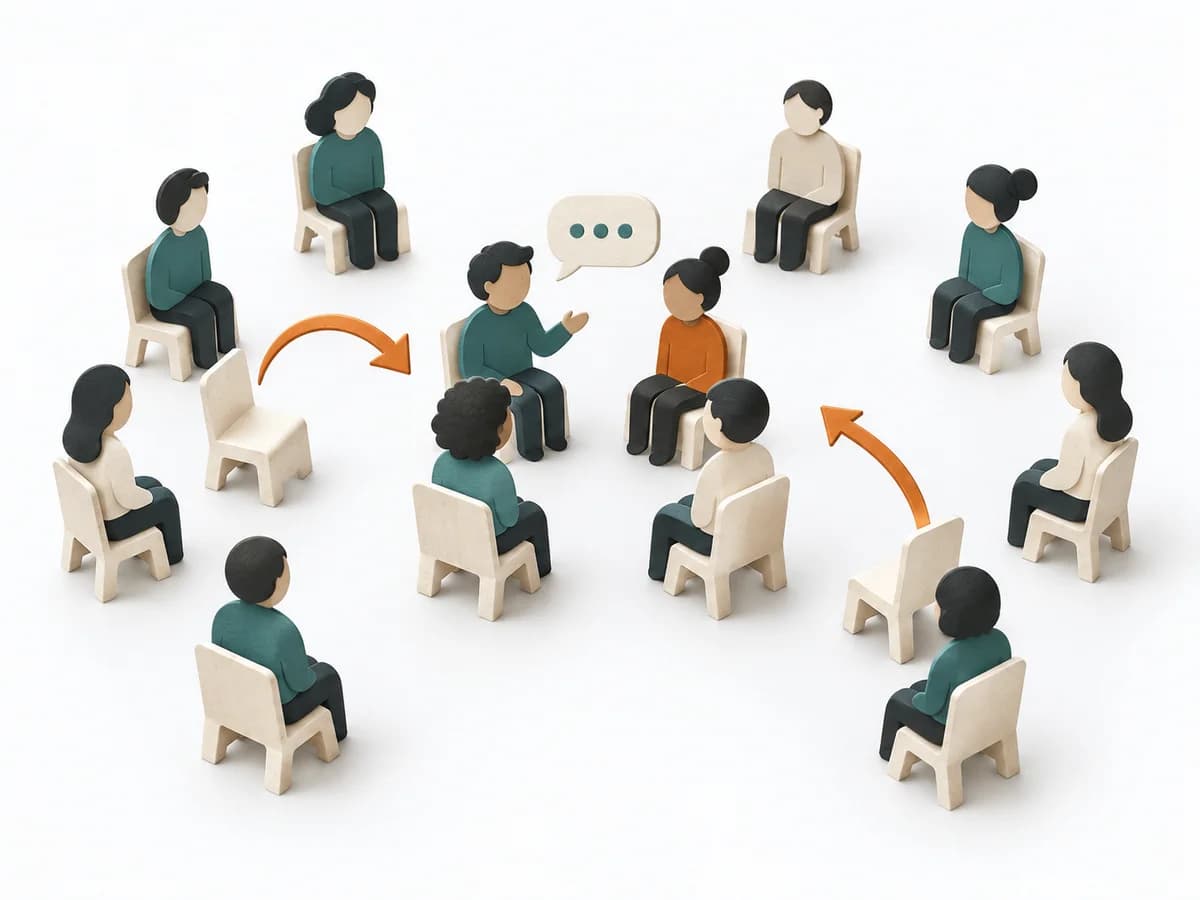
- Advance information: Set one focused discussion question, listening task, and rotation rule; arrange an inner circle with an open chair. Prepare real cases, sources, and boundaries.
- Overall time needed: 60–120 minutes.
- Setup: Create a workspace with Discussion frame · Fishbowl setup · Inner dialogue · Perspective shifts · Review; keep example values separate from live data.
Prepare for the work steps
Frame: Discussion frame
- Set one focused discussion question, listening task, and rotation rule; arrange an inner circle with an open chair.
- Guiding question, visible agenda, work surfaces, timer, and result repository
Circles: Fishbowl setup
Dialogue: Inner dialogue
Rotate: Perspective shifts
Review: Review
Fishbowl Discussion · working structure
Discussion frame
Clarify the discussion question, listening task, and rotation rule
...
Fishbowl setup
Form an inner circle with one empty chair and an outer observation circle
...
Inner dialogue
The inner group discusses while the outer circle listens to the agreed task
...
Perspective shifts
Outer participants use the empty chair or agreed rotation without taking over
...
Review
Review content insights, tensions, and observations from both circles
...
The blank worksheet contains prompts only.
Reference source · original teaching example
Frame: Discussion frame
Expected artifact: Discussion frame
Clarify the discussion question, listening task, and rotation rule
Entry:
...
Circles: Fishbowl setup
Expected artifact: Fishbowl setup
Form an inner circle with one empty chair and an outer observation circle
Entry:
...
Dialogue: Inner dialogue
Expected artifact: Inner dialogue
The inner group discusses while the outer circle listens to the agreed task
Entry:
...
Rotate: Perspective shifts
Expected artifact: Perspective shifts
Outer participants use the empty chair or agreed rotation without taking over
Entry:
...
Review: Review
Expected artifact: Review
Review content insights, tensions, and observations from both circles
Entry:
...
Open questions and next steps
...
Method guide: https://methodatlas.meierhoff-systems.de/en/methods/fishbowl-discussion/run-sheet