Purpose
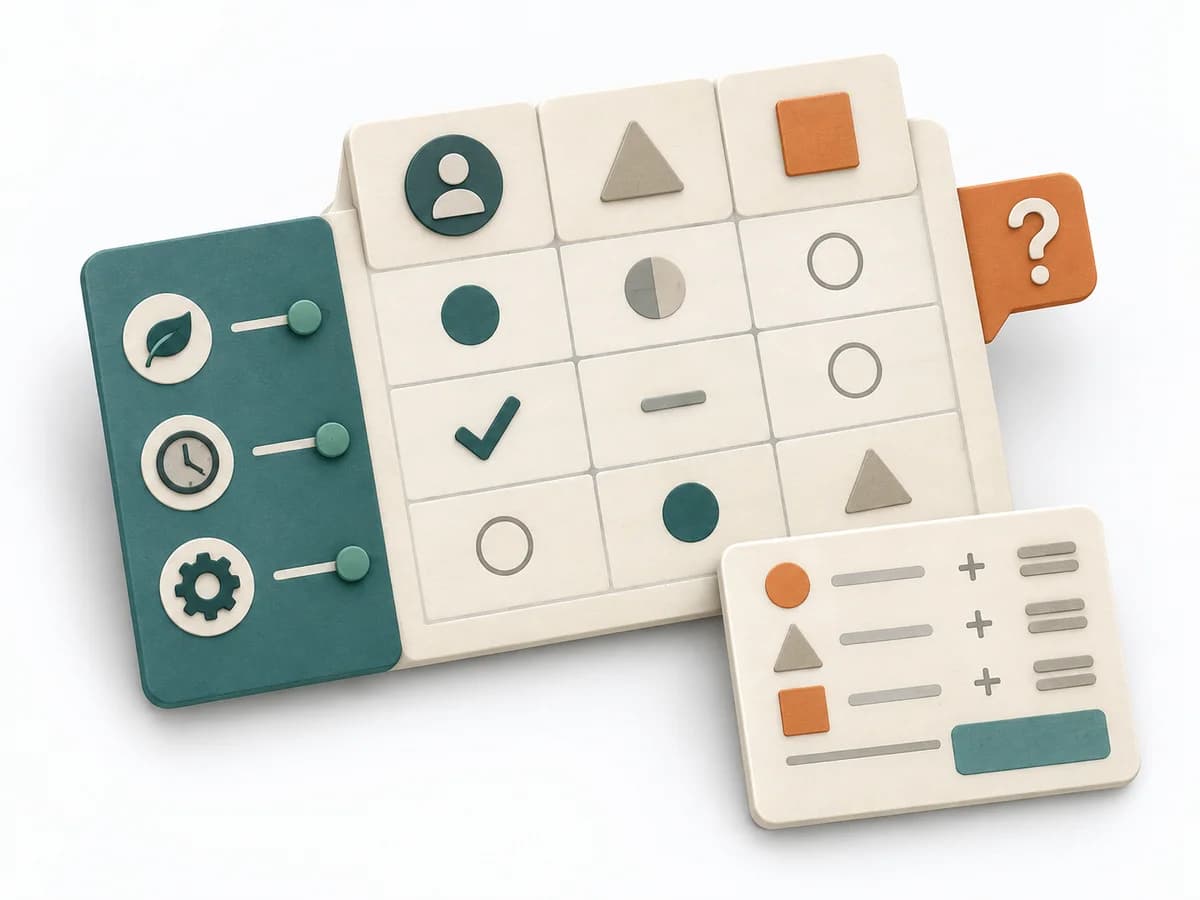
For a search for solutions with many degrees of freedom, a grid emerges for systematic combinations. The method separates features, variants, and exclusion criteria, so the space gets explored deliberately.
Innovation Workshop method
Generates solution spaces from independent parameters and manifestations and tests combinations with cross-consistency assessment.
General Morphological Analysis decomposes a non-quantifiable problem into parameters with discrete manifestations. Cross-consistency assessment removes pairs for logical contradiction, empirical impossibility, or normative incompatibility, not mere dislike.
Which internally consistent configurations emerge from the complete parameter space?
Parameters should jointly cover the problem space with minimal overlap. CCA tests pairwise incompatibility; remaining configurations are evaluated as wholes.

Parameters
Decompose the problem space into independent, jointly exhaustive parameters.
Manifestations
Create discrete, distinguishable manifestations for each parameter.
Cross-consistency
Test manifestation pairs for logical, empirical, and normative incompatibility.
Configurations
Build remaining combinations and compare them as whole concepts.
Update with versioning when evidence or scope changes.
For multidimensional design problems without a sufficient causal model but with definable parameters.
Morphological box with parameters, manifestations, CCA exclusions, and consistent concepts.
Rationales, open assumptions, owners, and review date remain traceable.
Fictional morphological box
Parameters × manifestations plus one complete example configuration; incompatibilities appear in the CCA note.
| Parameter/concept | Parameter | Manifestation 1 | Manifestation 2 | Manifestation 3 | Manifestation 4 |
|---|---|---|---|---|---|
| Dimension 1Complete parameter or concept. | Channel | In-app | Chat | SMS | |
| Dimension 2Complete parameter or concept. | Timing | Immediate | Daily | Weekly | On status change |
| Dimension 3Complete parameter or concept. | Recipient | Owner | Owner + lead | Team | External |
| Dimension 4Complete parameter or concept. | Content | Status | Status + obstacle | Full context | Deadline only |
| ConfigurationComplete parameter or concept. | Selected configuration | In-app | Daily | Owner + lead | Status + obstacle |
External CCA constraints: a regulatory immediate-escalation duty, external customers without chat accounts, and a prohibition on disclosing full context externally. Exclusions are justified as logical, empirical, or normative.
Swedish Morphological Society: General Morphological Analysis
Start with the core question: Which internally consistent configurations emerge from the complete parameter space?
For a search for solutions with many degrees of freedom, a grid emerges for systematic combinations. The method separates features, variants, and exclusion criteria, so the space gets explored deliberately.
The approach breaks a problem down into dimensions and treats each variant as a building block for a later combination. This creates not a linear stream of ideas but a structured search space in which variants are deliberately set against each other. The method is especially strong when several parameters shape the solution space at the same time and individual decisions influence each other.
Morphological Analysis works because it breaks a problem into shapeable dimensions, making new combinations systematically findable. It is especially valuable when the relevant features are chosen carefully and each variant has real consequences for the solution. Good application checks implausible as well as plausible combinations, so surprising options become visible without losing sight of the underlying reality.
First work on a clean feature structure before assessing combinations, or the box stays superficial. The lever lies with fields that are worded too similarly or that forget important degrees of freedom; adjustment is needed there. Close with a few combinations that get pursued further as a concept, experiment, or decision option.
The method guide walks execution through 4 phases, timing, 4 pitfalls, and clear stop criteria.
Open method guideYour perspective
Your feedback helps shape the next improvements to methodatlas.
Plan the session around the canonical method steps and a concrete decision.
To be confirmed
To be confirmed
Full session Time: 2–4 hours
Complete this worksheet on paper or in your own document during the work.
| Parameter/concept | Record Parameter | Record Manifestation 1 | Record Manifestation 2 | Record Manifestation 3 | Record Manifestation 4 |
|---|---|---|---|---|---|
| Dimension 1 | |||||
| Dimension 2 | |||||
| Dimension 3 | |||||
| Dimension 4 | |||||
| Configuration |
Justify every exclusion as logical, empirical, or normative; dislike is insufficient.
Swedish Morphological Society: General Morphological Analysis
Expected artifact: parameter set
parameter set with evidence, owner, and next decision.
Entry:
...
Expected artifact: morphological box
morphological box with evidence, owner, and next decision.
Entry:
...
Expected artifact: CCA matrix
CCA matrix with evidence, owner, and next decision.
Entry:
...
Expected artifact: concept portfolio
concept portfolio with evidence, owner, and next decision.
Entry:
...
...
Method guide: https://methodatlas.meierhoff-systems.de/en/methods/morphological-analysis/run-sheet
Fitting alternatives with decision guidance, followed by other related methods.

Instead of Morphological Analysis, when you want to use SCAMPER to vary an existing idea in a targeted way through fixed change questions.

Expands a core question into topic fields, filters out patterns, and condenses interesting paths into a shortlist.
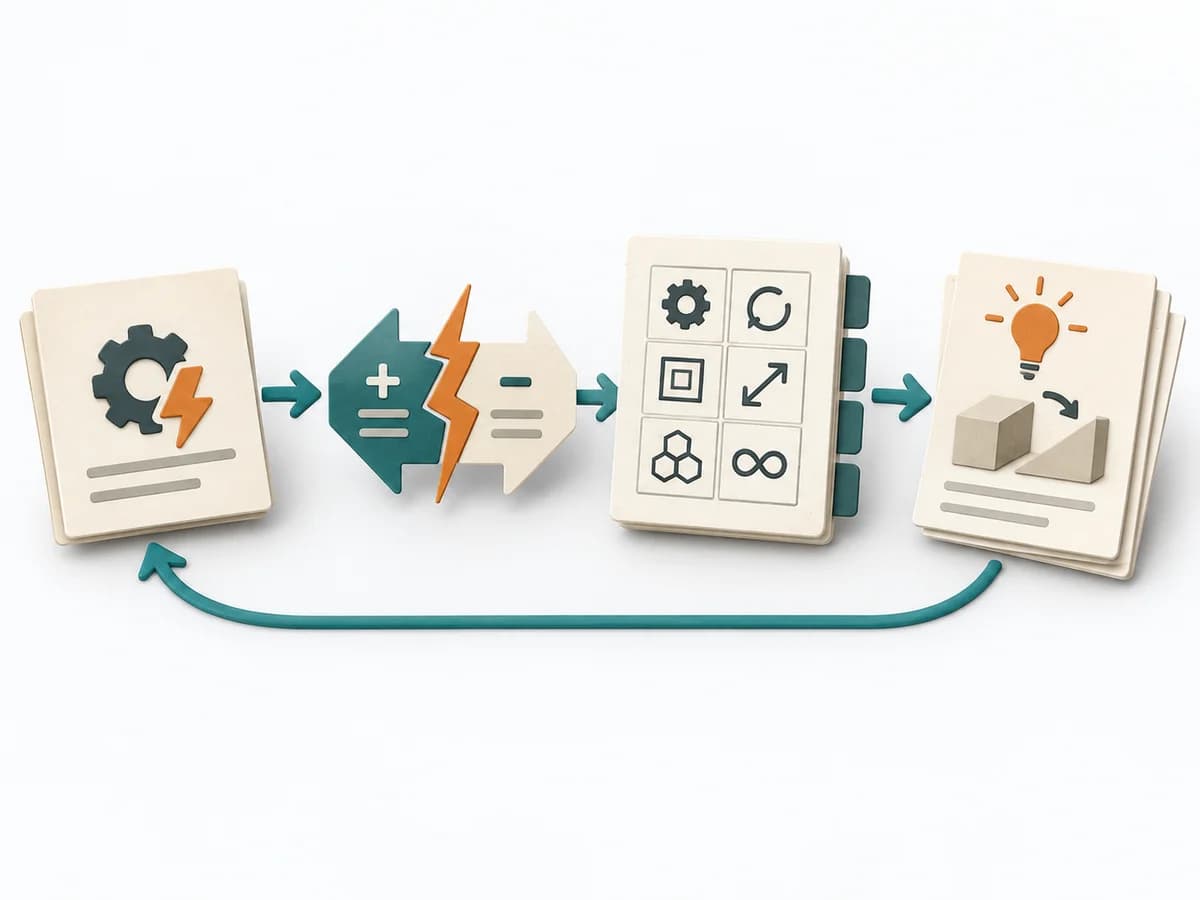
Clarifies ideas, open questions, and testable next steps by framing the contradiction, identifying improving and worsening factors, and checking feasibility.

Makes trade-off conflicts explicit, abstracts them into solution principles, and condenses testable concepts from them.

Opens the idea space, bundles contributions into theme clusters, and condenses them into a shortlist for the next step.

Deliberately flips the question toward the negative to expose risk themes and derive solid solution ideas from them.