SCAMPER: Worksheet
Prepare the whole flow or one selected phase with real inputs.
# SCAMPER: Worksheet

## Question
To be confirmed

## Desired outcome
To be confirmed

## Scope
Complete SCAMPER pass
Time: 30–60 minutes

Complete this worksheet on paper or in your own document during the work.

## Preparation for this scope

### Method setup
- **Materials:** SCAMPER matrix, cards, pens, a description or model of the current solution and a timer.
- **Roles:** Facilitator, two to ten people with usage, domain or delivery perspectives; one person documents.
- **Advance information:** Gather the current flow, relevant user signals, technical or regulatory constraints and known variants.
- **Overall time needed:** 30–60 minutes
- **Setup:** Prepare seven operator rows and keep the starting object visible. Park evaluation until the ideation pass is complete.

### Prepare for the work steps

#### Baseline: Define the object and aim
- Existing solution
- Observed problem or aim

#### Operators: Apply seven change operators
- SCAMPER brief
- Seven operator questions

#### Concepts: Combine variations into concepts
- Variation pool
- Aim and constraints

#### Test: Select and test a concept
- Concept cards
- Selection criteria and available means


## SCAMPER

| Operator | Your variations | Expected benefit and critical check |
| --- | --- | --- |
| S · Substitute |   |   |
| C · Combine |   |   |
| A · Adapt |   |   |
| M · Modify |   |   |
| P · Put to another use |   |   |
| E · Eliminate |   |   |
| R · Reverse / Rearrange |   |   |

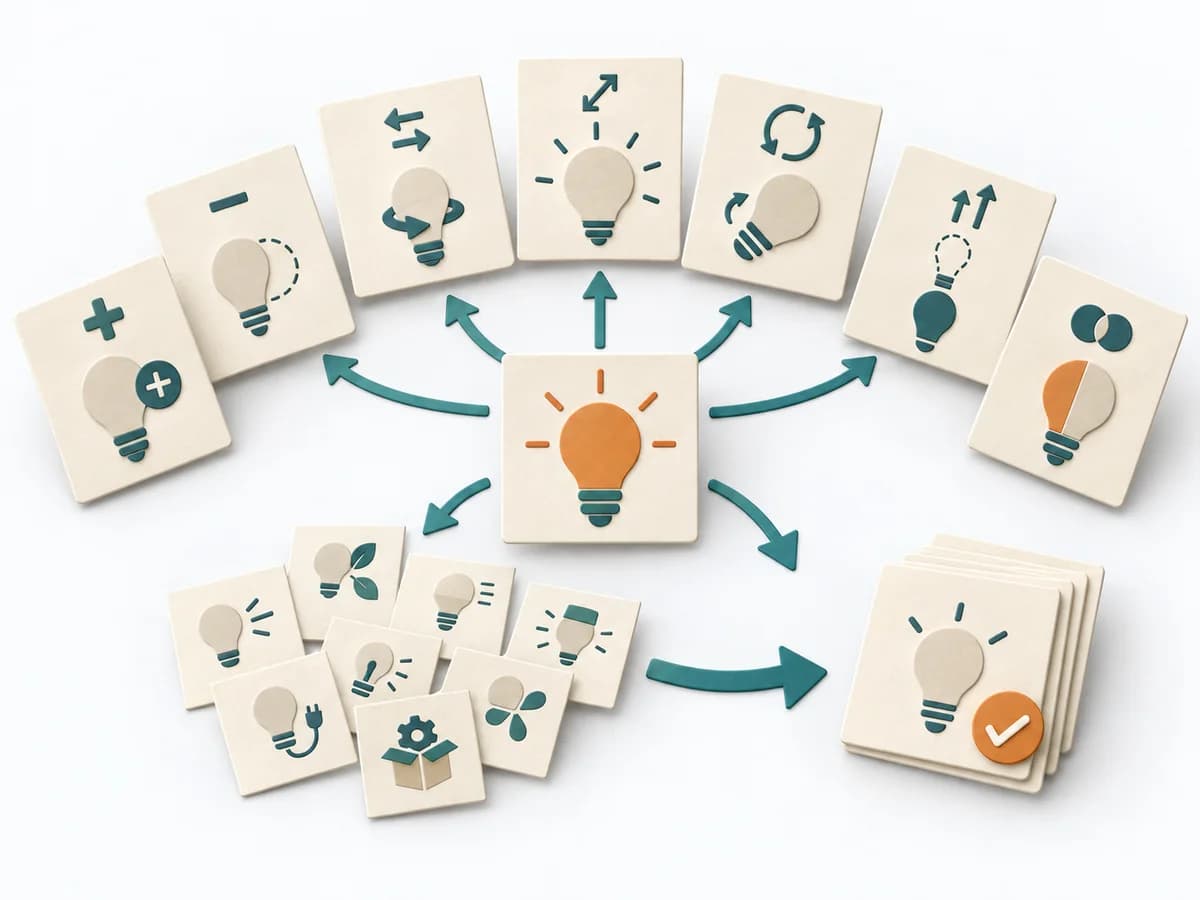
- **S · Substitute:** Which component can be replaced by something better?
- **C · Combine:** Which elements create more value together?
- **A · Adapt:** Which proven solution from another context fits here?
- **M · Modify:** What can be enlarged, reduced or reweighted?
- **P · Put to another use:** What additional use can an existing component serve?
- **E · Eliminate:** What can disappear without loss?
- **R · Reverse / Rearrange:** Which sequence or relationship can be reversed?

Capture several variations and their expected benefit per operator; cluster and select afterward.

[Bob Eberle · SCAMPER](https://www.creativeeducationfoundation.org/product/scamper/)


## Baseline: Define the object and aim
Expected artifact: SCAMPER brief

Object · user · aim · constraints

Entry:

...

- [ ] Is it clear which concrete component may be varied?

## Operators: Apply seven change operators
Expected artifact: Variation pool

S · C · A · M · P · E · R

Entry:

...

- [ ] Does every operator produce at least one distinct variation?

## Concepts: Combine variations into concepts
Expected artifact: Concept cards

Combination · benefit · assumption

Entry:

...

- [ ] Is each concept more than a renamed single idea?

## Test: Select and test a concept
Expected artifact: Test assignment

Concept · assumption · test · signal · owner

Entry:

...

- [ ] Does the test examine the critical assumption rather than merely implement?

## Open questions and next steps

...

Method guide: https://methodatlas.meierhoff-systems.de/en/methods/scamper/run-sheet
Crazy 8s: Worksheet
Prepare a short team exercise with eight minutes of individual work and a follow-up selection.
# Crazy 8s: Worksheet

## Question
To be confirmed

## Desired outcome
To be confirmed

## Scope
One Crazy 8s team exercise
Time: About 30–45 minutes, including framing, exactly eight minutes of sketching, and follow-up planning.

Complete this worksheet on paper or in your own document during the work.

## Preparation for this scope

### Method setup
- **Materials:** Design challenge, one eight-panel sheet per person, pens, a visible timer, and space to post and discuss sketches.
- **Roles:** Everyone sketches individually. Facilitation keeps time and the challenge stable; the team later interprets and selects directions to extend.
- **Advance information:** Name the user need, problem context, and decision that new solution directions should inform.
- **Overall time needed:** The sketching exercise takes exactly eight minutes. Plan about 30–45 minutes for the full team activity, including framing, sharing, and a next step.
- **Setup:** Prepare eight equal panels, display the timer, and explain that rough sketches are enough. No discussion during the eight minutes.

### Prepare for the work steps

#### Challenge: Bound the challenge
- Write a focused design challenge that allows eight different approaches.

#### Sketch: Sketch eight variations
- Visible challenge and shared work context.

#### Share: Share the sketches
- Eight distinguishable sketches per person.

#### Select: Select and extend a direction
- Shared set of variations with clarified ideas.


## Eight Crazy 8s directions

| Sketch panel | Direction | Fictional sketch | What changes? | Follow-up question |
| --- | --- | --- | --- | --- |
| Variation 1 |   |   |   |   |
| Variation 2 |   |   |   |   |
| Variation 3 |   |   |   |   |
| Variation 4 |   |   |   |   |
| Variation 5 |   |   |   |   |
| Variation 6 |   |   |   |   |
| Variation 7 |   |   |   |   |
| Variation 8 |   |   |   |   |

- **Variation 1:** Describe one rough direction.
- **Variation 2:** Describe one rough direction.
- **Variation 3:** Describe one rough direction.
- **Variation 4:** Describe one rough direction.
- **Variation 5:** Describe one rough direction.
- **Variation 6:** Describe one rough direction.
- **Variation 7:** Describe one rough direction.
- **Variation 8:** Describe one rough direction.

Blank template: add the challenge at the top and eight sketch panels of your own.

[Google Design Sprint Kit](https://designsprintkit.withgoogle.com/methodology/phase3-sketch/crazy-8s)


## Challenge: Bound the challenge
Expected artifact: Visible challenge and shared work context.

Visible challenge and shared work context.

Entry:

...

- [ ] Everyone can interpret the challenge and sketch different directions.

## Sketch: Sketch eight variations
Expected artifact: Eight distinguishable sketches per person.

Eight distinguishable sketches per person.

Entry:

...

- [ ] Each panel shows a different direction; sketches stay simple enough for the timebox.

## Share: Share the sketches
Expected artifact: Shared set of variations with clarified ideas.

Shared set of variations with clarified ideas.

Entry:

...

- [ ] Ideas are understood before evaluation; authorship does not dominate selection.

## Select: Select and extend a direction
Expected artifact: Selection rationale, prototype task, and open assumption.

Selection rationale, prototype task, and open assumption.

Entry:

...

- [ ] The rationale links to the challenge and user need; assumptions remain testable.

## Open questions and next steps

...

Method guide: https://methodatlas.meierhoff-systems.de/en/methods/crazy-8s/run-sheet
Morphological Analysis: Worksheet
Plan the session around the canonical method steps and a concrete decision.
# Morphological Analysis: Worksheet

## Question
To be confirmed

## Desired outcome
To be confirmed

## Scope
Full session
Time: 2–4 hours

Complete this worksheet on paper or in your own document during the work.

## Preparation for this scope

### Method setup
- **Materials:** morphological box, timer, notes, and decision log.
- **Roles:** Facilitator · 4–8 domain experts · decision owner
- **Advance information:** Collect existing evidence and constraints in advance.
- **Overall time needed:** 2–4 hours
- **Setup:** Prepare the canonical blank structure and make timeboxes visible.

### Prepare for the work steps

#### Parameters: Parameters
- Clear problem complex

#### Manifestations: Manifestations
- parameter set

#### Cross-consistency: Cross-consistency
- morphological box

#### Configurations: Configurations
- CCA matrix


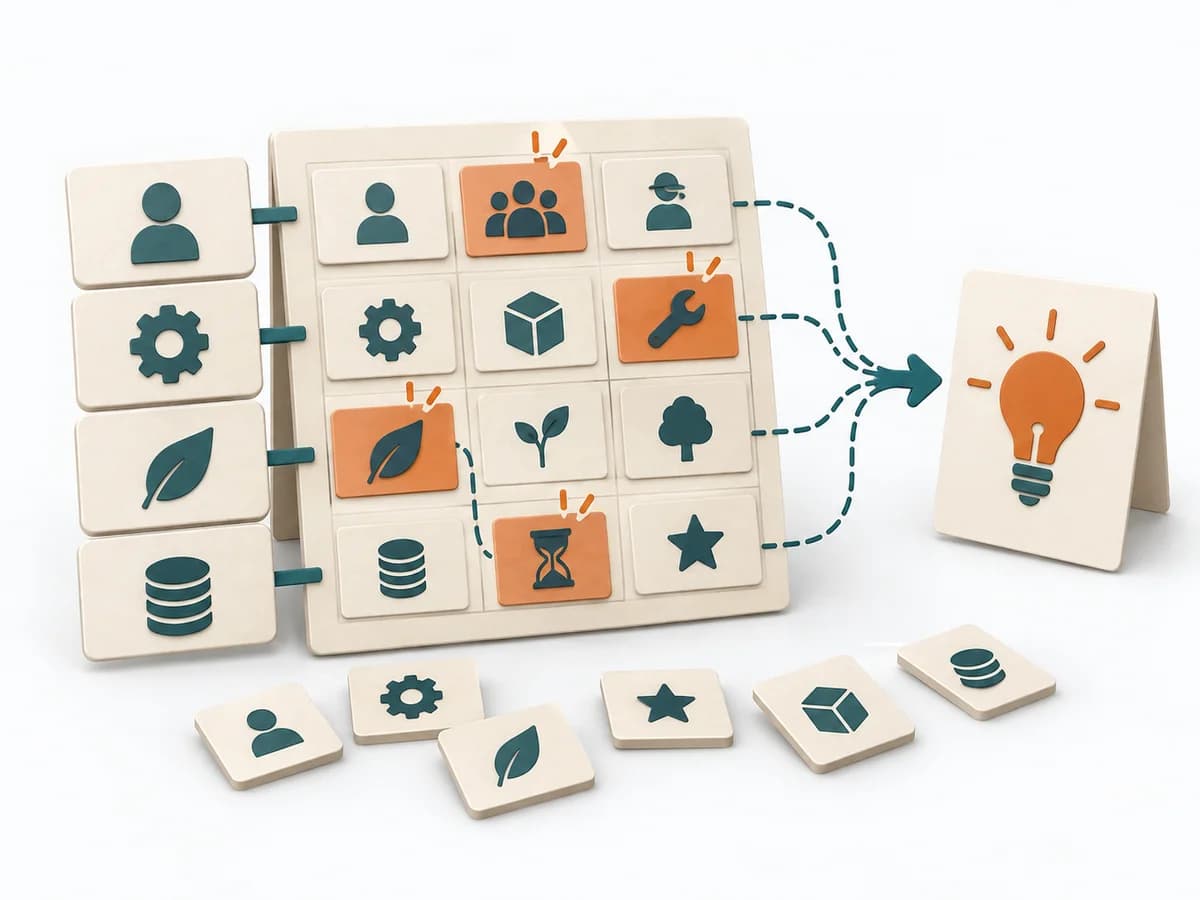
## Morphological box

| Parameter/concept | Record Parameter | Record Manifestation 1 | Record Manifestation 2 | Record Manifestation 3 | Record Manifestation 4 |
| --- | --- | --- | --- | --- | --- |
| Dimension 1 |   |   |   |   |   |
| Dimension 2 |   |   |   |   |   |
| Dimension 3 |   |   |   |   |   |
| Dimension 4 |   |   |   |   |   |
| Configuration |   |   |   |   |   |

- **Dimension 1:** Complete parameter or concept.
- **Dimension 2:** Complete parameter or concept.
- **Dimension 3:** Complete parameter or concept.
- **Dimension 4:** Complete parameter or concept.
- **Configuration:** Complete parameter or concept.

Justify every exclusion as logical, empirical, or normative; dislike is insufficient.

[Swedish Morphological Society: General Morphological Analysis](https://www.swemorph.com/ma.html)


## Parameters: Parameters
Expected artifact: parameter set

parameter set with evidence, owner, and next decision.

Entry:

...

- [ ] Are parameters sufficiently orthogonal and jointly exhaustive?

## Manifestations: Manifestations
Expected artifact: morphological box

morphological box with evidence, owner, and next decision.

Entry:

...

- [ ] Do manifestations cover the relevant range?

## Cross-consistency: Cross-consistency
Expected artifact: CCA matrix

CCA matrix with evidence, owner, and next decision.

Entry:

...

- [ ] Does every exclusion have a type and rationale?

## Configurations: Configurations
Expected artifact: concept portfolio

concept portfolio with evidence, owner, and next decision.

Entry:

...

- [ ] Does each concept use exactly one manifestation per parameter?

## Open questions and next steps

...

Method guide: https://methodatlas.meierhoff-systems.de/en/methods/morphological-analysis/run-sheet
ICE Scoring: Worksheet
Plan ICE Scoring around its domain steps and the concrete decision question.
# ICE Scoring: Worksheet

## Question
To be confirmed

## Desired outcome
To be confirmed

## Scope
Full workshop
Time: 30–45 minutes

Complete this worksheet on paper or in your own document during the work.

## Preparation for this scope

### Method setup
- **Materials:** Comparable ideas, Impact, confidence, and ease anchors, Evidence per idea, shared workspace, source links, and decision log.
- **Roles:** Product · Analytics · Engineering/Delivery · domain role
- **Advance information:** Collect Comparable ideas, Impact, confidence, and ease anchors, Evidence per idea in advance and mark open assumptions.
- **Overall time needed:** 30–45 minutes
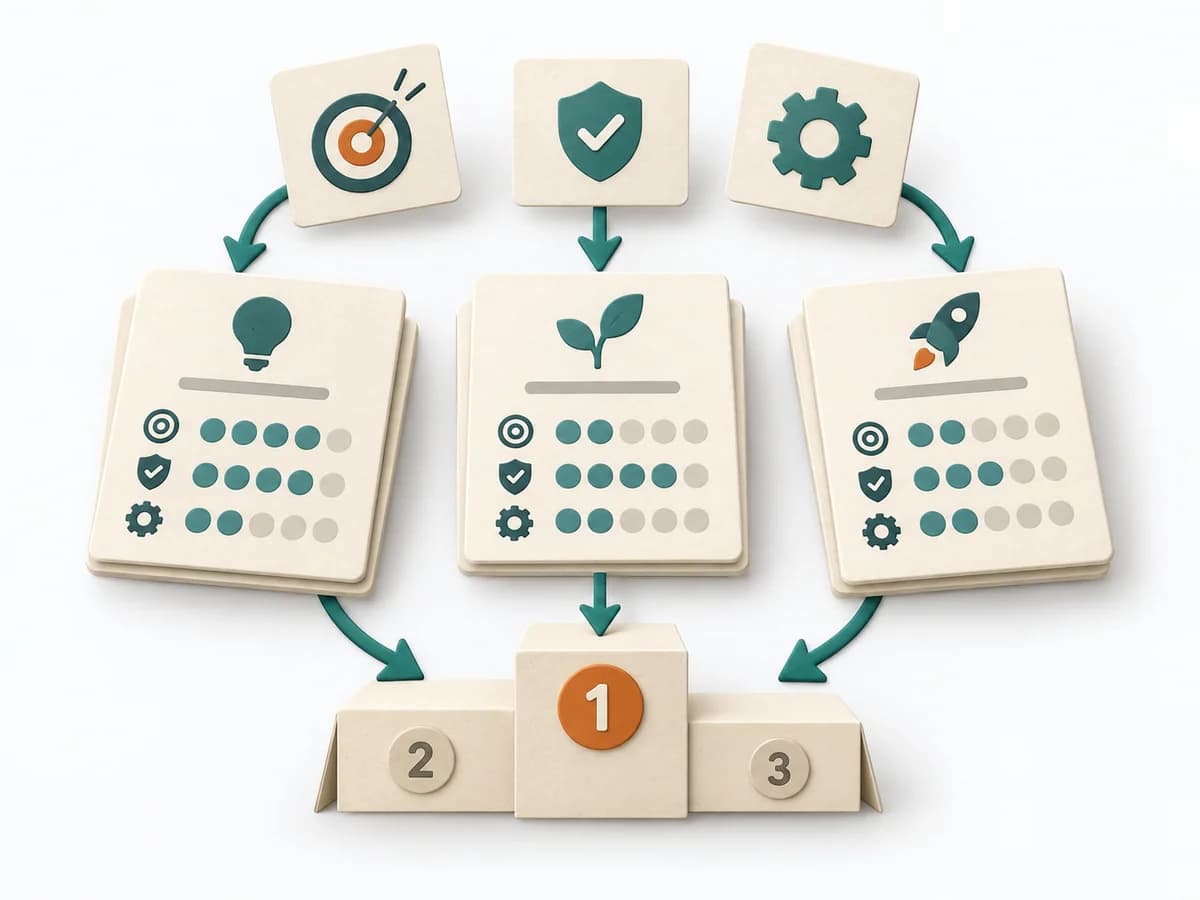
- **Setup:** Prepare ICE = Impact × Confidence × Ease using consistent 1–10 scales visibly and calibrate assessment terms before starting.

### Prepare for the work steps

#### Calibrate scales: Calibrate scales
- Comparable ideas
- Impact, confidence, and ease anchors
- Evidence per idea

#### Score ideas: Score ideas
- ICE scales
- Impact, confidence, and ease anchors
- Evidence per idea

#### Rank and challenge: Rank and challenge
- scoring table
- Impact, confidence, and ease anchors
- Evidence per idea


## ICE ranking

| Item | 1–10 + anchor | 1–10 using evidence anchors | 1–10: 10 = very easy | Impact × Confidence × Ease |
| --- | --- | --- | --- | --- |
| ICE ranking |   |   |   |   |

- **ICE ranking:** Worked example

Enter only real input, sources, and decisions.

[GrowthHackers: ICE Score](https://growthhackers.com/articles/ice-score)


## Calibrate scales: Calibrate scales
Expected artifact: ICE scales

ICE scales · source · uncertainty · next decision

Entry:

...

- [ ] Are 1, 5, and 10 concrete?

## Score ideas: Score ideas
Expected artifact: scoring table

scoring table · source · uncertainty · next decision

Entry:

...

- [ ] Is confidence derived from evidence strength?

## Rank and challenge: Rank and challenge
Expected artifact: ICE ranking

ICE ranking · source · uncertainty · next decision

Entry:

...

- [ ] Does uncertainty remain visible beside the score?

## Open questions and next steps

...

Method guide: https://methodatlas.meierhoff-systems.de/en/methods/ice-scoring/run-sheet