
Purpose
The NeOn Methodology structures ontology work as a controlled process with reuse, scenarios, and reviews. It is useful when ontologies should not emerge ad hoc but modularly and reusably.
Knowledge Modeling Process model
Plans ontology projects as combinations of nine scenarios for specification, reuse, reengineering, and alignment.
NeOn treats ontologies as networks and provides nine scenarios rather than one linear process. A project selects scenarios, outputs, dependencies, and lifecycle to fit its context.
Which NeOn scenarios and activities lead from our sources to a maintainable ontology network?
NeOn Methodology uses project-specific combination of the nine NeOn scenarios with explicit deliverables. Assessments remain justified and context-bound.
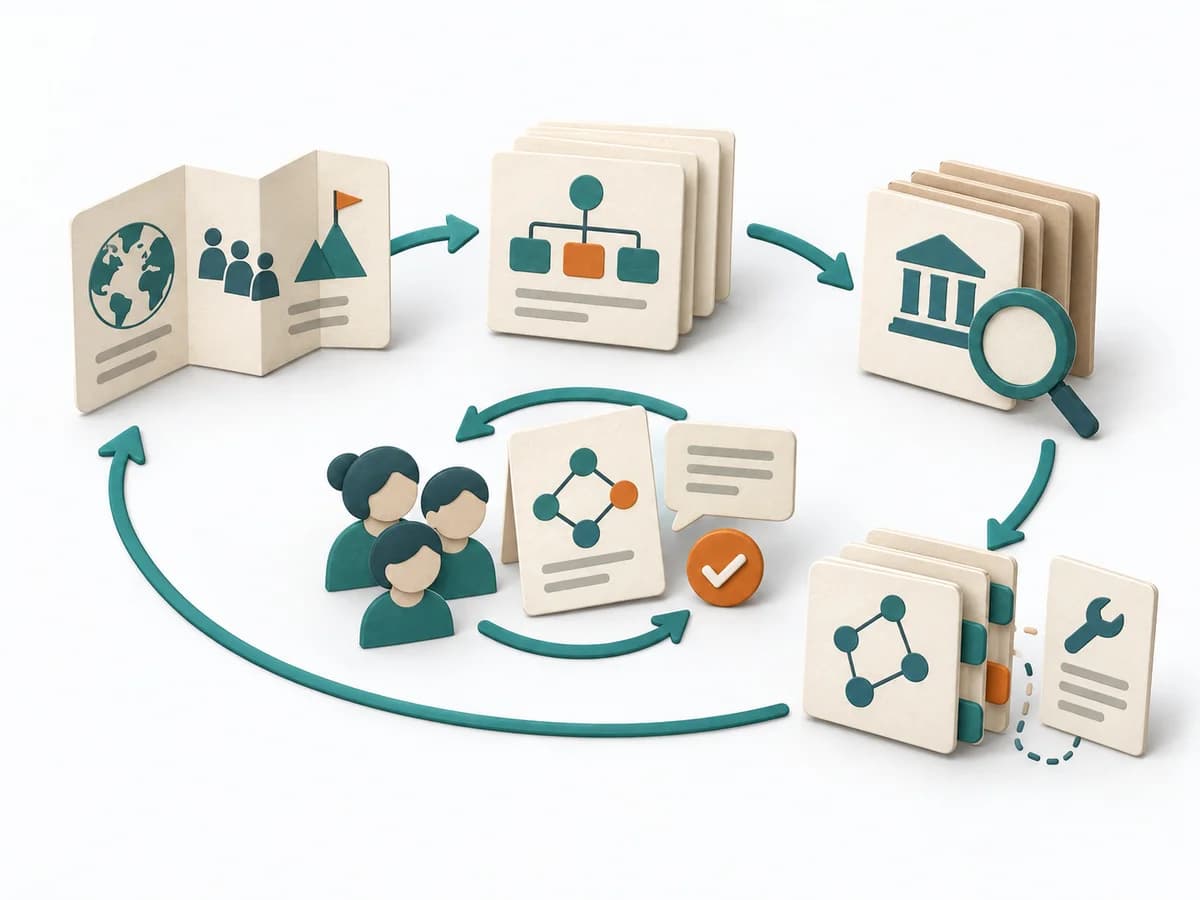
Requirements
Establish ontology requirements specification and network boundary.
Select scenarios
Choose NeOn scenarios from sources and reuse needs.
Plan activities
Plan deliverables, dependencies, roles, and tests per scenario.
Govern lifecycle
Govern modules, versions, alignments, and releases.
Update after new evidence or a material context change and retain the previous version.
For larger ontology initiatives involving reuse, non-ontological sources, or multiple ontologies.
NeOn project route with traceable sources, assumptions, and domain decisions.
Owners, dates, and next review for NeOn project route.
Fictional worked example
project-specific combination of the nine NeOn scenarios with explicit deliverables as a precise working structure with a fictional example.
CQ · scope · non-goal
Project actions, no finance ontology.
Number · purpose · input
S2: reuse and re-engineer CSV; S3: reuse ORG.
Output · test · owner
Mapping tests; ontology lead.
Module · version · alignment
Reuse W3C ORG; Person↔Member mapping.
The example demonstrates the domain logic of NeOn Methodology; worksheets remain blank.
Start with the core question: Which NeOn scenarios and activities lead from our sources to a maintainable ontology network?
The NeOn Methodology structures ontology work as a controlled process with reuse, scenarios, and reviews. It is useful when ontologies should not emerge ad hoc but modularly and reusably.
First, context, goals, and matching NeOn scenarios are set. The team then plans reuse of existing ontologies and works through iterative modeling and review steps. In the end, documented modules and clear maintenance paths remain for larger knowledge graph initiatives.
The NeOn Methodology works because it organizes ontology work as a reusable development process with scenarios, reuse, and reviews. Its benefit grows when decisions about sources, modules, and maintenance are treated not incidentally but as shapeable work packages. It gains substance through the living connection between domain goal, reused building blocks, and governance, so that the ontology can keep evolving consistently beyond the first draft.
A clear use case with a few modules and a review rhythm that brings together domain and technical feedback is suitable for getting started. It becomes a sensitive point when reuse looks more attractive than fit; then adoptions must be checked hard against the own domain. A good close anchors responsibilities, review criteria, and the next iteration step within the ongoing way of working.
The method guide walks execution through 4 phases, timing, 4 pitfalls, and clear stop criteria.
Open method guideYour perspective
Your feedback helps shape the next improvements to methodatlas.
Plan NeOn Methodology around its domain steps and the concrete decision question.
To be confirmed
To be confirmed
Full initiative Time: 2–4 hours planning; initiative over multiple iterations
Complete this worksheet on paper or in your own document during the work.
CQ · scope · non-goal
...
Number · purpose · input
...
Output · test · owner
...
Module · version · alignment
...
Enter only real input, sources, and decisions.
NeOn Methodology for Building Ontology Networks
Expected artifact: ORSD
ORSD · source · uncertainty · next decision
Entry:
...
Expected artifact: scenario route
scenario route · source · uncertainty · next decision
Entry:
...
Expected artifact: work plan
work plan · source · uncertainty · next decision
Entry:
...
Expected artifact: release route
release route · source · uncertainty · next decision
Entry:
...
...
Method guide: https://methodatlas.meierhoff-systems.de/en/methods/neon-methodology/run-sheet
Fitting alternatives with decision guidance, followed by other related methods.

Instead of NeOn Methodology, choose Linked Open Terms when you want to network terms using open vocabularies and external references.

Query patterns drive node labels, relationships, and constraints so property graphs match real retrieval needs.

Validation shapes define required classes, properties, and constraints before graph data enters production pipelines.

Forces complex content into simple language and immediately reveals which knowledge gaps still need closing.
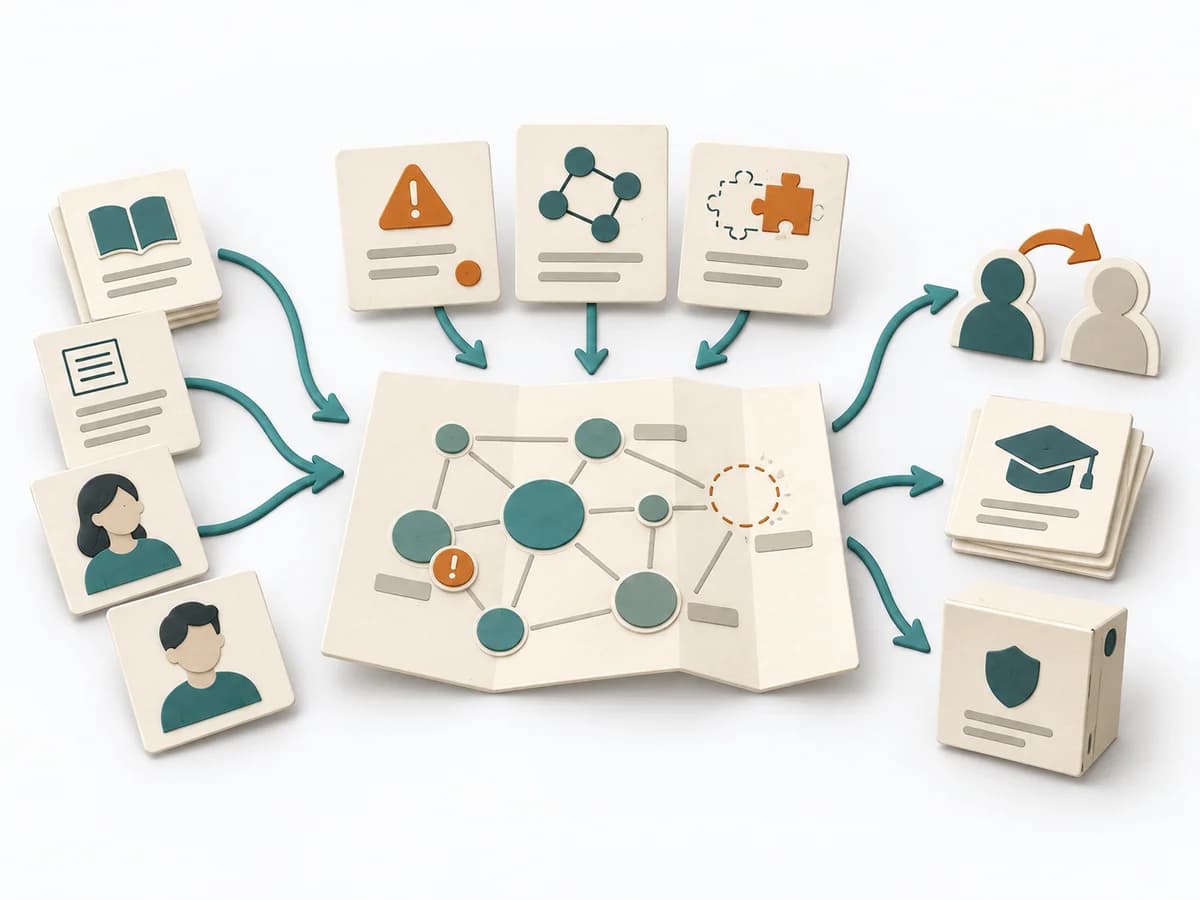
Maps critical knowledge, knowledge holders, and gaps so handovers and transfer can be planned deliberately.

Sorts knowledge into Projects, Areas, Resources, and Archive so personal knowledge work stays easier to steer.