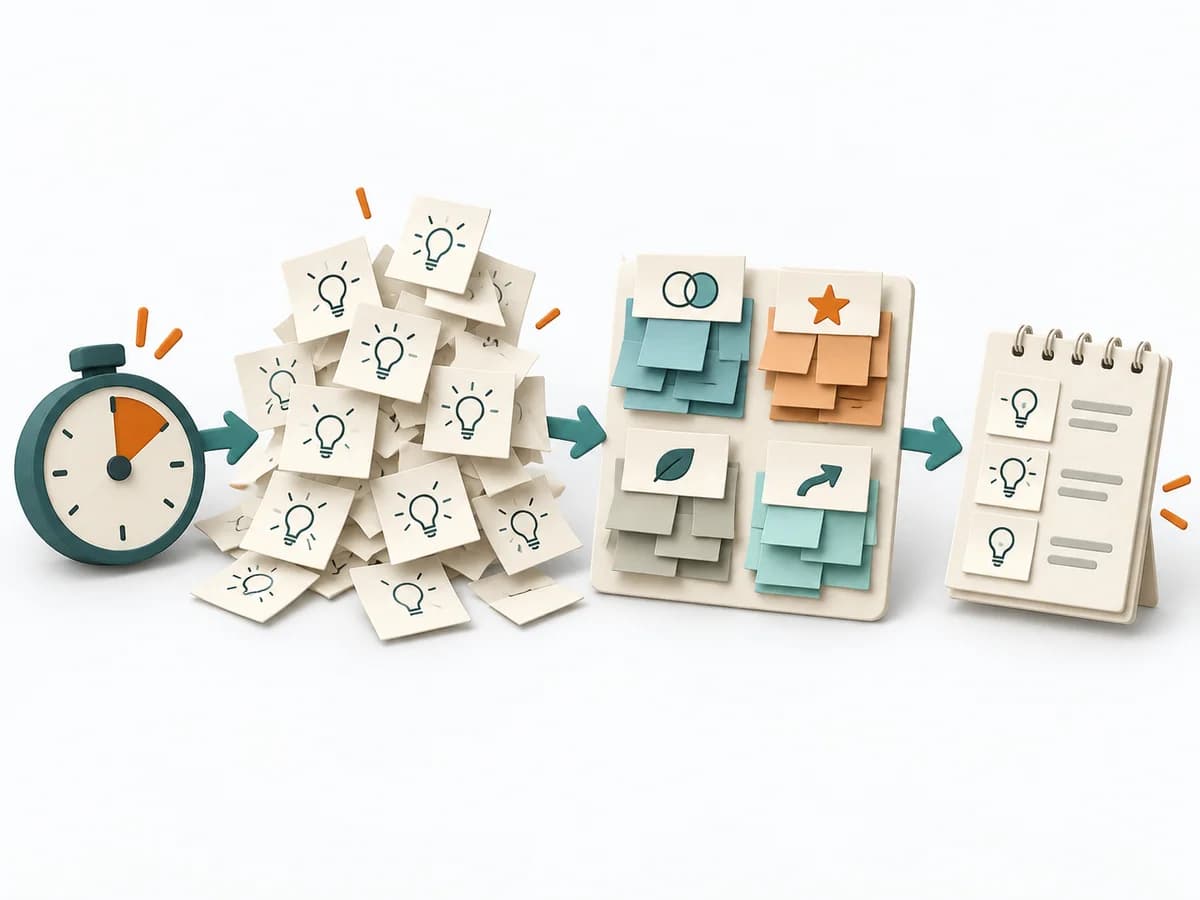
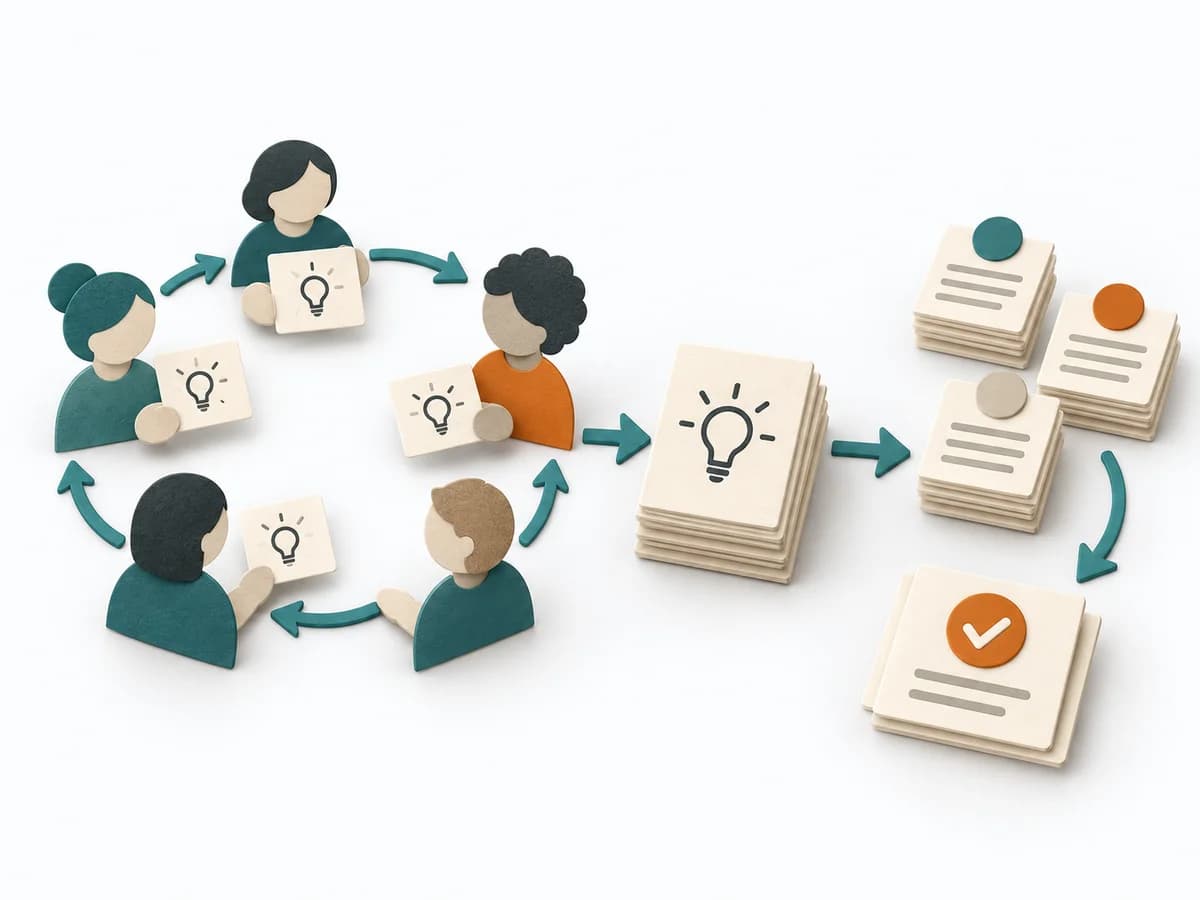
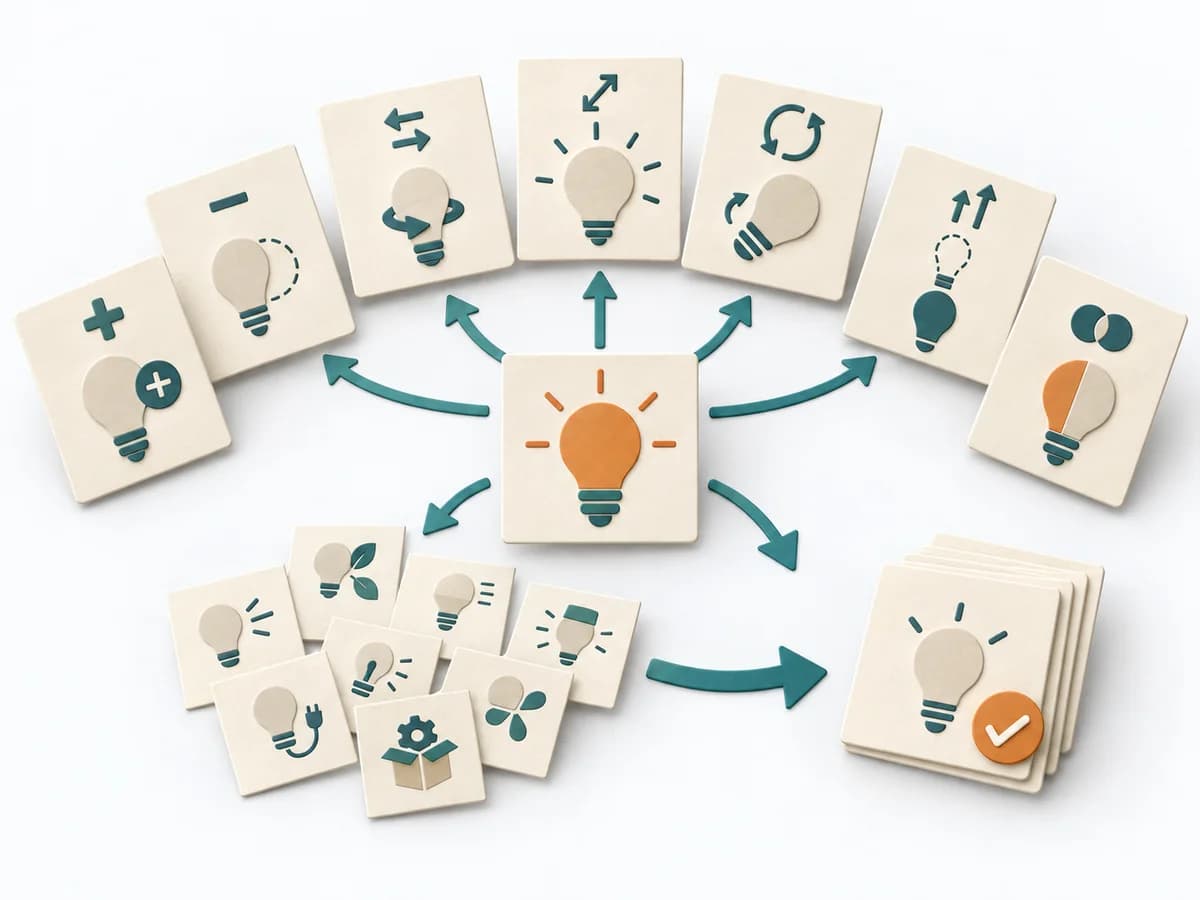
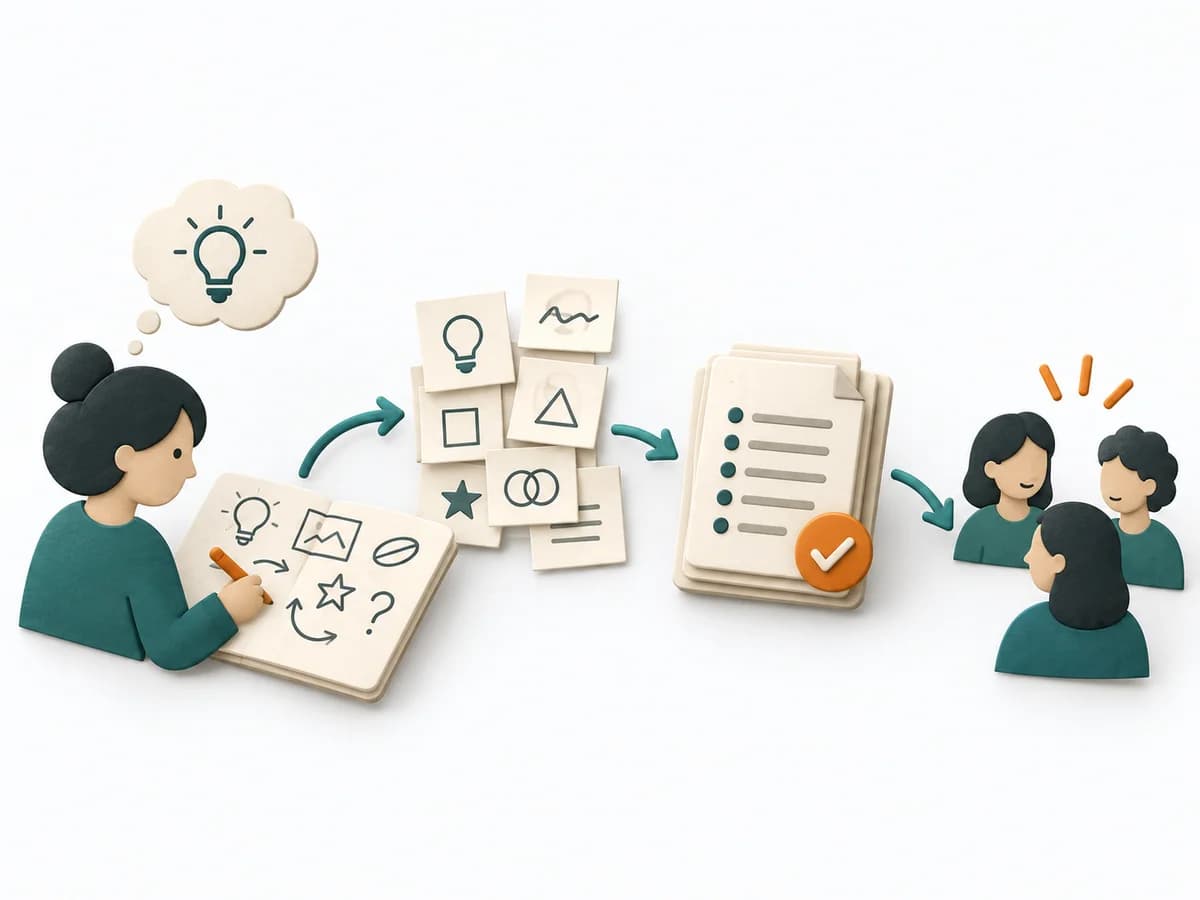
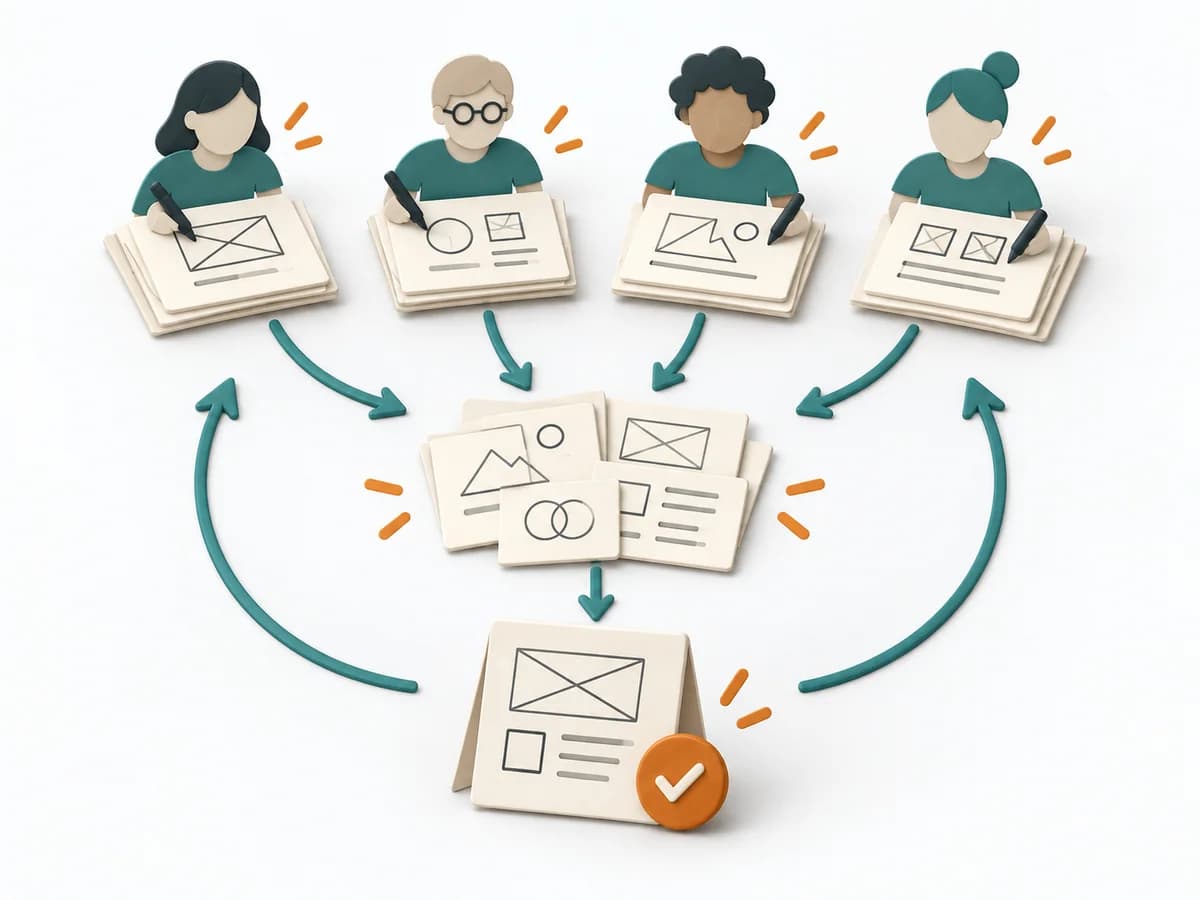
Brainwriting collects ideas silently and develops them across rounds.
Brainwriting separates idea generation from group discussion at first. In the classic 6-3-5 variant, six people write three ideas per five-minute round and pass their sheets. Format parameters record any changes to group size, timing, or rotation.
Core question
What different ideas emerge when everyone writes silently first and then builds on others’ contributions?
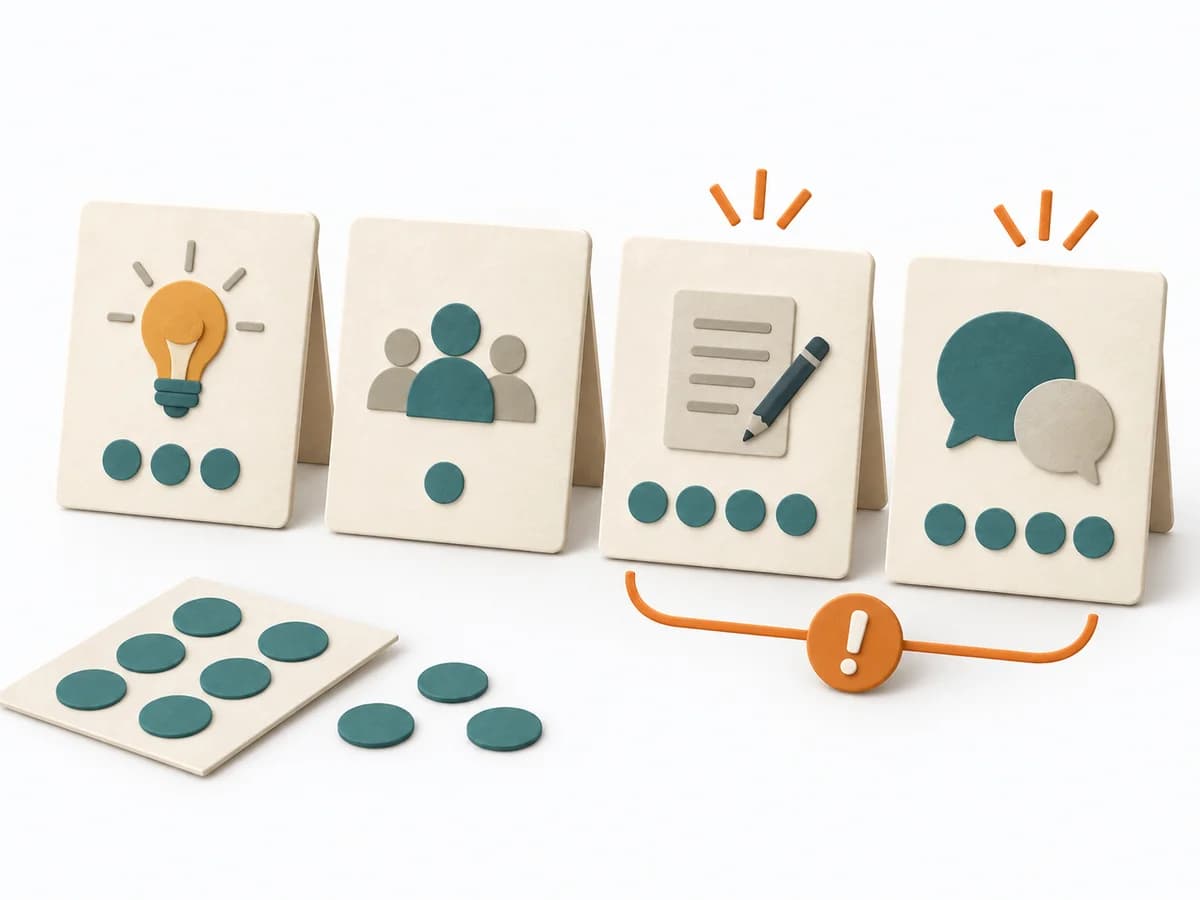
The phase bar groups the shared question, silent ideas, rotation, and later review.
Frame
Set the question and format
Write a shared prompt and explain the silent process.
Write
Write initial ideas
Have everyone write ideas silently at the same time.
Pass
Pass and build on ideas
Pass the sheets in a set direction after each round.
Review
Review the contributions
Open discussion after the writing sequence and prepare a separate selection.
Review contributions only after the silent rounds. Then cluster related directions, preserve distinct ideas, and mark follow-up questions for selection or prototyping.
A good fit when
Use brainwriting when everyone should first generate ideas in parallel without taking turns speaking. A shared, concrete prompt is required. For visual variation in exactly eight minutes, use Crazy 8s.
Ideal for
Remote ideation
Introverted groups
Bias reduction
Not good for
Immediate debate
Clarification without shared context
Outputs
Idea sheets
Silent contributions and visible extensions across rounds.
Reviewed selection
Selected ideas with rationale and a next question.
6×3 brainwriting sheet
Fictional completed example sheet
Six neutral rounds with three idea fields each. The filled rows show one fictional example sheet.
6×3 brainwriting sheet
Round
Idea 1
Idea 2
Idea 3
Round 1Write three initial ideas for the shared prompt.
Show stock by pickup day.
List sites open in the evening.
Notify people when a returned tool becomes available.
Round 2Read the previous round and build on its ideas.
Filter by date and mark available stock.
Map sites and show opening times after work.
Notify interested people when a tool is returned.
Round 3Add three ideas that extend contributions on the sheet.
Show a pickup window beside stock for the chosen date.
Explore locker pickup outside staffed hours.
Offer a waitlist with an expiry for newly available tools.
Round 4Add further variations, combinations, or extensions.
Hold a tool for a selected pickup window.
Send a one-time code to access a locker.
Notify the next person if there is no response.
Round 5Refine the direction or open alternatives.
Show the hold expiry in the reservation confirmation.
Show access requirements and return route on the card.
Let people on the waitlist choose a notification channel.
Round 6Complete the final round, then preserve ideas unchanged.
Test if date and pickup time make stock understandable.
Check access and returns with people outside staffed hours.
Make consent and notification expiry visible.
1. Idea 1
Round 1
Show stock by pickup day.
Round 2
Filter by date and mark available stock.
Round 3
Show a pickup window beside stock for the chosen date.
Round 4
Hold a tool for a selected pickup window.
Round 5
Show the hold expiry in the reservation confirmation.
Round 6
Test if date and pickup time make stock understandable.
2. Idea 2
Round 1
List sites open in the evening.
Round 2
Map sites and show opening times after work.
Round 3
Explore locker pickup outside staffed hours.
Round 4
Send a one-time code to access a locker.
Round 5
Show access requirements and return route on the card.
Round 6
Check access and returns with people outside staffed hours.
3. Idea 3
Round 1
Notify people when a returned tool becomes available.
Round 2
Notify interested people when a tool is returned.
Round 3
Offer a waitlist with an expiry for newly available tools.
Round 4
Notify the next person if there is no response.
Round 5
Let people on the waitlist choose a notification channel.
Round 6
Make consent and notification expiry visible.
The example shows one invented sheet cycle. Idea volume is not evidence of quality or user need.
When loud voices or hierarchy distort the idea search, the method creates a quiet entry into joint development. It gives everyone thinking space and gathers contributions without social brakes, making diversity more visible and easier to build on.
How it works
The written phase decouples thinking from spontaneous reaction and lets ideas form before they get commented on. When passed along, existing contributions are extended, condensed, or turned in a new direction, so every round builds on the previous one. This grows not just the quantity but also the depth of the proposals.
In detail
Brainwriting works because ideas first form quietly, giving dominant voices less influence on the search space. The work gains depth when contributions build on each other and intermediate states visibly open new perspectives. Care is needed with clear prompts, legible continuation, and later synthesis, so parallel individual work turns into a rich field of shared options.
Facilitation
Prepare a clear written prompt and define how contributions get extended or passed along. It gets interesting when participants only repeat instead of building further; targeted follow-up questions or a shift in perspective help there. Close with a sort by pattern and pick a few ideas to serve as the next round of drafts.
The method guide walks execution through 4 phases, timing, 4 pitfalls, and clear stop criteria.
Workshop AgendaCompact agenda template for method sequences with timebox, purpose, and output.
agenda
workshop-agenda-markdown.md
Compact agenda template for method sequences with timebox, purpose, and output.
Workshop Agenda
Goal: ...
Participants: ...
Duration: ...
Time
Method
Purpose
Output
00:00
Check-in
Set focus
Shared start
00:10
How Might We
Ideation questions
HMW list
00:35
Brainwriting
Generate ideas
Idea pool
01:10
Dot Voting
Prepare selection
Prioritized ideas
01:30
Storyboarding
Make the concept tangible
Storyboard
Close-out
Decision, owner, next test.
Brainwriting: WorksheetPlan silent idea generation with a clear prompt, round rules, and separate review.
markdown
brainwriting-working-template.md
Plan silent idea generation with a clear prompt, round rules, and separate review.
Brainwriting: Worksheet
Question
To be confirmed
Desired outcome
To be confirmed
Scope
One brainwriting round
Time: Classic 6-3-5 writing takes up to 30 minutes; allow about 45–60 minutes with introduction, passes, and review.
Complete this worksheet on paper or in your own document during the work.
Preparation for this scope
Method setup
Materials: Focused prompt, a sheet with three idea columns and one row per round for each person, pens, timer, and a planned passing path.
Roles: A facilitator explains prompt, rules, and timer; everyone writes silently first and reads the previous round. The team reviews ideas afterward.
Advance information: Summarize problem context and known user needs. Choose prompt, group size, and format so everyone can take part.
Overall time needed: Classic writing: six rounds of up to five minutes, about 30 minutes total. Plan about 45–60 minutes including introduction, passes, and review.
Setup: Prepare sheets with three columns and one row per round. Agree on passing direction, timing, and silence; check rotation and legibility on a digital board.
Prepare for the work steps
Frame: Set the question and format
Write a concrete open question and decide whether to use classic 6-3-5 or an adapted brainwriting format.
Write: Write initial ideas
Visible prompt and clear round sequence.
Pass: Pass and build on ideas
Individual starting ideas before group discussion.
Review: Review the contributions
Rotated idea sheets with visible development and provenance.
6×3 brainwriting sheet
Round
Idea 1
Idea 2
Idea 3
Round 1
Round 2
Round 3
Round 4
Round 5
Round 6
Round 1: Write three initial ideas for the shared prompt.
Round 2: Read the previous round and build on its ideas.
Round 3: Add three ideas that extend contributions on the sheet.
Round 4: Add further variations, combinations, or extensions.
Round 5: Refine the direction or open alternatives.
Round 6: Complete the final round, then preserve ideas unchanged.
Blank template: six rounds × three idea fields; facilitation provides all three fields per round.
LowComplexity: low. Estimates preparation, facilitation effort, and method confidence needed.Workshop + asyncFormat: workshop or async. Shows whether the method works in a workshop, asynchronously, or both.15-30 minTimebox: 15-30 min. Rough time frame for a typical run.