When a decision needs to be prepared quickly, the method generates many solution-close variants in a short time. It deliberately relies on pace to undercut self-censorship and perfectionism. This quickly produces a usable field for prioritization and further work.
Innovation Workshop method
Rapid Ideation
Generates many distinct solution directions in a short silent timebox for a focused question.
Rapid Ideation separates divergent generation from evaluation. A clear how-might-we question, visible constraints, and silent individual work reduce group conformity.
Which distinct solution directions address the focused user barrier?
- Participants
- 1-20
- Time
- 5-20 min
Rapid Ideation uses silent time-boxed volume generation followed by clustering. Assessments remain justified and context-bound.

Focus
Focus
Expose HMW question, user barrier, and no-gos.
Diverge
Diverge
Write or sketch ideas in a short silent timebox.
Cluster
Cluster
Cluster by mechanism and mark unusual options.
Select
Select
Select contrasting options by problem fit and learning value.
Update after new evidence or a material context change and retain the previous version.
A good fit when
For early solution spaces after sufficient problem framing.
Ideal for
- Workshop Warmups
- Divergenzphasen
- Festgefahrene Teams
Not good for
- Bereits konvergente Phasen
- Komplexe Detailentscheidungen
Outputs

rapid idea set
rapid idea set with traceable sources, assumptions, and domain decisions.

Decision and review trail
Owners, dates, and next review for rapid idea set.
rapid idea set
Fictional worked example
silent time-boxed volume generation followed by clustering as a precise working structure with a fictional example.
Question
HMW · user · barrier
Detect missing evidence before submission.
Constraint
Must · no-go · time
No additional mandatory page.
Idea
Mechanism · sketch · assumption
Inline evidence preview.
Test value
Contrast · risk · next test
Preview versus checklist in click test.
First step
Start with the core question: Which distinct solution directions address the focused user barrier?
Good to do first
Deep dive
The time limit shifts the focus from elaboration to generation and makes quantity the engine of quality. The fast side-by-side of many approaches makes repetitions, patterns, and surprising branches visible sooner than in a slow discussion. Afterward, the idea space can be sorted with considerably more substance.
Rapid Ideation lowers self-censorship through a high cadence and enlarges the search space in a short time. The format gains when pace meets genuine thematic focus and the subsequent selection step is not skipped. Recurring patterns, surprising outliers, and connectability to prototypes help translate speed into a solid direction.
Set a narrow topic at the start and make clear that roughness is welcome as long as the contributions stay understandable. The situation is especially sensitive when speed eats into legibility or traceability; a brief pause is then worthwhile. Close with a condensed selection and decide immediately which ideas feed the next design.
The method guide walks execution through 4 phases, timing, 4 pitfalls, and clear stop criteria.
Open method guideYour perspective
Does this method help with your work?
Your feedback helps shape the next improvements to methodatlas.
Sources and topics
Rapid Ideation: WorksheetPlan Rapid Ideation around its domain steps and the concrete decision question.canvas
rapid-ideation-working-template.md
Plan Rapid Ideation around its domain steps and the concrete decision question.
Rapid Ideation: Worksheet
Question
To be confirmed
Desired outcome
To be confirmed
Scope
Full workshop Time: 30–45 minutes
Complete this worksheet on paper or in your own document during the work.
Preparation for this scope
Method setup
- Materials: How-might-we question, research evidence, constraints and no-gos, shared workspace, source links, and decision log.
- Roles: Facilitator · 3–8 cross-functional participants
- Advance information: Collect How-might-we question, research evidence, constraints and no-gos in advance and mark open assumptions.
- Overall time needed: 30–45 minutes
- Setup: Prepare silent time-boxed volume generation followed by clustering visibly and calibrate assessment terms before starting.
Prepare for the work steps
Focus: Focus
- How-might-we question
- research evidence
- constraints and no-gos
Diverge: Diverge
- ideation brief
- research evidence
- constraints and no-gos
Cluster: Cluster
- raw ideas
- research evidence
- constraints and no-gos
Select: Select
- idea landscape
- research evidence
- constraints and no-gos
rapid idea set
Question
HMW · user · barrier
...
Constraint
Must · no-go · time
...
Idea
Mechanism · sketch · assumption
...
Test value
Contrast · risk · next test
...
Design Council: Ideation methods
Focus: Focus
Expected artifact: ideation brief
ideation brief · source · uncertainty · next decision
Entry:
...
- Is exactly one barrier in focus?
Diverge: Diverge
Expected artifact: raw ideas
raw ideas · source · uncertainty · next decision
Entry:
...
- Has each person generated several directions?
Cluster: Cluster
Expected artifact: idea landscape
idea landscape · source · uncertainty · next decision
Entry:
...
- Are clusters based on mechanism rather than author?
Select: Select
Expected artifact: test candidates
test candidates · source · uncertainty · next decision
Entry:
...
- Will candidates produce different learning?
Open questions and next steps
...
Method guide: https://methodatlas.meierhoff-systems.de/en/methods/rapid-ideation/run-sheet
Alternatives and neighbors
Fitting alternatives with decision guidance, followed by other related methods.

Instead of Rapid Ideation, choose Crazy 8s when you want to generate eight quick sketches for a broad range of solution variants.

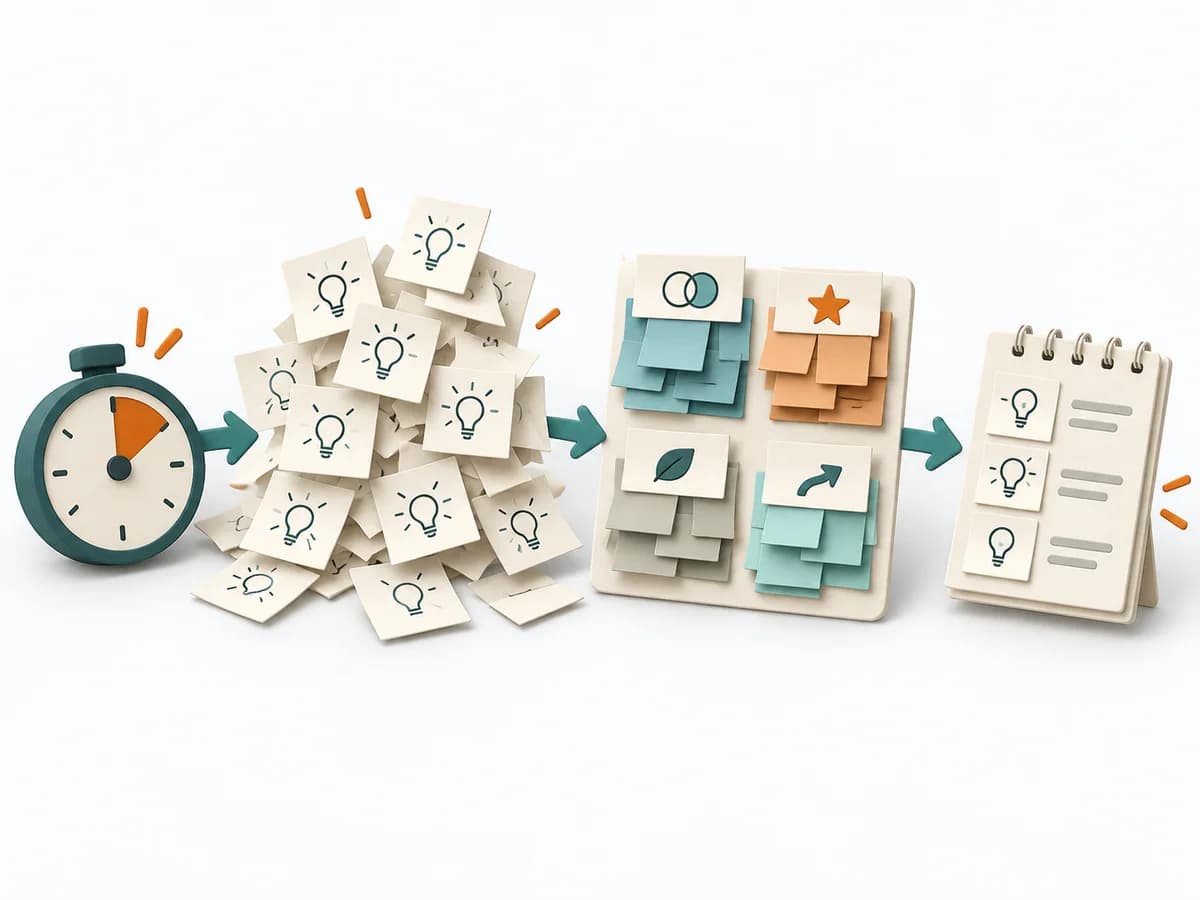
Opens the idea space, bundles contributions into theme clusters, and condenses them into a shortlist for the next step.

A single person uses a chosen prompt technique to create, sort, and sharpen ideas before group discussion starts.

Ensures participation in turn, produces a broad idea list, and then leads it into clusters and a shortlist.

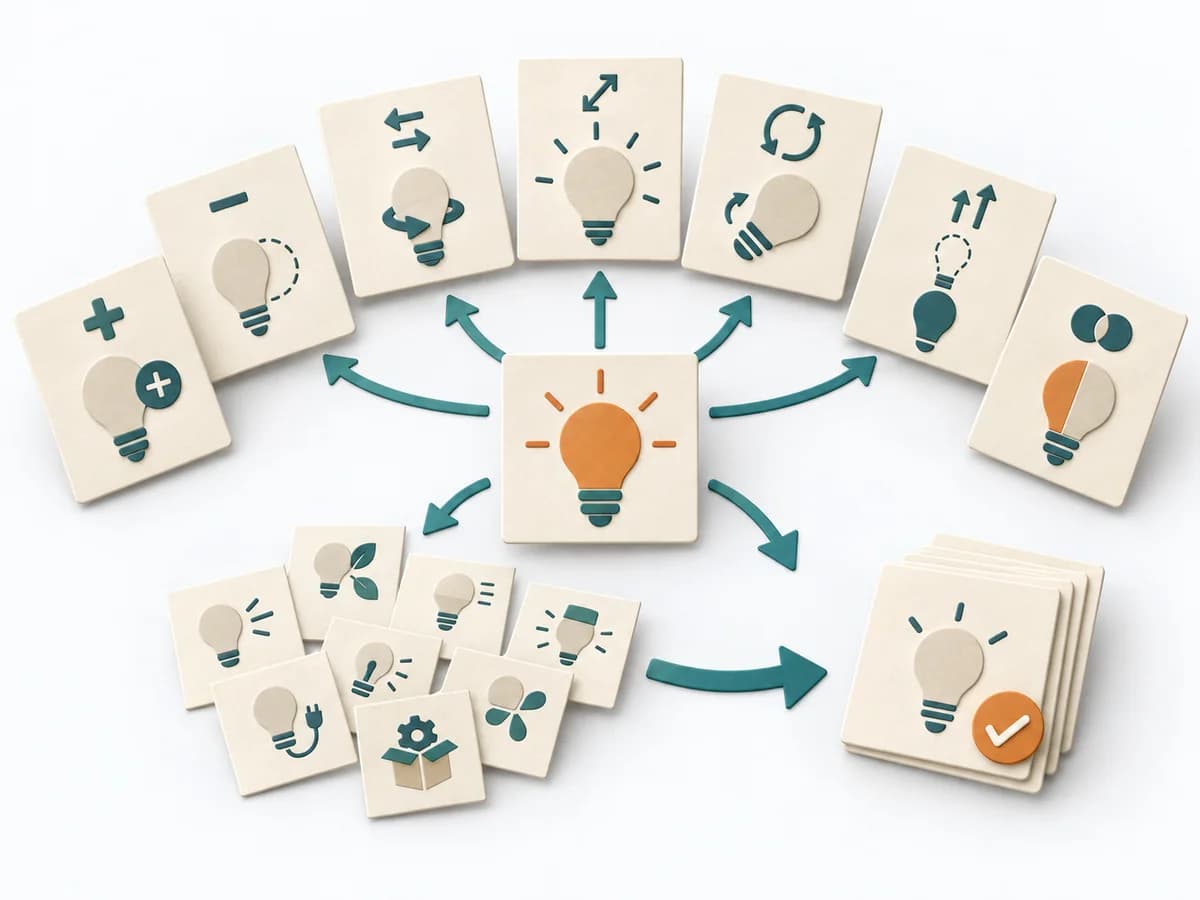
Varies a starting idea across seven targeted change questions and condenses approaches into a concept shortlist.

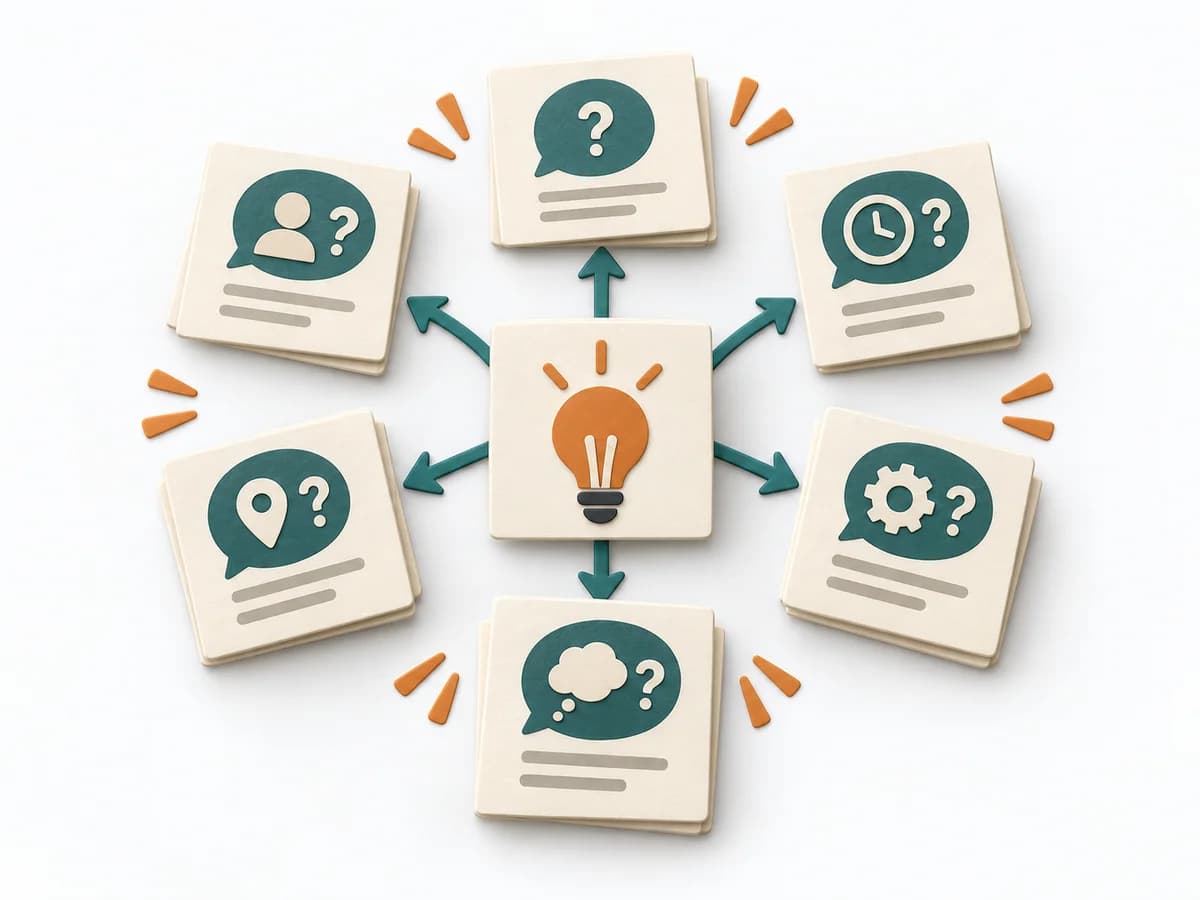
Moves ideas, open questions, and testable next steps toward a concrete result through "place the core idea in the center", "label the six points with who, what, when, where, how, and why", and "mark gaps and follow-up questions".
Constraints and origin
Profile
- Method form
- Workshop method
- Participants
- 1-20
- Time
- 5-20 min
- Maturity
- Established
- Origin
- Praxisgemeinschaft