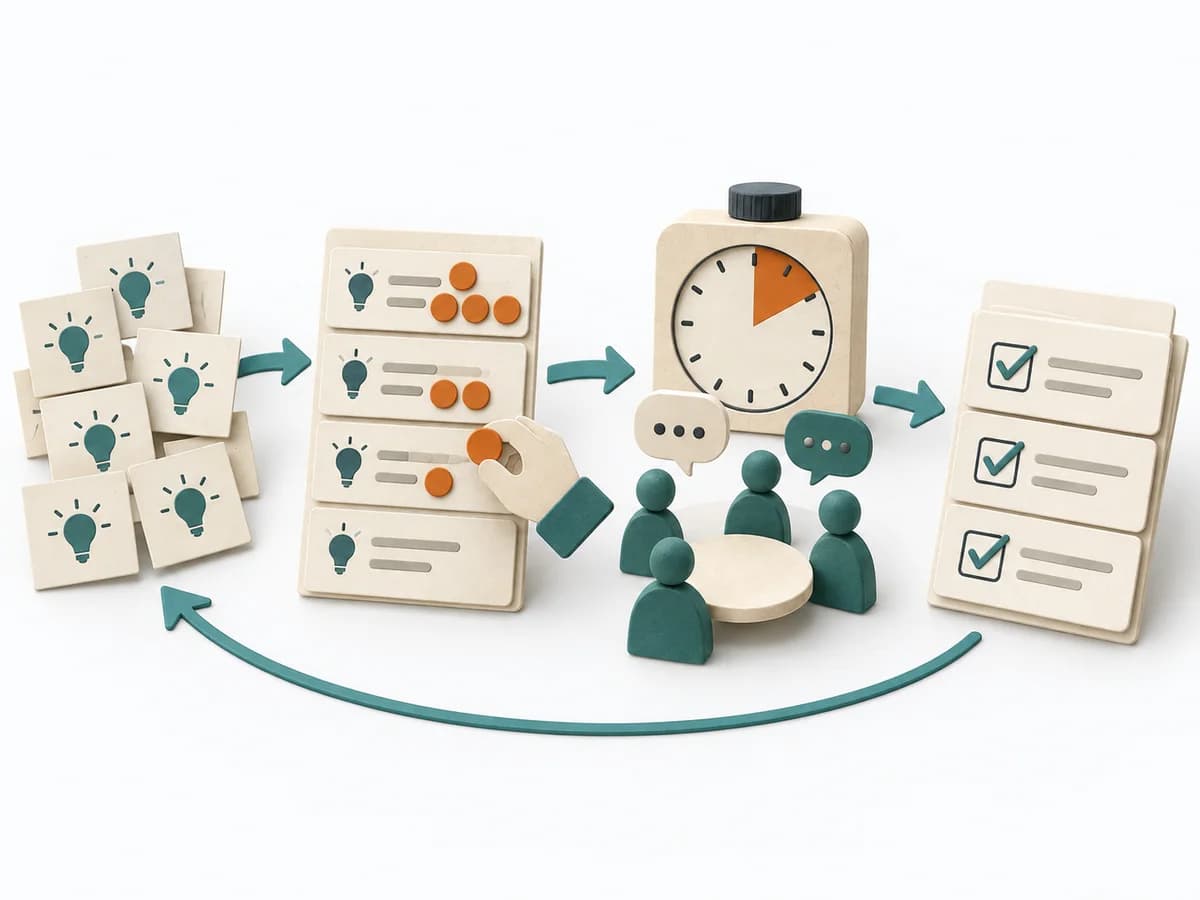
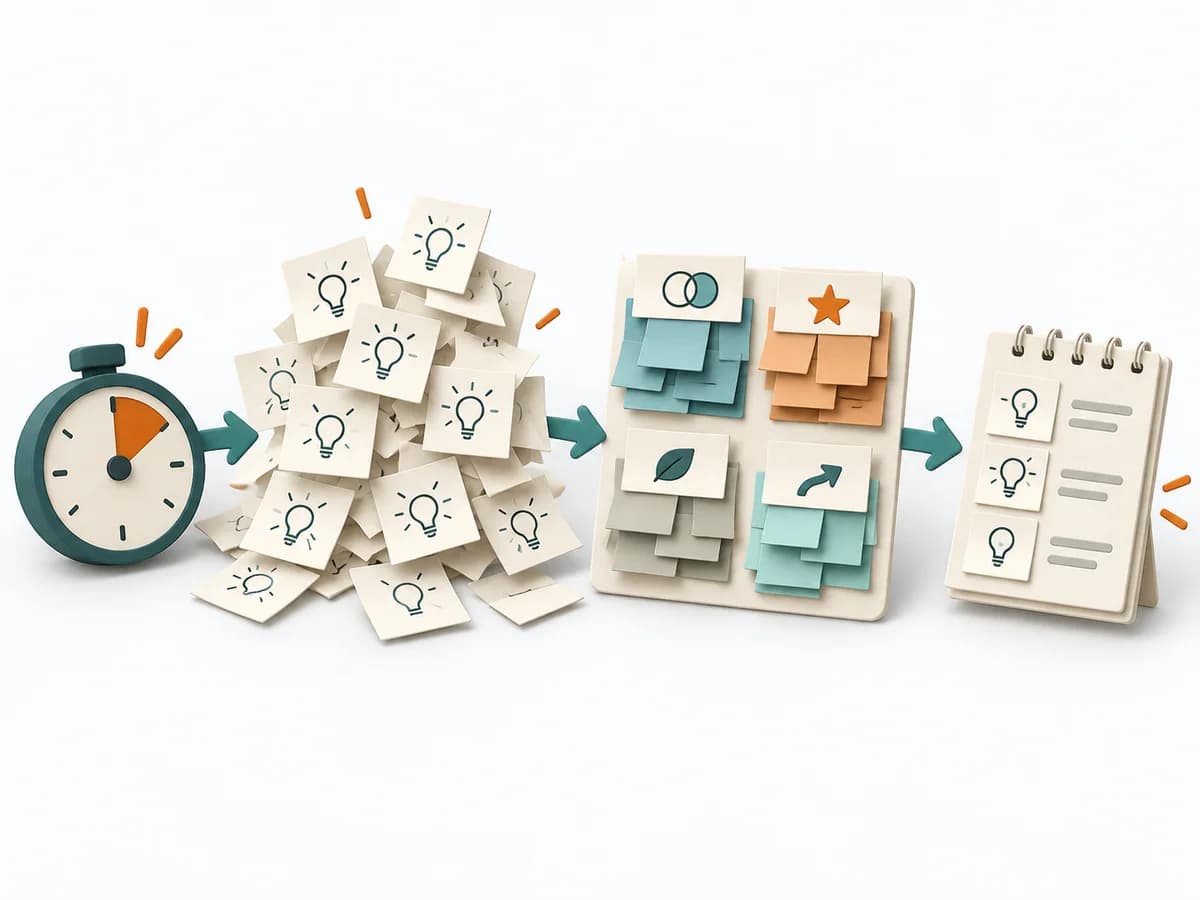
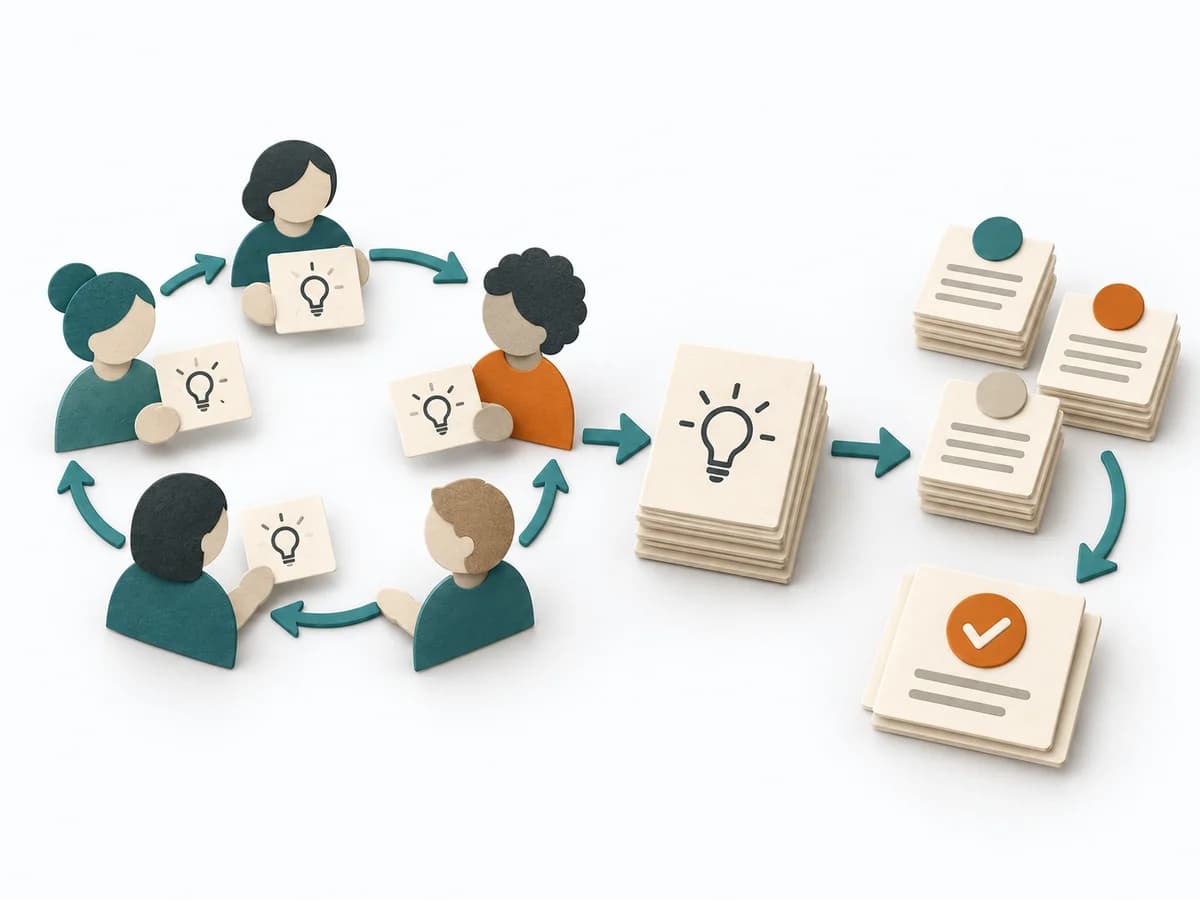
For an individual thinking problem with no counterpart immediately available, the method creates a protected space for one's own approaches. It prevents outside opinions from narrowing thinking too early. This lets ideas mature before they go into a group format.
Innovation Planning tool
Solo Brainstorming
Generates ideas independently before group status and anchors influence selection.
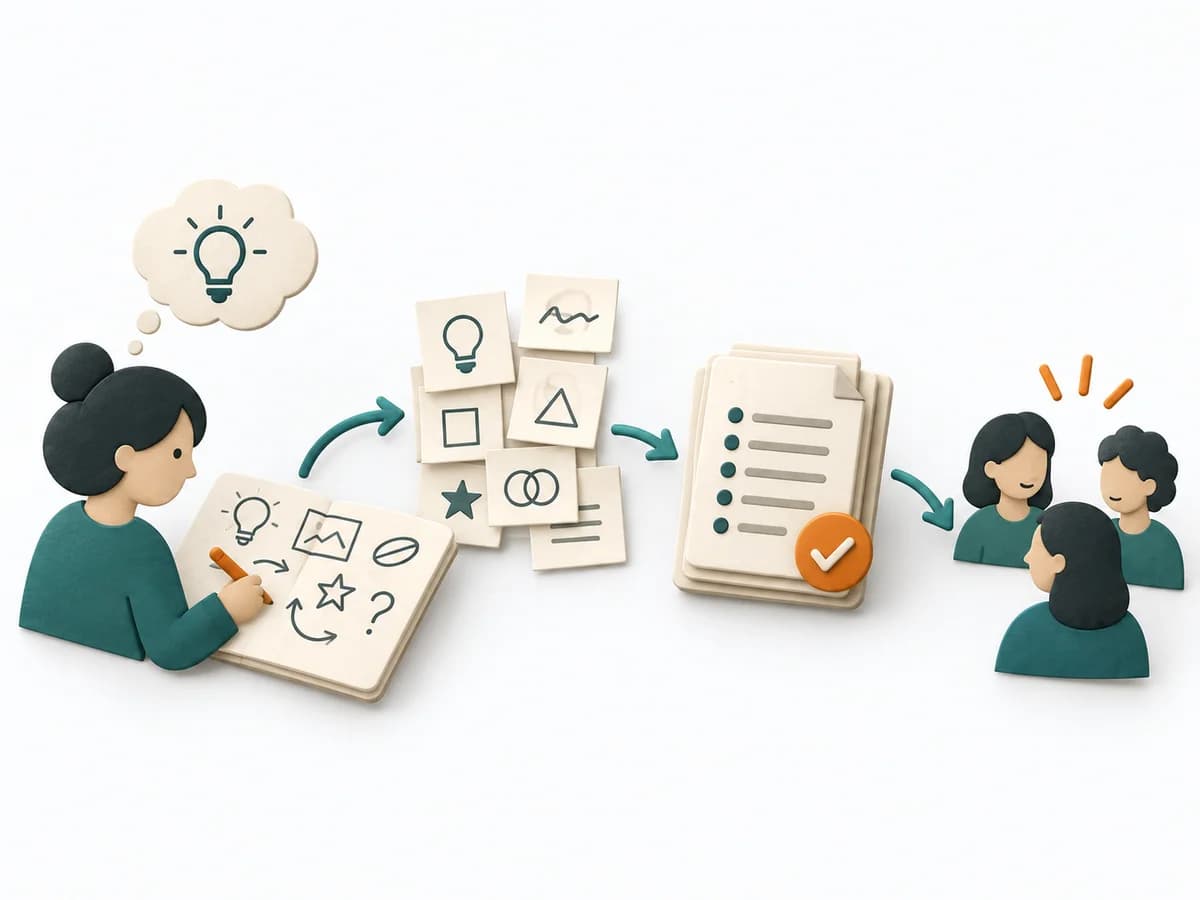
Solo brainstorming uses a clear prompt, short sprints, and deliberate perspective shifts. A later group sees all ideas anonymised and separates author status from content.
Which solution options can each person develop independently before collective synthesis?
- Participants
- 1
- Time
- 15-60 min
Solo Brainstorming uses individual idea sprints with stimulus shifts and anonymised consolidation. Assessments remain justified and context-bound.

Set prompt
Set prompt
Provide problem, user, evidence, and no-gos compactly.
Run sprints
Run sprints
Run three short rounds with changing stimuli.
Submit
Submit
Submit ideas in a common format with assumption and sketch.
Synthesize
Synthesize
Cluster mechanisms and select contrasting tests.
Update after new evidence or a material context change and retain the previous version.
A good fit when
For distributed teams, sensitive hierarchies, or preparation for a group ideation session.
Ideal for
- Preparing workshops
- Introverted thinking styles
- Remote and asynchronous setups
Not good for
- Topics with a high need for clarification
- Complex stakeholder alignment
Outputs

independent idea pack
independent idea pack with traceable sources, assumptions, and domain decisions.

Decision and review trail
Owners, dates, and next review for independent idea pack.
independent idea pack
Fictional worked example
individual idea sprints with stimulus shifts and anonymised consolidation as a precise working structure with a fictional example.
Prompt
Problem · user · constraint
Explain import mismatch without jargon.
Sprint idea
Stimulus · mechanism · sketch
Support perspective: repairable diff.
Assumption
Expectation · uncertainty
Users understand row comparison.
Synthesis
Cluster · contrast · test
Preview versus diff in usability test.
The example demonstrates the domain logic of Solo Brainstorming; worksheets remain blank.
First step
Start with the core question: Which solution options can each person develop independently before collective synthesis?
Deep dive
The silent phase gives thinking enough freedom from friction for first images, variants, and counter-ideas to emerge. Because no discussion interferes yet, unusual material can be allowed more easily and revised later in a targeted way. The later connection to a group is often clearer as a result, because the preliminary work has already been condensed.
Solo Brainstorming works because it lets individual thinking unfold without group pressure, making unfamiliar approaches more likely to surface. The method delivers good results when the starting question is clear and the individual deliberately distinguishes between generating, sorting, and checking. What matters are shifts of perspective, short condensing steps, and later linking back to real requirements, so that a quiet abundance of ideas becomes usable options.
For self-application, a clear prompt and a visible collection surface where variants can quickly sit side by side help. It becomes a checkpoint when you latch onto a favorite idea too early; a forced change of perspective is then worthwhile. Close with a few approaches that can be carried forward and one small next trial action.
The method guide walks execution through 4 phases, timing, 4 pitfalls, and clear stop criteria.
Open method guideYour perspective
Does this method help with your work?
Your feedback helps shape the next improvements to methodatlas.
Sources and topics
Solo Brainstorming: WorksheetPlan Solo Brainstorming around its domain steps and the concrete decision question.markdown
solo-brainstorming-working-template.md
Plan Solo Brainstorming around its domain steps and the concrete decision question.
Solo Brainstorming: Worksheet
Question
To be confirmed
Desired outcome
To be confirmed
Scope
Full workshop Time: 20–40 minutes plus synthesis
Complete this worksheet on paper or in your own document during the work.
Preparation for this scope
Method setup
- Materials: focused ideation prompt, research snapshot, submission format and deadline, shared workspace, source links, and decision log.
- Roles: Prompt owner · individual contributors · later facilitator
- Advance information: Collect focused ideation prompt, research snapshot, submission format and deadline in advance and mark open assumptions.
- Overall time needed: 20–40 minutes plus synthesis
- Setup: Prepare individual idea sprints with stimulus shifts and anonymised consolidation visibly and calibrate assessment terms before starting.
Prepare for the work steps
Set prompt: Set prompt
- focused ideation prompt
- research snapshot
- submission format and deadline
Run sprints: Run sprints
- solo brief
- research snapshot
- submission format and deadline
Submit: Submit
- idea set
- research snapshot
- submission format and deadline
Synthesize: Synthesize
- anonymous pack
- research snapshot
- submission format and deadline
independent idea pack
Prompt
Problem · user · constraint
...
Sprint idea
Stimulus · mechanism · sketch
...
Assumption
Expectation · uncertainty
...
Synthesis
Cluster · contrast · test
...
Enter only real input, sources, and decisions.
IDEO.org Design Kit: Brainstorm
Set prompt: Set prompt
Expected artifact: solo brief
solo brief · source · uncertainty · next decision
Entry:
...
- Can the prompt be used without clarification?
Run sprints: Run sprints
Expected artifact: idea set
idea set · source · uncertainty · next decision
Entry:
...
- Do mechanisms differ rather than just surfaces?
Submit: Submit
Expected artifact: anonymous pack
anonymous pack · source · uncertainty · next decision
Entry:
...
- Is authorship hidden for review?
Synthesize: Synthesize
Expected artifact: test selection
test selection · source · uncertainty · next decision
Entry:
...
- Is selection based on learning value and problem fit?
Open questions and next steps
...
Method guide: https://methodatlas.meierhoff-systems.de/en/methods/solo-brainstorming/run-sheet
Alternatives and neighbors
Fitting alternatives with decision guidance, followed by other related methods.

Instead of Solo Brainstorming, choose Brainwriting when several people should contribute ideas at the same time without going straight into discussion.

Opens the idea space, bundles contributions into theme clusters, and condenses them into a shortlist for the next step.

A strict timebox pushes quick idea volume first, then clusters and selects options after the burst is complete.

Ensures participation in turn, produces a broad idea list, and then leads it into clusters and a shortlist.

Varies a starting idea across seven targeted change questions and condenses approaches into a concept shortlist.

Moves ideas, open questions, and testable next steps toward a concrete result through "place the core idea in the center", "label the six points with who, what, when, where, how, and why", and "mark gaps and follow-up questions".
Constraints and origin
Profile
- Method form
- Planning tool
- Participants
- 1
- Time
- 15-60 min
- Maturity
- Established
- Origin
- Praxisgemeinschaft