Kepner-Tregoe: Worksheet
Collect concerns, facts, impact and ownership; first choose the needed analysis route.
# Kepner-Tregoe: Worksheet

## Question
To be confirmed

## Desired outcome
To be confirmed

## Scope
Complete cycle
Time: Multiple analysis blocks as needed; 45–90 minutes each

Complete this worksheet on paper or in your own document during the work.

## Preparation for this scope

### Method setup
- **Materials:** Concern list, IS/IS NOT comparison, decision criteria, alternatives and risk plan.
- **Roles:** Domain experts, process owners, decision maker and experienced facilitator.
- **Advance information:** Collect concerns, facts, impact and ownership; first choose the needed analysis route.
- **Overall time needed:** Multiple analysis blocks as needed; 45–90 minutes each
- **Setup:** Sort concerns first; prepare separate workspaces for IS/IS NOT, decision criteria and plan risks.

### Prepare for the work steps

#### Situation: Situation Appraisal
- Concerns
- Impact

#### Problem: Problem Analysis
- Deviation data
- Comparison cases

#### Decision: Decision Analysis
- Objective
- Criteria and options

#### Plan risks: Potential Problem Analysis
- Selected plan
- Critical steps


## Kepner-Tregoe· worksheet

### Situation Appraisal
What concerns exist and which analysis route fits each?

...

### IS / IS NOT
What, where, when and to what extent does the deviation occur or not occur?

...

### Distinction, change, test
Which change explains all facts and how is it verified?

...

### Must, want, risk
Which options pass must criteria and differ in benefits and risk?

...

### Prevention and contingency
Which problem do we prevent and what trigger starts which response?

...

Answer the prompts with your own information. Explicitly mark unknowns and assumptions.

[Kepner-Tregoe: FAQs](https://kepner-tregoe.com/about/faqs/)


## Situation: Situation Appraisal
Expected artifact: Analysis briefs

Is the needed thinking process clear per concern?

Entry:

...

- [ ] Is the needed thinking process clear per concern?

## Problem: Problem Analysis
Expected artifact: Verified cause

Does the cause explain IS and IS NOT consistently?

Entry:

...

- [ ] Does the cause explain IS and IS NOT consistently?

## Decision: Decision Analysis
Expected artifact: Reasoned choice

Does the selected option meet all must criteria?

Entry:

...

- [ ] Does the selected option meet all must criteria?

## Plan risks: Potential Problem Analysis
Expected artifact: Safeguarded plan

Are prevention and response with trigger distinct?

Entry:

...

- [ ] Are prevention and response with trigger distinct?

## Open questions and next steps

...

Method guide: https://methodatlas.meierhoff-systems.de/en/methods/kepner-tregoe/run-sheet
Fault Tree Analysis: Worksheet
Set subject, evidence, roles, flow, and review.
# Fault Tree Analysis: Worksheet

## Question
To be confirmed

## Desired outcome
To be confirmed

## Scope
Whole initiative
Time: One to three working days for a bounded tree; add expert and evidence review.

Complete this worksheet on paper or in your own document during the work.

## Preparation for this scope

### Method setup
- **Materials:** Precise top event, system boundary and operating state, architecture and failure data, AND/OR gate notation, evidence register
- **Roles:** FTA lead · system architecture · reliability/safety · component experts · control owners
- **Advance information:** Define the top event as an observable failure with system boundary, operating state, and time horizon.
- **Overall time needed:** One to three working days for a bounded tree; add expert and evidence review.
- **Setup:** Prepare a workspace with Top event · Gates · Decompose · Cut sets · Controls; separate example from live data.

### Prepare for the work steps

#### Top event: Defined top event
- Define the top event as an observable failure with system boundary, operating state, and time horizon.
- Precise top event, system boundary and operating state, architecture and failure data, AND/OR gate notation, evidence register

#### Gates: First logic level
- Defined top event

#### Decompose: Evidence-backed tree
- First logic level

#### Cut sets: Minimal cut sets
- Evidence-backed tree

#### Controls: Control plan
- Minimal cut sets


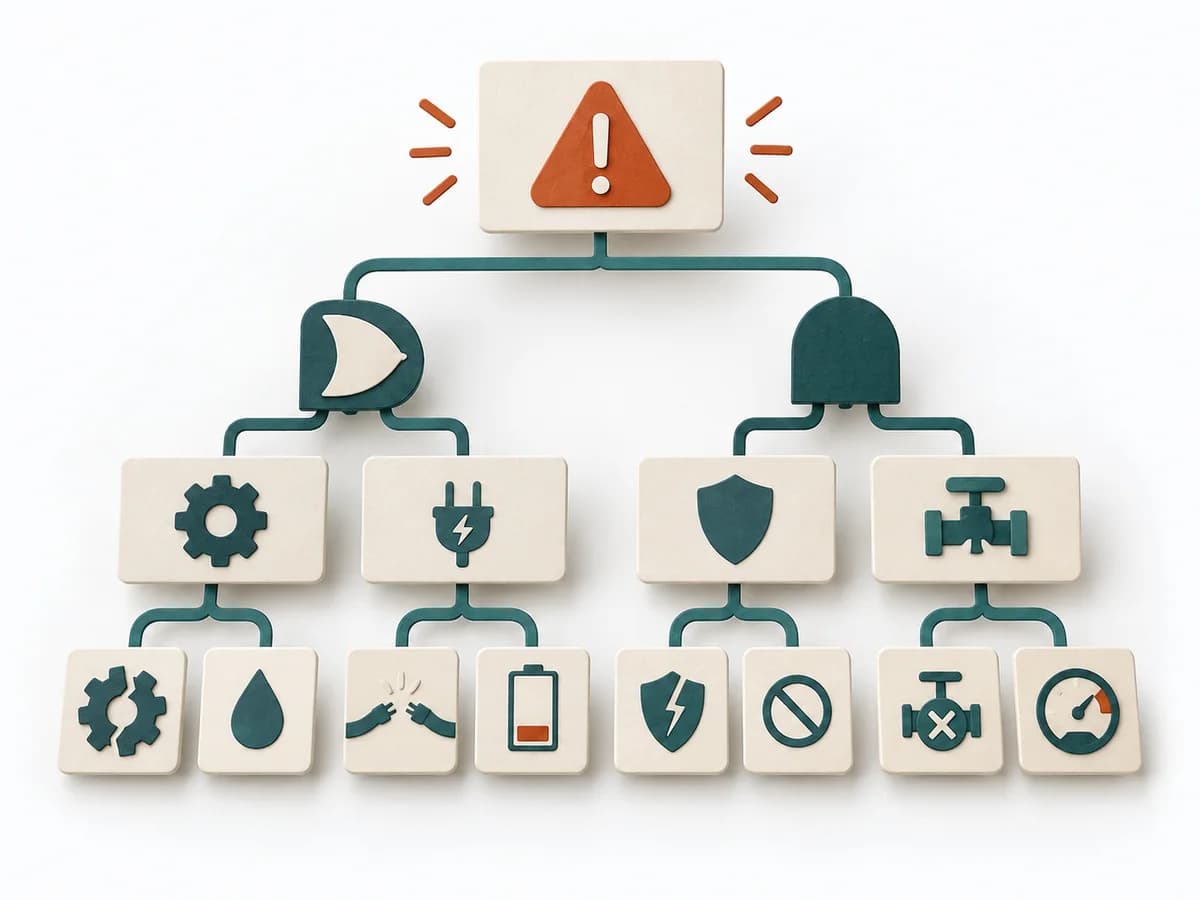
## Fault Tree Analysis · working structure

### Defined top event
State the undesired event precisely and without a solution, including system state and boundary.

...

### First logic level
Arrange immediate causes beneath the top event and choose AND or OR from actual logic.

...

### Evidence-backed tree
Expand intermediate events to controllable basic events or justified development boundaries.

...

### Minimal cut sets
Derive minimal event combinations whose occurrence logically produces the top event; identify shared events.

...

### Control plan
Prioritise controls against single events and combinations; test effect and remaining paths.

...

The blank worksheet contains prompts only.

[Reference · original teaching example](https://extapps.ksc.nasa.gov/reliability/Documents/Fault_Tree_Handbook_with_Aerospace_Applications_August_2002.pdf)


## Top event: Defined top event
Expected artifact: Defined top event

State the undesired event precisely and without a solution, including system state and boundary.

Entry:

...

- [ ] Is the top event binary-testable and bound to an operating state?

## Gates: First logic level
Expected artifact: First logic level

Arrange immediate causes beneath the top event and choose AND or OR from actual logic.

Entry:

...

- [ ] Does OR mean one input suffices and AND mean all inputs are jointly required?

## Decompose: Evidence-backed tree
Expected artifact: Evidence-backed tree

Expand intermediate events to controllable basic events or justified development boundaries.

Entry:

...

- [ ] Are basic events concrete, independently understandable, and labelled by evidence or assumption?

## Cut sets: Minimal cut sets
Expected artifact: Minimal cut sets

Derive minimal event combinations whose occurrence logically produces the top event; identify shared events.

Entry:

...

- [ ] Are cut sets minimal and derivable from documented gate logic?

## Controls: Control plan
Expected artifact: Control plan

Prioritise controls against single events and combinations; test effect and remaining paths.

Entry:

...

- [ ] Does each priority control break a relevant cut set while residual logic stays visible?

## Open questions and next steps

...

Method guide: https://methodatlas.meierhoff-systems.de/en/methods/fault-tree-analysis/run-sheet
Barrier Analysis: Worksheet
Plan Barrier Analysis around its domain steps and the concrete decision question.
# Barrier Analysis: Worksheet

## Question
To be confirmed

## Desired outcome
To be confirmed

## Scope
Full workshop
Time: 60–120 minutes

Complete this worksheet on paper or in your own document during the work.

## Preparation for this scope

### Method setup
- **Materials:** Incident or scenario description, system and process data, barrier and test evidence, shared workspace, source links, and decision log.
- **Roles:** Investigator · operator · safety/domain expert · control owner
- **Advance information:** Collect Incident or scenario description, system and process data, barrier and test evidence in advance and mark open assumptions.
- **Overall time needed:** 60–120 minutes
- **Setup:** Prepare hazard-target path plus barrier function, condition, failure mode, and correction visibly and calibrate assessment terms before starting.

### Prepare for the work steps

#### Define path: Define path
- Incident or scenario description
- system and process data
- barrier and test evidence

#### Inventory barriers: Inventory barriers
- hazard-target path
- system and process data
- barrier and test evidence

#### Analyse failure: Analyse failure
- barrier set
- system and process data
- barrier and test evidence

#### Improve barriers: Improve barriers
- failure analysis
- system and process data
- barrier and test evidence


## barrier analysis table

| Subject | Hazard · path · target | Function · type · standard | Present · effective · independent | Change · owner · negative test |
| --- | --- | --- | --- | --- |
| barrier analysis table |   |   |   |   |

- **barrier analysis table:** Worked example

Enter only real input, sources, and decisions.

[U.S. Department of Energy: Accident Prevention and Investigation Program](https://www.energy.gov/ehss/doe-accident-prevention-and-investigation-program)


## Define path: Define path
Expected artifact: hazard-target path

hazard-target path · source · uncertainty · next decision

Entry:

...

- [ ] Is the unwanted transfer clear?

## Inventory barriers: Inventory barriers
Expected artifact: barrier set

barrier set · source · uncertainty · next decision

Entry:

...

- [ ] Does every barrier have a clear function?

## Analyse failure: Analyse failure
Expected artifact: failure analysis

failure analysis · source · uncertainty · next decision

Entry:

...

- [ ] Does evidence support the condition?

## Improve barriers: Improve barriers
Expected artifact: barrier improvement

barrier improvement · source · uncertainty · next decision

Entry:

...

- [ ] Does the test prove interruption of the path?

## Open questions and next steps

...

Method guide: https://methodatlas.meierhoff-systems.de/en/methods/barrier-analysis/run-sheet
8D Problem Solving: Worksheet
Set subject, evidence, roles, flow, and review.
# 8D Problem Solving: Worksheet

## Question
To be confirmed

## Desired outcome
To be confirmed

## Scope
Whole initiative
Time: Several days to weeks; contain immediately, implement permanent correction only after verified cause.

Complete this worksheet on paper or in your own document during the work.

## Preparation for this scope

### Method setup
- **Materials:** 8D report, 5W2H problem statement, containment log, occurrence and escape-point evidence, correction and prevention plan
- **Roles:** 8D lead · cross-functional team · process owner · customer/quality perspective · action owners
- **Advance information:** Confirm problem significance, initiate immediate protection, and secure sponsor plus cross-functional expertise for 8D.
- **Overall time needed:** Several days to weeks; contain immediately, implement permanent correction only after verified cause.
- **Setup:** Prepare a workspace with D1 Team · D2 Problem · D3 Contain · D4 Causes · D5 Correction · D6 Implement · D7 Prevent · D8 Recognise; separate example from live data.

### Prepare for the work steps

#### D1 Team: Mandated team
- Confirm problem significance, initiate immediate protection, and secure sponsor plus cross-functional expertise for 8D.
- 8D report, 5W2H problem statement, containment log, occurrence and escape-point evidence, correction and prevention plan

#### D2 Problem: 5W2H statement
- Mandated team

#### D3 Contain: Effective containment
- 5W2H statement

#### D4 Causes: Verified causes
- Effective containment

#### D5 Correction: Verified correction
- Verified causes

#### D6 Implement: Validated implementation
- Verified correction

#### D7 Prevent: System prevention
- Validated implementation

#### D8 Recognise: Closed 8D
- System prevention


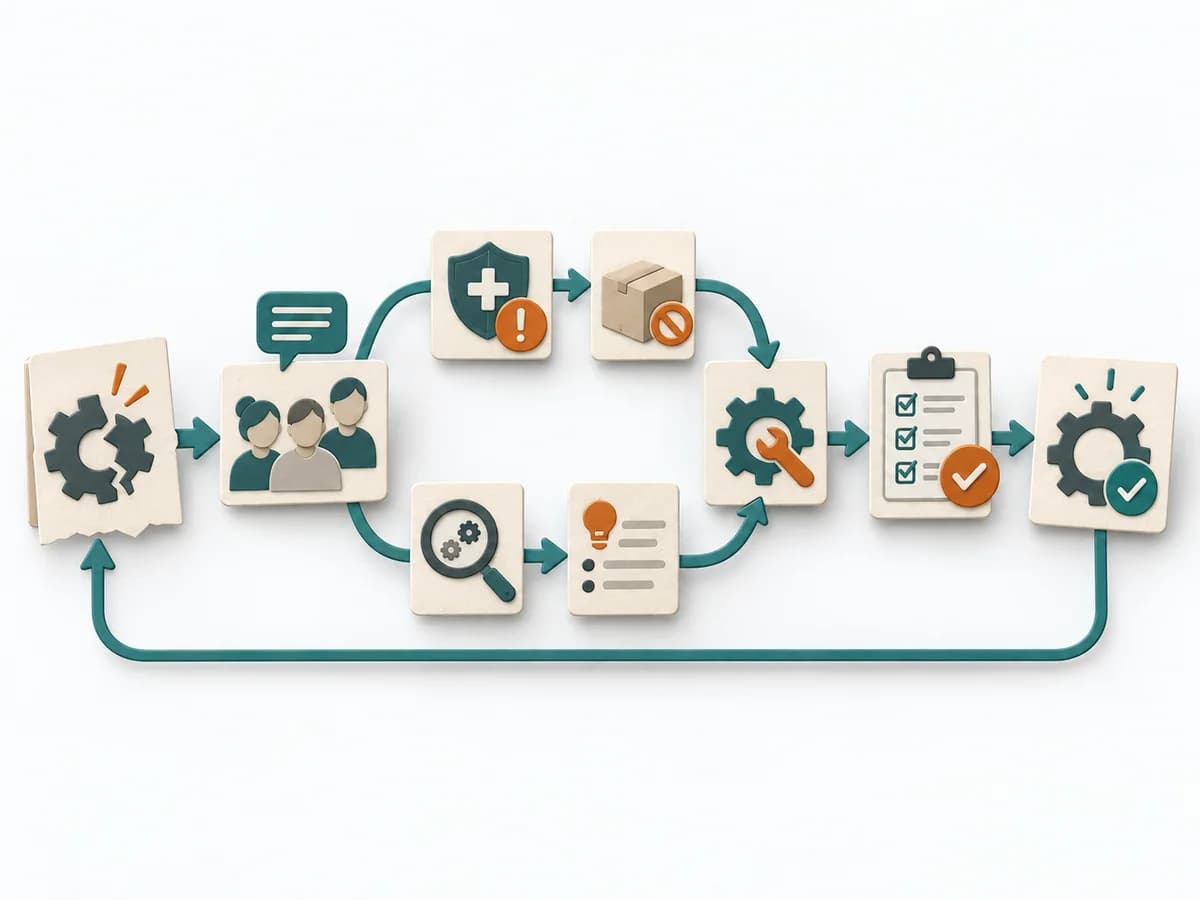
## 8D Problem Solving · working structure

### Mandated team
Appoint a small cross-functional team with process knowledge, authority, lead, and sponsor.

...

### 5W2H statement
Quantify the problem with 5W2H and document Is/Is-Not boundaries.

...

### Effective containment
Choose interim containment actions to protect customers; monitor effectiveness and side risk.

...

### Verified causes
Identify occurrence cause and escape point and verify both through data or reproduction.

...

### Verified correction
Select permanent corrections and quantitatively verify cause removal, risk, and customer requirement before release.

...

### Validated implementation
Roll out permanent correction, validate it, and withdraw containment in a controlled way.

...

### System prevention
Update similar processes, standards, FMEA, tests, and controls to prevent recurrence elsewhere.

...

### Closed 8D
Close result, learning, and team contribution formally; approve report and hand over long-term controls.

...

The blank worksheet contains prompts only.

[Reference · original teaching example](https://asq.org/quality-resources/eight-disciplines-8d)


## D1 Team: Mandated team
Expected artifact: Mandated team

Appoint a small cross-functional team with process knowledge, authority, lead, and sponsor.

Entry:

...

- [ ] Does the team cover occurrence, detection, and customer impact?

## D2 Problem: 5W2H statement
Expected artifact: Problem statement

Quantify the problem with 5W2H and document Is/Is-Not boundaries.

Entry:

...

- [ ] Are who, what, where, when, relevance, how, and how many described without causal claim?

## D3 Contain: Effective containment
Expected artifact: Containment

Choose interim containment actions to protect customers; monitor effectiveness and side risk.

Entry:

...

- [ ] Does it protect immediately without pretending to be permanent correction?

## D4 Causes: Verified causes
Expected artifact: Cause evidence

Identify occurrence cause and escape point and verify both through data or reproduction.

Entry:

...

- [ ] Are both occurrence and non-detection proven?

## D5 Correction: Verified correction
Expected artifact: Tested correction

Select permanent corrections and quantitatively verify cause removal, risk, and customer requirement before release.

Entry:

...

- [ ] Does the correction remove the cause without unacceptable side effects?

## D6 Implement: Validated implementation
Expected artifact: Effect evidence

Roll out permanent correction, validate it, and withdraw containment in a controlled way.

Entry:

...

- [ ] Does effect persist in operation, with containment removed only afterwards?

## D7 Prevent: System prevention
Expected artifact: Prevention plan

Update similar processes, standards, FMEA, tests, and controls to prevent recurrence elsewhere.

Entry:

...

- [ ] Were similar systems and the management-system gap examined?

## D8 Recognise: Closed 8D
Expected artifact: 8D closure

Close result, learning, and team contribution formally; approve report and hand over long-term controls.

Entry:

...

- [ ] Are customer impact, effectiveness, residual actions, and team contribution transparently closed?

## Open questions and next steps

...

Method guide: https://methodatlas.meierhoff-systems.de/en/methods/8d-problem-solving/run-sheet