Complete firstClear boundary
Confirm problem significance, initiate immediate protection, and secure sponsor plus cross-functional expertise for 8D.
Without a boundary, cases, periods, or variables become mixed.
A practical method guide: clarify prerequisites and materials, understand the complete process, and look up outputs, pitfalls, and stop criteria.
What needs to be finished first
Confirm problem significance, initiate immediate protection, and secure sponsor plus cross-functional expertise for 8D.
8D report, 5W2H problem statement, containment log, occurrence and escape-point evidence, correction and prevention plan
What needs to be ready before start
8D report, 5W2H problem statement, containment log, occurrence and escape-point evidence, correction and prevention plan
8D lead · cross-functional team · process owner · customer/quality perspective · action owners
Confirm problem significance, initiate immediate protection, and secure sponsor plus cross-functional expertise for 8D.
Several days to weeks; contain immediately, implement permanent correction only after verified cause.
Prepare a workspace with D1 Team · D2 Problem · D3 Contain · D4 Causes · D5 Correction · D6 Implement · D7 Prevent · D8 Recognise; separate example from live data.
The one question this method answers
How will we safely contain a material problem, permanently remove verified occurrence and detection causes, and prevent similar cases?
Phases with goal, actions, output and pitfall
8D Problem Solving contains immediate impact while parallel analysis identifies deeper causes. Verification shows whether the selected correction actually resolves the problem.
Fictional example
Fictional values show the actual method fields.
Appoint a small cross-functional team with process knowledge, authority, lead, and sponsor.
Lead Nina; Warehouse, Checkout Engineering, Support, Quality; Operations sponsor; daily 15-minute review.
Quantify the problem with 5W2H and document Is/Is-Not boundaries.
38% checkout failures, EU production, 14 May 09:12–09:47, 214 customers; mobile app unaffected.
Choose interim containment actions to protect customers; monitor effectiveness and side risk.
Batch paused; checkout stable from 09:47; manual check every 15 minutes; Murat owns.
Identify occurrence cause and escape point and verify both through data or reproduction.
Occurrence: shared pool plus batch load, reproduced. Escape: dashboard excluded batch connections, configuration confirmed.
Select permanent corrections and quantitatively verify cause removal, risk, and customer requirement before release.
Separated pools in load test: 0.4% checkout failure, batch completes; rollback tested.
Roll out permanent correction, validate it, and withdraw containment in a controlled way.
Pools separated 21 May; two peaks stable; batch pause removed 28 May; monitoring active.
Update similar processes, standards, FMEA, tests, and controls to prevent recurrence elsewhere.
Pool isolation becomes platform standard; four batch jobs reviewed; load test added to release gate.
Close result, learning, and team contribution formally; approve report and hand over long-term controls.
Quality approves report; Support gets briefing; 90-day control to Ops; contributions recorded.
All values are fictional.
D1 Team
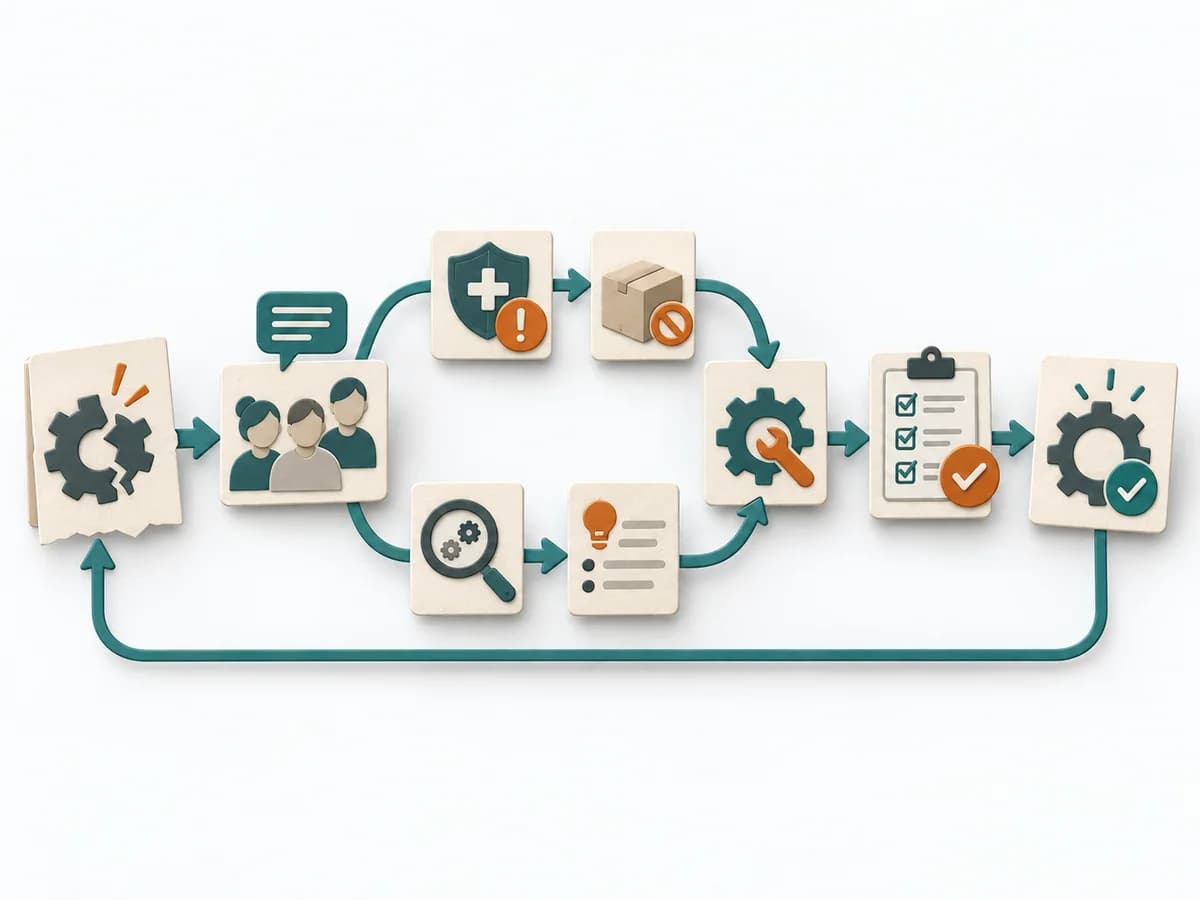
Goal
Mandated team: Appoint a small cross-functional team with process knowledge, authority, lead, and sponsor.
Inputs for this step
Actions
Output
Mandated team
Appoint a small cross-functional team with process knowledge, authority, lead, and sponsor.
Quality check
Does the team cover occurrence, detection, and customer impact?
Pitfall
Quality works alone without process authority. Add missing occurrence, detection, and decision roles.
Timing: 30–60 minutes
D2 Problem
Goal
5W2H statement: Quantify the problem with 5W2H and document Is/Is-Not boundaries.
Inputs for this step
Actions
Output
Problem statement
Quantify the problem with 5W2H and document Is/Is-Not boundaries.
Quality check
Are who, what, where, when, relevance, how, and how many described without causal claim?
Pitfall
Faulty batch is fixed as the problem statement. State observation and boundary; leave causes open for D4.
Timing: 45–90 minutes
D3 Contain
Goal
Effective containment: Choose interim containment actions to protect customers; monitor effectiveness and side risk.
Inputs for this step
Actions
Output
Containment
Choose interim containment actions to protect customers; monitor effectiveness and side risk.
Quality check
Does it protect immediately without pretending to be permanent correction?
Pitfall
Restart is treated as permanent and not monitored. Record ICA target, owner, measure, expiry, and removal condition.
Timing: Immediate until cause confirmed
D4 Causes
Goal
Verified causes: Identify occurrence cause and escape point and verify both through data or reproduction.
Inputs for this step
Actions
Output
Cause evidence
Identify occurrence cause and escape point and verify both through data or reproduction.
Quality check
Are both occurrence and non-detection proven?
Pitfall
The most plausible fishbone idea is selected without testing. Test every candidate against data, reproduction, and counterexample.
Timing: One to five days
D5 Correction
Goal
Verified correction: Select permanent corrections and quantitatively verify cause removal, risk, and customer requirement before release.
Inputs for this step
Actions
Output
Tested correction
Select permanent corrections and quantitatively verify cause removal, risk, and customer requirement before release.
Quality check
Does the correction remove the cause without unacceptable side effects?
Pitfall
The largest solution wins without verification. Pilot options against the cause and guardrails before approval.
Timing: One to three days
D6 Implement
Goal
Validated implementation: Roll out permanent correction, validate it, and withdraw containment in a controlled way.
Inputs for this step
Actions
Output
Effect evidence
Roll out permanent correction, validate it, and withdraw containment in a controlled way.
Quality check
Does effect persist in operation, with containment removed only afterwards?
Pitfall
Containment ends at deployment rather than after evidence. Set validation window and removal criterion before rollout.
Timing: One to four weeks
D7 Prevent
Goal
System prevention: Update similar processes, standards, FMEA, tests, and controls to prevent recurrence elsewhere.
Inputs for this step
Actions
Output
Prevention plan
Update similar processes, standards, FMEA, tests, and controls to prevent recurrence elsewhere.
Quality check
Were similar systems and the management-system gap examined?
Pitfall
Only the affected service is patched. Extend shared cause and escape control to similar products and processes.
Timing: One to three weeks
D8 Recognise
Goal
Closed 8D: Close result, learning, and team contribution formally; approve report and hand over long-term controls.
Inputs for this step
Actions
Output
8D closure
Close result, learning, and team contribution formally; approve report and hand over long-term controls.
Quality check
Are customer impact, effectiveness, residual actions, and team contribution transparently closed?
Pitfall
Case closes without handover once failures disappear. Record approval, residual controls, communication, and recognition.
Timing: 30–60 minutes
What comes out at the end
Sketch: what the artifact looks like
Complete 8D report with team, 5W2H, containment, verified causes, permanent corrections, prevention, and recognition.
Record date, owner, source state, and review date; preserve prior versions.
Set subject, evidence, roles, flow, and review.
To be confirmed
To be confirmed
Whole initiative Time: Several days to weeks; contain immediately, implement permanent correction only after verified cause.
Complete this worksheet on paper or in your own document during the work.
Appoint a small cross-functional team with process knowledge, authority, lead, and sponsor.
...
Quantify the problem with 5W2H and document Is/Is-Not boundaries.
...
Choose interim containment actions to protect customers; monitor effectiveness and side risk.
...
Identify occurrence cause and escape point and verify both through data or reproduction.
...
Select permanent corrections and quantitatively verify cause removal, risk, and customer requirement before release.
...
Roll out permanent correction, validate it, and withdraw containment in a controlled way.
...
Update similar processes, standards, FMEA, tests, and controls to prevent recurrence elsewhere.
...
Close result, learning, and team contribution formally; approve report and hand over long-term controls.
...
The blank worksheet contains prompts only.
Reference · original teaching example
Expected artifact: Mandated team
Appoint a small cross-functional team with process knowledge, authority, lead, and sponsor.
Entry:
...
Expected artifact: Problem statement
Quantify the problem with 5W2H and document Is/Is-Not boundaries.
Entry:
...
Expected artifact: Containment
Choose interim containment actions to protect customers; monitor effectiveness and side risk.
Entry:
...
Expected artifact: Cause evidence
Identify occurrence cause and escape point and verify both through data or reproduction.
Entry:
...
Expected artifact: Tested correction
Select permanent corrections and quantitatively verify cause removal, risk, and customer requirement before release.
Entry:
...
Expected artifact: Effect evidence
Roll out permanent correction, validate it, and withdraw containment in a controlled way.
Entry:
...
Expected artifact: Prevention plan
Update similar processes, standards, FMEA, tests, and controls to prevent recurrence elsewhere.
Entry:
...
Expected artifact: 8D closure
Close result, learning, and team contribution formally; approve report and hand over long-term controls.
Entry:
...
...
Method guide: https://methodatlas.meierhoff-systems.de/en/methods/8d-problem-solving/run-sheet
Concrete filled scenario, fictional example
Fictional example for orientation. Counts and timings describe this case and are not universal requirements.
Concrete filled scenario, fictional example
Lead Nina; Warehouse, Checkout Engineering, Support, Quality; Operations sponsor; daily 15-minute review.
38% checkout failures, EU production, 14 May 09:12–09:47, 214 customers; mobile app unaffected.
Batch paused; checkout stable from 09:47; manual check every 15 minutes; Murat owns.
Occurrence: shared pool plus batch load, reproduced. Escape: dashboard excluded batch connections, configuration confirmed.
Separated pools in load test: 0.4% checkout failure, batch completes; rollback tested.
Pools separated 21 May; two peaks stable; batch pause removed 28 May; monitoring active.
Pool isolation becomes platform standard; four batch jobs reviewed; load test added to release gate.
Quality approves report; Support gets briefing; 90-day control to Ops; contributions recorded.
Recognize symptoms and steer against them
Quick overview, the full text is in the matching phase in the flow
Quality works alone without process authority.
Add missing occurrence, detection, and decision roles.
Faulty batch is fixed as the problem statement.
State observation and boundary; leave causes open for D4.
Restart is treated as permanent and not monitored.
Record ICA target, owner, measure, expiry, and removal condition.
The most plausible fishbone idea is selected without testing.
Test every candidate against data, reproduction, and counterexample.
The largest solution wins without verification.
Pilot options against the cause and guardrails before approval.
Containment ends at deployment rather than after evidence.
Set validation window and removal criterion before rollout.
Only the affected service is patched.
Extend shared cause and escape control to similar products and processes.
Case closes without handover once failures disappear.
Record approval, residual controls, communication, and recognition.
When to pause, resolve prerequisites, or choose another approach
Go to the profile for purpose, similar methods, and sources or continue to the next method in the catalog.