Complete firstClear boundary
Define the top event as an observable failure with system boundary, operating state, and time horizon.
Without a boundary, cases, periods, or variables become mixed.
A practical method guide: clarify prerequisites and materials, understand the complete process, and look up outputs, pitfalls, and stop criteria.
What needs to be finished first
Define the top event as an observable failure with system boundary, operating state, and time horizon.
Precise top event, system boundary and operating state, architecture and failure data, AND/OR gate notation, evidence register
What needs to be ready before start
Precise top event, system boundary and operating state, architecture and failure data, AND/OR gate notation, evidence register
FTA lead · system architecture · reliability/safety · component experts · control owners
Define the top event as an observable failure with system boundary, operating state, and time horizon.
One to three working days for a bounded tree; add expert and evidence review.
Prepare a workspace with Top event · Gates · Decompose · Cut sets · Controls; separate example from live data.
The one question this method answers
Which individual or combined basic events are logically sufficient to produce the defined top event?
Phases with goal, actions, output and pitfall
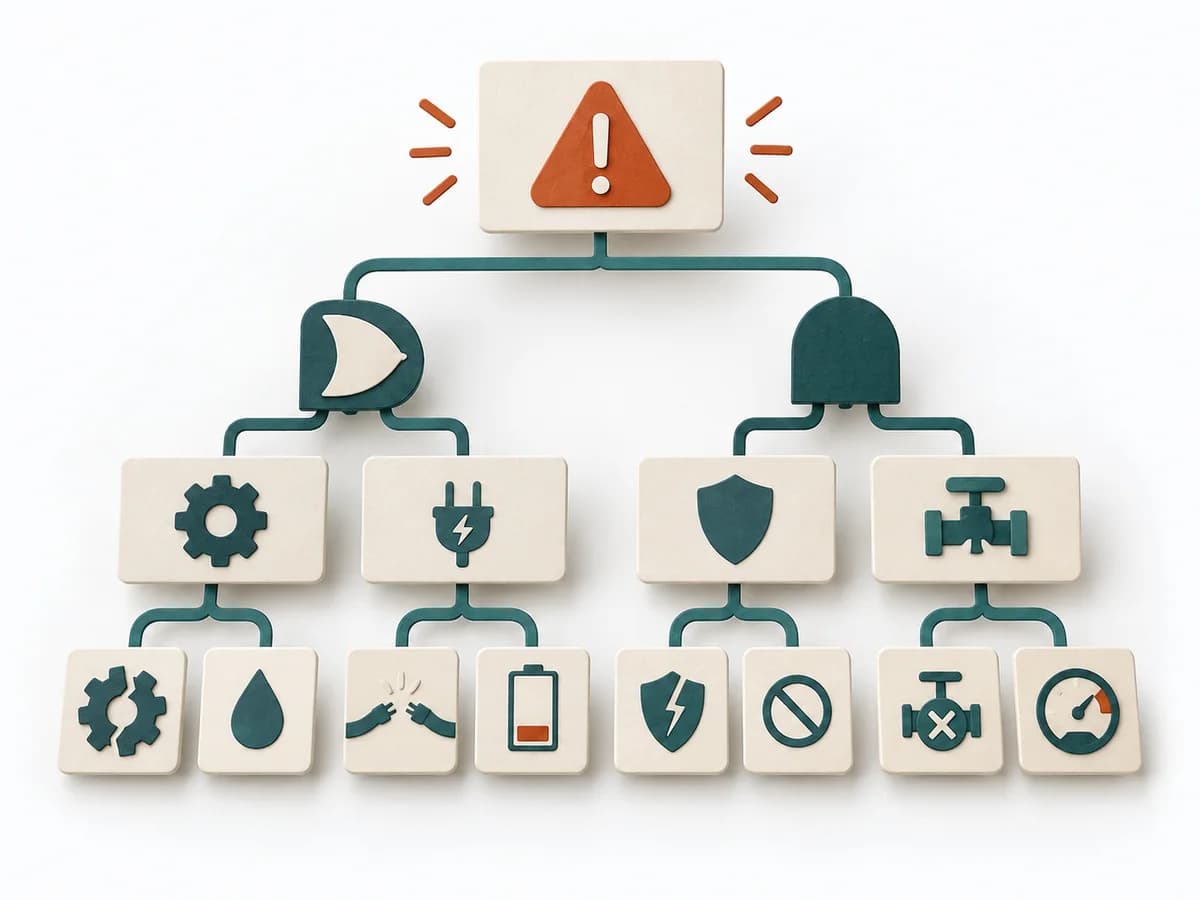
Fault tree analysis decomposes a top event into logical combinations of individual and combined failures. The structure shows where redundant protections hold and where a small gap becomes critical.
Fictional example
Fictional values show the actual method fields.
State the undesired event precisely and without a solution, including system state and boundary.
Top event: reserved pickup cannot be completed Saturday between 09:00 and 12:00.
Arrange immediate causes beneath the top event and choose AND or OR from actual logic.
Top = OR [payment unavailable, unit not handoff-ready]. Handoff-ready failure = OR [not found, not released].
Expand intermediate events to controllable basic events or justified development boundaries.
Payment unavailable = AND [terminal offline, no manual fallback]. Terminal offline = OR [network outage, device fault].
Derive minimal event combinations whose occurrence logically produces the top event; identify shared events.
Cut sets: {unit not found}; {not released}; {terminal offline + no fallback}.
Prioritise controls against single events and combinations; test effect and remaining paths.
Fallback payment breaks the payment combination; scan requirement addresses not found; owner and test date recorded.
All values are fictional.
Top event
Goal
Defined top event: State the undesired event precisely and without a solution, including system state and boundary.
Inputs for this step
Actions
Output
Defined top event
State the undesired event precisely and without a solution, including system state and boundary.
Quality check
Is the top event binary-testable and bound to an operating state?
Pitfall
Bad pickup system is neither binary nor bounded. Add failure state, system, period, and success criterion.
Timing: 30–45 minutes
Gates
Goal
First logic level: Arrange immediate causes beneath the top event and choose AND or OR from actual logic.
Inputs for this step
Actions
Output
First logic level
Arrange immediate causes beneath the top event and choose AND or OR from actual logic.
Quality check
Does OR mean one input suffices and AND mean all inputs are jointly required?
Pitfall
AND is chosen because factors belong together although either alone suffices. Write a truth sentence for every gate and test counterexamples.
Timing: 45–75 minutes
Decompose
Goal
Evidence-backed tree: Expand intermediate events to controllable basic events or justified development boundaries.
Inputs for this step
Actions
Output
Evidence-backed tree
Expand intermediate events to controllable basic events or justified development boundaries.
Quality check
Are basic events concrete, independently understandable, and labelled by evidence or assumption?
Pitfall
A branch ends at human error without an observable state. Phrase a concrete state and state its control and evidence boundary.
Timing: 2–6 hours
Cut sets
Goal
Minimal cut sets: Derive minimal event combinations whose occurrence logically produces the top event; identify shared events.
Inputs for this step
Actions
Output
Minimal cut sets
Derive minimal event combinations whose occurrence logically produces the top event; identify shared events.
Quality check
Are cut sets minimal and derivable from documented gate logic?
Pitfall
Frequent events are called critical paths without logical derivation. Evaluate Boolean paths and remove every non-minimal superset.
Timing: 45–90 minutes
Controls
Goal
Control plan: Prioritise controls against single events and combinations; test effect and remaining paths.
Inputs for this step
Actions
Output
Control plan
Prioritise controls against single events and combinations; test effect and remaining paths.
Quality check
Does each priority control break a relevant cut set while residual logic stays visible?
Pitfall
Only the most frequent event is treated while a single-event path remains open. Check controls against every cut set and record remaining single and combined paths.
Timing: 45–75 minutes
What comes out at the end
Sketch: what the artifact looks like
Reviewed fault tree with AND/OR logic, basic events, minimal cut sets, evidence, and prioritised controls.
Record date, owner, source state, and review date; preserve prior versions.
Set subject, evidence, roles, flow, and review.
To be confirmed
To be confirmed
Whole initiative Time: One to three working days for a bounded tree; add expert and evidence review.
Complete this worksheet on paper or in your own document during the work.
State the undesired event precisely and without a solution, including system state and boundary.
...
Arrange immediate causes beneath the top event and choose AND or OR from actual logic.
...
Expand intermediate events to controllable basic events or justified development boundaries.
...
Derive minimal event combinations whose occurrence logically produces the top event; identify shared events.
...
Prioritise controls against single events and combinations; test effect and remaining paths.
...
The blank worksheet contains prompts only.
Reference · original teaching example
Expected artifact: Defined top event
State the undesired event precisely and without a solution, including system state and boundary.
Entry:
...
Expected artifact: First logic level
Arrange immediate causes beneath the top event and choose AND or OR from actual logic.
Entry:
...
Expected artifact: Evidence-backed tree
Expand intermediate events to controllable basic events or justified development boundaries.
Entry:
...
Expected artifact: Minimal cut sets
Derive minimal event combinations whose occurrence logically produces the top event; identify shared events.
Entry:
...
Expected artifact: Control plan
Prioritise controls against single events and combinations; test effect and remaining paths.
Entry:
...
...
Method guide: https://methodatlas.meierhoff-systems.de/en/methods/fault-tree-analysis/run-sheet
Concrete filled scenario, fictional example
Fictional example for orientation. Counts and timings describe this case and are not universal requirements.
Concrete filled scenario, fictional example
Top event: reserved pickup cannot be completed Saturday between 09:00 and 12:00.
Top = OR [payment unavailable, unit not handoff-ready]. Handoff-ready failure = OR [not found, not released].
Payment unavailable = AND [terminal offline, no manual fallback]. Terminal offline = OR [network outage, device fault].
Cut sets: {unit not found}; {not released}; {terminal offline + no fallback}.
Fallback payment breaks the payment combination; scan requirement addresses not found; owner and test date recorded.
Recognize symptoms and steer against them
Quick overview, the full text is in the matching phase in the flow
Bad pickup system is neither binary nor bounded.
Add failure state, system, period, and success criterion.
AND is chosen because factors belong together although either alone suffices.
Write a truth sentence for every gate and test counterexamples.
A branch ends at human error without an observable state.
Phrase a concrete state and state its control and evidence boundary.
Frequent events are called critical paths without logical derivation.
Evaluate Boolean paths and remove every non-minimal superset.
Only the most frequent event is treated while a single-event path remains open.
Check controls against every cut set and record remaining single and combined paths.
When to pause, resolve prerequisites, or choose another approach
Go to the profile for purpose, similar methods, and sources or continue to the next method in the catalog.