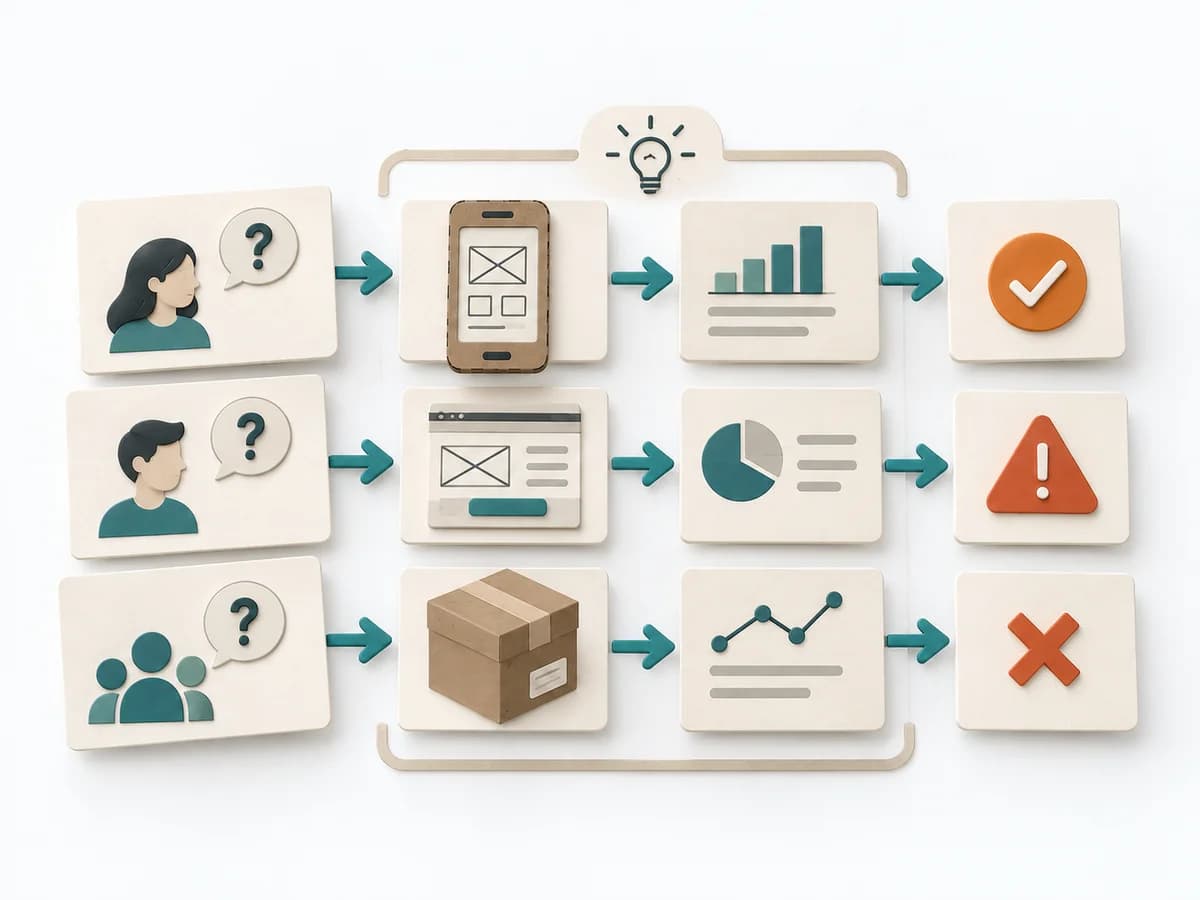
Complete firstExisting object
A concrete current solution or clear flow exists.
Without a starting object, the operators become arbitrary.
A practical method guide: clarify prerequisites and materials, understand the complete process, and look up outputs, pitfalls, and stop criteria.
What needs to be finished first
A concrete current solution or clear flow exists.
User and intended effect are named.
What needs to be ready before start
SCAMPER matrix, cards, pens, a description or model of the current solution and a timer.
Facilitator, two to ten people with usage, domain or delivery perspectives; one person documents.
Gather the current flow, relevant user signals, technical or regulatory constraints and known variants.
30–60 minutes
Prepare seven operator rows and keep the starting object visible. Park evaluation until the ideation pass is complete.
The one question this method answers
How can seven distinct directions of change improve this existing solution?
Phases with goal, actions, output and pitfall
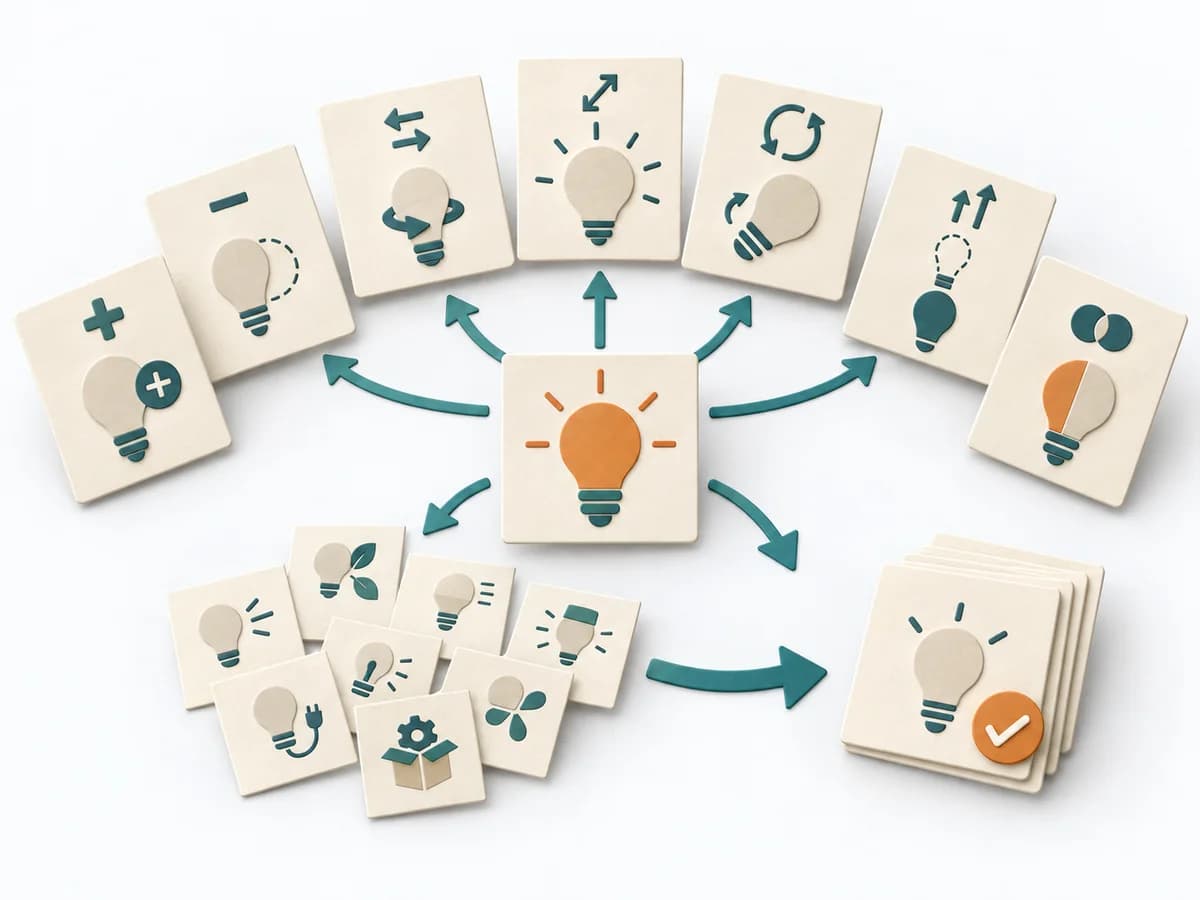
SCAMPER structures ideation around an existing object: Substitute, Combine, Adapt, Modify, Put to another use, Eliminate and Reverse/Rearrange. The operators alter concrete components and are evaluated only after the full pass.
Fictional example
Seven operators applied to a fictional course portal; the row prompt holds the question and examples show variation and expected benefit.
| Operator | Fictional variation | Expected benefit / check |
|---|---|---|
| S · SubstituteWhich component can be replaced by something better? | Replace the printed starter pack with guided in-app onboarding. | Less media switching during the first start. |
| C · CombineWhich elements create more value together? | Combine course selection and a learning-goal check in one entry. | Fewer steps to a suitable recommendation. |
| A · AdaptWhich proven solution from another context fits here? | Adapt a fitness-app progress cue to learning streaks. | More motivating progress; test acceptance with learners. |
| M · ModifyWhat can be enlarged, reduced or reweighted? | Shorten the first lesson to five minutes. | Faster first success; comprehension must not fall. |
| P · Put to another useWhat additional use can an existing component serve? | Use the final quiz as a personal learning recommendation. | Existing answers create follow-up value. |
| E · EliminateWhat can disappear without loss? | Remove mandatory profile setup before the first course. | Shorter path; profile data is collected later. |
| R · Reverse / RearrangeWhich sequence or relationship can be reversed? | Start with a sample task and offer explanation afterward. | Action before explanation; observe overload in testing. |
Variations remain unevaluated until the full pass is complete.
Baseline
Goal
One existing product, service or process becomes the object of variation.
Inputs for this step
Actions
Output
SCAMPER brief
Object · user · aim · constraints
Quality check
Is it clear which concrete component may be varied?
Pitfall
The group tries to transform an abstract problem without an existing solution. Choose a concrete object, version and observed usage context.
Timing: 5–8 minutes
Operators
Goal
All seven SCAMPER directions create targeted variations rather than free repetition.
Inputs for this step
Actions
Output
Variation pool
S · C · A · M · P · E · R
Quality check
Does every operator produce at least one distinct variation?
Pitfall
The group repeats the same favorite idea under several letters. Change the component under examination and answer the exact operator question.
Timing: 20–35 minutes
Concepts
Goal
Compatible changes are bundled into understandable whole concepts.
Inputs for this step
Actions
Output
Concept cards
Combination · benefit · assumption
Quality check
Is each concept more than a renamed single idea?
Pitfall
The shortlist contains loose thoughts without a recognizable use scenario. Connect variations into a before-and-after flow and state the expected benefit.
Timing: 8–15 minutes
Test
Goal
One concept receives a small test against its most critical assumption.
Inputs for this step
Actions
Output
Test assignment
Concept · assumption · test · signal · owner
Quality check
Does the test examine the critical assumption rather than merely implement?
Pitfall
The most creative idea becomes an implementation project without comparison. Apply criteria and define a bounded learning step first.
Timing: 5–10 minutes
What comes out at the end
Sketch: what the artifact looks like
Completed seven-operator matrix, bundled concept cards and a test assignment for one critical assumption.
Record baseline version, date and constraints; append tested variations with result and follow-up date.
Prepare the whole flow or one selected phase with real inputs.
To be confirmed
To be confirmed
Complete SCAMPER pass Time: 30–60 minutes
Complete this worksheet on paper or in your own document during the work.
| Operator | Your variations | Expected benefit and critical check |
|---|---|---|
| S · Substitute | ||
| C · Combine | ||
| A · Adapt | ||
| M · Modify | ||
| P · Put to another use | ||
| E · Eliminate | ||
| R · Reverse / Rearrange |
Capture several variations and their expected benefit per operator; cluster and select afterward.
Expected artifact: SCAMPER brief
Object · user · aim · constraints
Entry:
...
Expected artifact: Variation pool
S · C · A · M · P · E · R
Entry:
...
Expected artifact: Concept cards
Combination · benefit · assumption
Entry:
...
Expected artifact: Test assignment
Concept · assumption · test · signal · owner
Entry:
...
...
Method guide: https://methodatlas.meierhoff-systems.de/en/methods/scamper/run-sheet
Concrete filled scenario, fictional example
Fictional example for orientation. Counts and timings describe this case and are not universal requirements.
Concrete filled scenario, fictional example
Substitute: Replace the printed starter pack with guided in-app onboarding. Combine: Combine course selection with a learning-goal check. Eliminate: Remove mandatory profile setup before the first course. Reverse: Start with a sample task, explanation afterward.
Concept: “Learn immediately” combines Eliminate and Reverse. Test: Five new users start with the sample task; the signal is whether four reach the first lesson without help.
Recognize symptoms and steer against them
Quick overview, the full text is in the matching phase in the flow
The group tries to transform an abstract problem without an existing solution.
Choose a concrete object, version and observed usage context.
The group repeats the same favorite idea under several letters.
Change the component under examination and answer the exact operator question.
The shortlist contains loose thoughts without a recognizable use scenario.
Connect variations into a before-and-after flow and state the expected benefit.
The most creative idea becomes an implementation project without comparison.
Apply criteria and define a bounded learning step first.
When to pause, resolve prerequisites, or choose another approach
Go to the profile for purpose, similar methods, and sources or continue to the next method in the catalog.