Business Model Canvas: Worksheet
Prepare a model discussion or one selected step. Take your plan and blank canvas worksheet into the work.
# Business Model Canvas: Worksheet

## Question
To be confirmed

## Desired outcome
To be confirmed

## Scope
Work through one business model
Time: 60 to 120 minutes for a first draft; further appointments as needed

Complete this worksheet on paper or in your own document during the work.

## Preparation for this scope

### Method setup
- **Materials:** A large nine-field canvas, sticky notes or an editable board, pens and available customer, delivery and cost information.
- **Roles:** One person guides the model question; participants contribute customer, delivery and economic perspectives. A named owner follows up on tests.
- **Advance information:** Collect existing offer descriptions, customer observations, cost categories and revenue assumptions. Record sources and dates; leave unknowns visible.
- **Overall time needed:** A first shared draft may take 60 to 120 minutes. Research and testing are planned as additional work.
- **Setup:** Use one surface per model and one statement per note. Distinguish observations, assumptions and open questions with a written legend; use color as an additional cue.

### Prepare for the work steps

#### Scope: Frame the model
- An offer or model idea
- A concrete decision question

#### Value: Connect customers and value
- Insights about one customer segment
- Existing offers and touchpoints

#### Delivery: Describe delivery
- Customer side of the canvas
- Knowledge of fulfillment and support

#### Coherence: Check economic logic
- Customer and operational model sides
- Known cost categories and payment assumptions

#### Learning: Test critical assumptions
- A coherent canvas
- Labeled assumptions and open questions


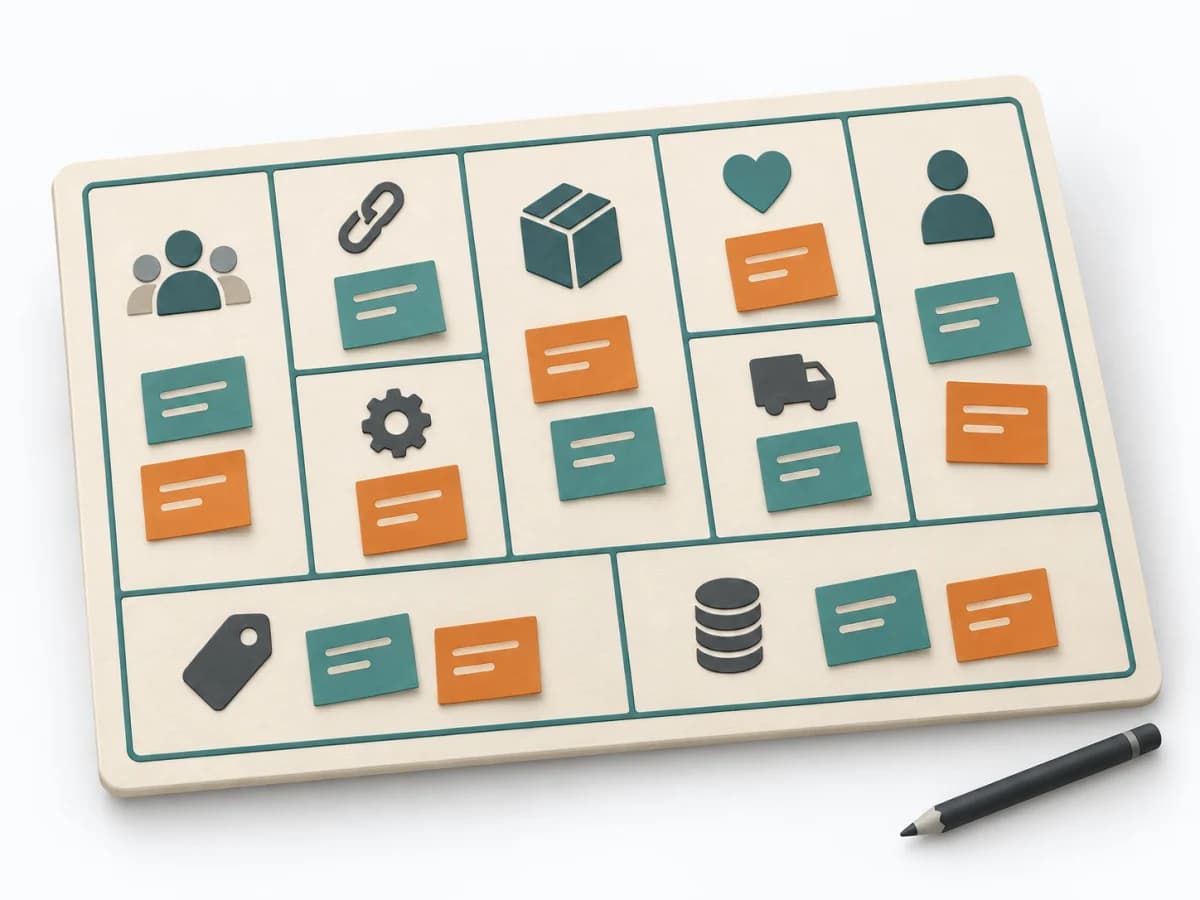
## The canvas as a connected model

### Key Partners
Who enables delivery?

...

### Key Activities
What must reliably happen?

...

### Key Resources
Which resources are required?

...

### Value Propositions
What value does the segment receive?

...

### Customer Relationships
How is the relationship created and maintained?

...

### Channels
How do customers find and receive the offer?

...

### Customer Segments
For whom is value created?

...

### Cost Structure
What costs does the model incur?

...

### Revenue Streams
Who pays for what, and how?

...

[Business Model Canvas by Strategyzer · original educational rendering](https://www.strategyzer.com/library/the-business-model-canvas)


## Scope: Frame the model
Expected artifact: Model frame

Purpose · scope · segment · version

Entry:

...

- [ ] Is the model being described clear?
- [ ] Can the group name the open decision?

## Value: Connect customers and value
Expected artifact: Customer side of the canvas

Segment · value · channel · relationship

Entry:

...

- [ ] Does the value proposition fit the segment?
- [ ] Can customer evidence be distinguished from team assumptions?

## Delivery: Describe delivery
Expected artifact: Operational side of the model

Activity · resource · partner contribution

Entry:

...

- [ ] Can the promised service be delivered this way?
- [ ] Are critical dependencies visible?

## Coherence: Check economic logic
Expected artifact: Coherent canvas

Paying customer · payment logic · cost drivers · unknown quantities

Entry:

...

- [ ] Does revenue fit the service and segment?
- [ ] Are effort and major cost drivers covered?

## Learning: Test critical assumptions
Expected artifact: Prioritized test plan

Assumption · test · decision criterion · owner · date

Entry:

...

- [ ] Does the test address a critical model assumption?
- [ ] Is it clear how its result could change the canvas?

## Open questions and next steps

...

Method guide: https://methodatlas.meierhoff-systems.de/en/methods/business-model-canvas/run-sheet
Value Chain Analysis: Worksheet
Plan Value Chain Analysis around its domain steps and the concrete decision question.
# Value Chain Analysis: Worksheet

## Question
To be confirmed

## Desired outcome
To be confirmed

## Scope
Full workshop
Time: 90–120 minutes

Complete this worksheet on paper or in your own document during the work.

## Preparation for this scope

### Method setup
- **Materials:** Defined offer and segment, Activity and cost data, Customer value and process knowledge, shared workspace, source links, and decision log.
- **Roles:** Business owner · Operations · Finance · Customer/Product · function owners
- **Advance information:** Collect Defined offer and segment, Activity and cost data, Customer value and process knowledge in advance and mark open assumptions.
- **Overall time needed:** 90–120 minutes
- **Setup:** Prepare primary and support activities with cost/value drivers and linkages visibly and calibrate assessment terms before starting.

### Prepare for the work steps

#### Set boundary: Set boundary
- Defined offer and segment
- Activity and cost data
- Customer value and process knowledge

#### Map activities: Map activities
- analysis boundary
- Activity and cost data
- Customer value and process knowledge

#### Analyse drivers: Analyse drivers
- activity chain
- Activity and cost data
- Customer value and process knowledge

#### Choose options: Choose options
- driver analysis
- Activity and cost data
- Customer value and process knowledge


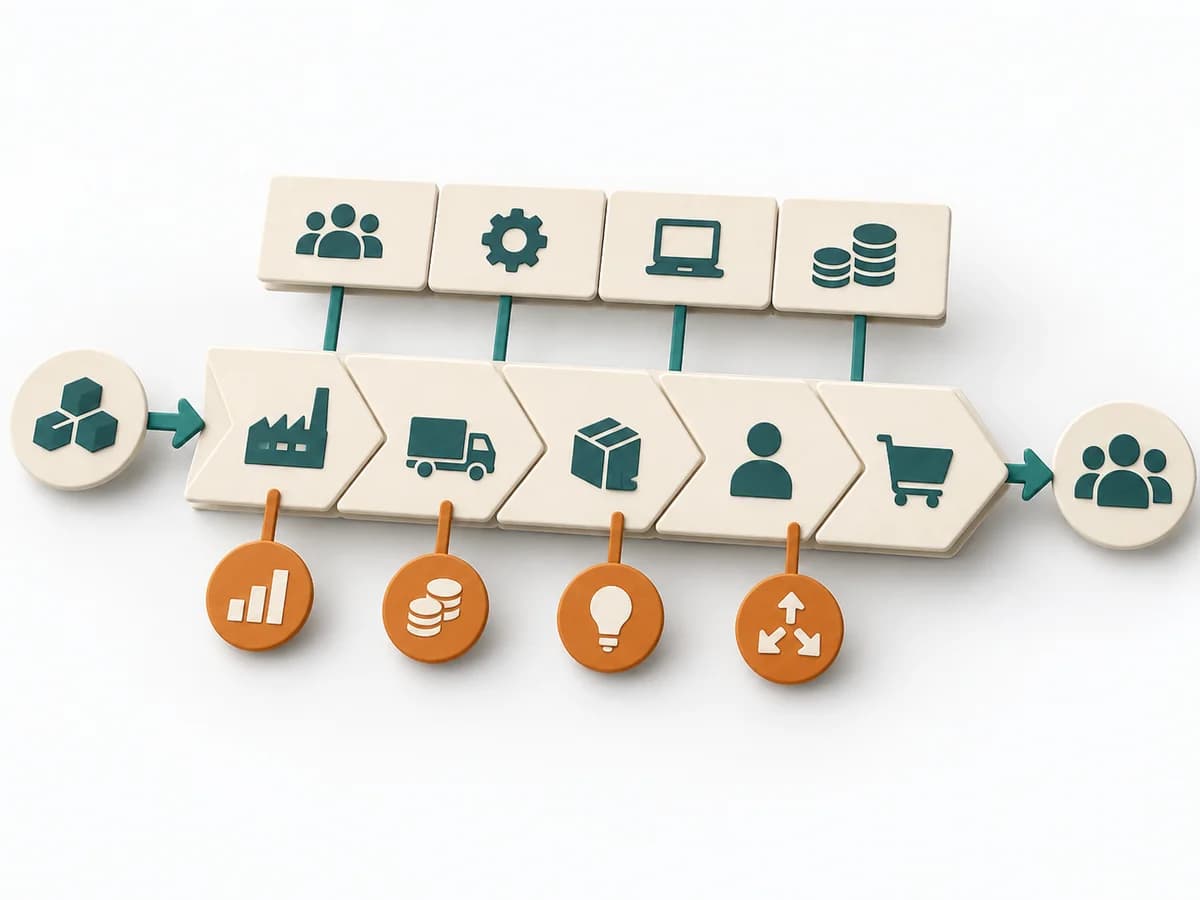
## value chain map

### Business and customer
Offer · segment · boundary

...

### Primary activities
Inbound · Operations · Outbound · Sales · Service

...

### Support activities
Infrastructure · HR · Technology · Procurement

...

### Drivers and linkage
Data · effect · linked activity

...

### Strategic option
Change · trade-off · metric

...

Enter only real input, sources, and decisions.

[Harvard Business School: The Value Chain](https://www.isc.hbs.edu/strategy/business-strategy/Pages/the-value-chain.aspx)


## Set boundary: Set boundary
Expected artifact: analysis boundary

analysis boundary · source · uncertainty · next decision

Entry:

...

- [ ] Is it clear whose value and margin are analysed?

## Map activities: Map activities
Expected artifact: activity chain

activity chain · source · uncertainty · next decision

Entry:

...

- [ ] Are activities described rather than departments?

## Analyse drivers: Analyse drivers
Expected artifact: driver analysis

driver analysis · source · uncertainty · next decision

Entry:

...

- [ ] Is the path from driver to cost or value visible?

## Choose options: Choose options
Expected artifact: intervention portfolio

intervention portfolio · source · uncertainty · next decision

Entry:

...

- [ ] Does the option improve system margin or differentiation?

## Open questions and next steps

...

Method guide: https://methodatlas.meierhoff-systems.de/en/methods/value-chain-analysis/run-sheet
VRIO Framework: Worksheet
Plan VRIO Framework around its domain steps and the concrete decision question.
# VRIO Framework: Worksheet

## Question
To be confirmed

## Desired outcome
To be confirmed

## Scope
Full workshop
Time: 60–90 minutes

Complete this worksheet on paper or in your own document during the work.

## Preparation for this scope

### Method setup
- **Materials:** Resource inventory, competitor and substitution data, organisation data, shared workspace, source links, and decision log.
- **Roles:** Strategy · resource owner · Finance · People/Operations
- **Advance information:** Collect Resource inventory, competitor and substitution data, organisation data in advance and mark open assumptions.
- **Overall time needed:** 60–90 minutes
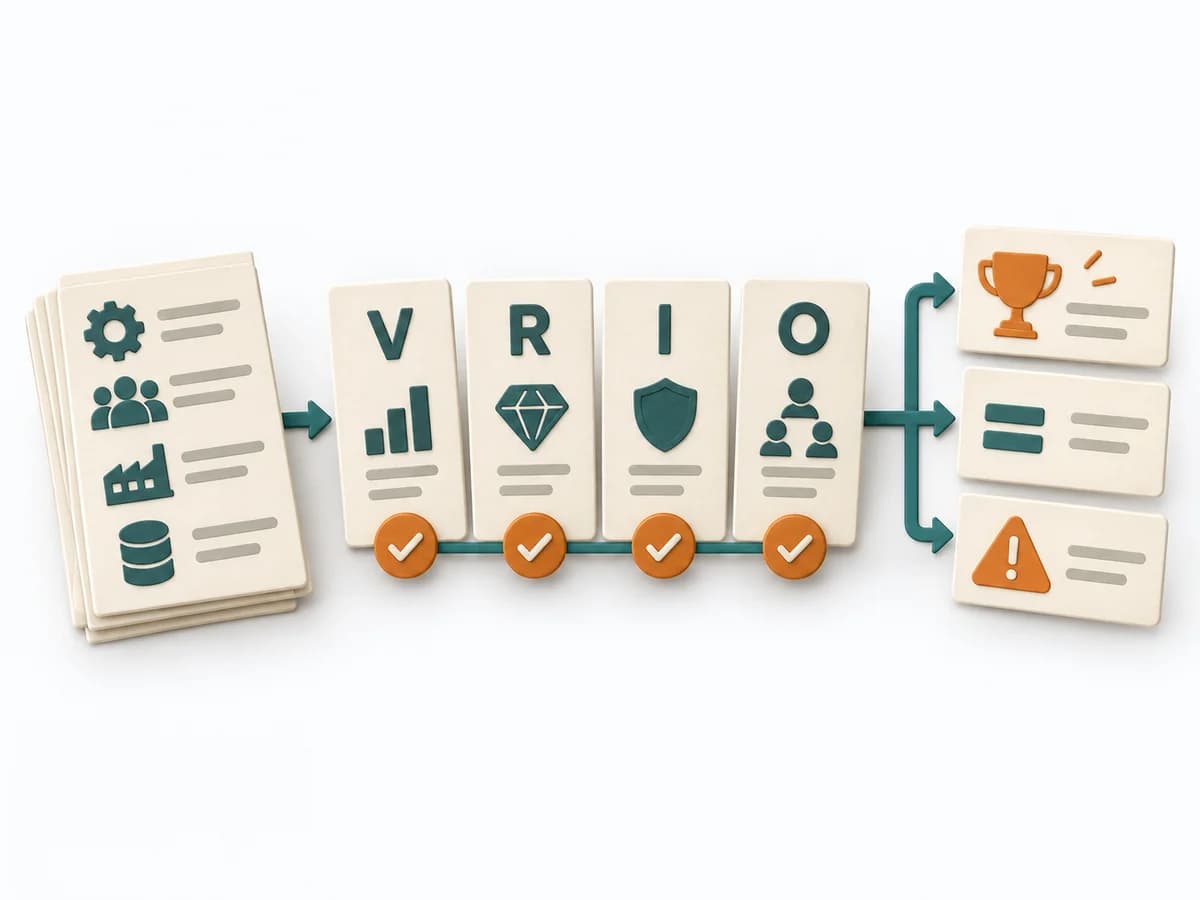
- **Setup:** Prepare sequential V-R-I-O assessment with evidence and competitive implication visibly and calibrate assessment terms before starting.

### Prepare for the work steps

#### Bound resource: Bound resource
- Resource inventory
- competitor and substitution data
- organisation data

#### Test value: Test value
- resource profile
- competitor and substitution data
- organisation data

#### Rarity/imitation: Rarity/imitation
- value evidence
- competitor and substitution data
- organisation data

#### Test organisation: Test organisation
- competitive comparison
- competitor and substitution data
- organisation data


## VRIO assessment

| Subject | Unit · control · context | Causal path · metric · evidence | Comparison · substitutes · imitation cost | Process · rights · governance |
| --- | --- | --- | --- | --- |
| VRIO assessment |   |   |   |   |

- **VRIO assessment:** Worked example

Enter only real input, sources, and decisions.

[Jay Barney: Firm Resources and Sustained Competitive Advantage](https://doi.org/10.1177/014920639101700108)


## Bound resource: Bound resource
Expected artifact: resource profile

resource profile · source · uncertainty · next decision

Entry:

...

- [ ] Is the resource controllable and concrete?

## Test value: Test value
Expected artifact: value evidence

value evidence · source · uncertainty · next decision

Entry:

...

- [ ] Is the causal path measurable?

## Rarity/imitation: Rarity/imitation
Expected artifact: competitive comparison

competitive comparison · source · uncertainty · next decision

Entry:

...

- [ ] Are comparator group and horizon clear?

## Test organisation: Test organisation
Expected artifact: VRIO implication

VRIO implication · source · uncertainty · next decision

Entry:

...

- [ ] Does the implication follow from all four tests?

## Open questions and next steps

...

Method guide: https://methodatlas.meierhoff-systems.de/en/methods/vrio-framework/run-sheet
Business Model Stress Test: Worksheet
Plan Business Model Stress Test around its domain steps and the concrete decision question.
# Business Model Stress Test: Worksheet

## Question
To be confirmed

## Desired outcome
To be confirmed

## Scope
Full workshop
Time: 90 minutes

Complete this worksheet on paper or in your own document during the work.

## Preparation for this scope

### Method setup
- **Materials:** Current business model, critical assumptions, environmental and market data, shared workspace, source links, and decision log.
- **Roles:** Business owner · Finance · Product · market expert
- **Advance information:** Collect Current business model, critical assumptions, environmental and market data in advance and mark open assumptions.
- **Overall time needed:** 90 minutes
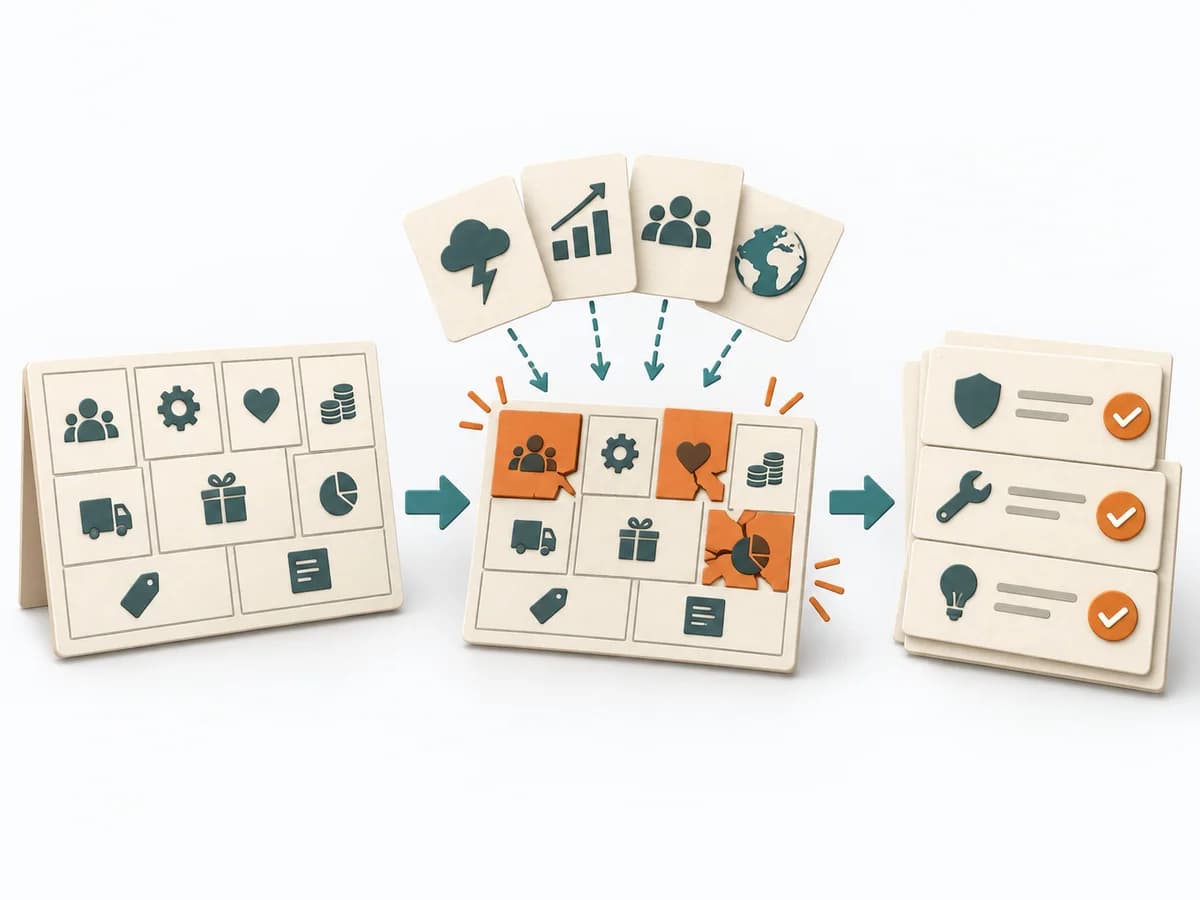
- **Setup:** Prepare scenario, canvas building block, impact chain, exposure, and response visibly and calibrate assessment terms before starting.

### Prepare for the work steps

#### Frame stressor: Frame stressor
- Current business model
- critical assumptions
- environmental and market data

#### Trace impact: Trace impact
- stress scenario
- critical assumptions
- environmental and market data

#### Assess exposure: Assess exposure
- impact chain
- critical assumptions
- environmental and market data

#### Design response: Design response
- exposure profile
- critical assumptions
- environmental and market data


## business model stress map

| Subject | Trigger · horizon · indicator | Affected element · dependency | Chain · metric · buffer | Option · trigger · test |
| --- | --- | --- | --- | --- |
| business model stress map |   |   |   |   |

- **business model stress map:** Worked example

Enter only real input, sources, and decisions.

[Strategyzer: Assessment Questions for Leaders](https://www.strategyzer.com/library/nine-questions-to-assess-your-business-model-design)


## Frame stressor: Frame stressor
Expected artifact: stress scenario

stress scenario · source · uncertainty · next decision

Entry:

...

- [ ] Is the stressor plausible and observable?

## Trace impact: Trace impact
Expected artifact: impact chain

impact chain · source · uncertainty · next decision

Entry:

...

- [ ] Are direct and indirect effects separated?

## Assess exposure: Assess exposure
Expected artifact: exposure profile

exposure profile · source · uncertainty · next decision

Entry:

...

- [ ] Does evidence support the assessment?

## Design response: Design response
Expected artifact: adaptation test

adaptation test · source · uncertainty · next decision

Entry:

...

- [ ] Does the option have an owner, trigger, and learning goal?

## Open questions and next steps

...

Method guide: https://methodatlas.meierhoff-systems.de/en/methods/business-model-stress-test/run-sheet