Complete firstOne model and one decision
The offer, customer segment and decision question are bounded. Current and proposed models are labeled separately.
Mixing several models hides which revenue belongs to which service and customer.
A practical method guide: clarify prerequisites and materials, understand the complete process, and look up outputs, pitfalls, and stop criteria.
What needs to be finished first
The offer, customer segment and decision question are bounded. Current and proposed models are labeled separately.
Knowledge about customers, delivery and economic assumptions is available, or missing knowledge is explicitly recorded.
What needs to be ready before start
A large nine-field canvas, sticky notes or an editable board, pens and available customer, delivery and cost information.
One person guides the model question; participants contribute customer, delivery and economic perspectives. A named owner follows up on tests.
Collect existing offer descriptions, customer observations, cost categories and revenue assumptions. Record sources and dates; leave unknowns visible.
A first shared draft may take 60 to 120 minutes. Research and testing are planned as additional work.
Use one surface per model and one statement per note. Distinguish observations, assumptions and open questions with a written legend; use color as an additional cue.
The one question this method answers
How does this business model create, deliver and capture value, and which assumption could challenge it first?
Phases with goal, actions, output and pitfall
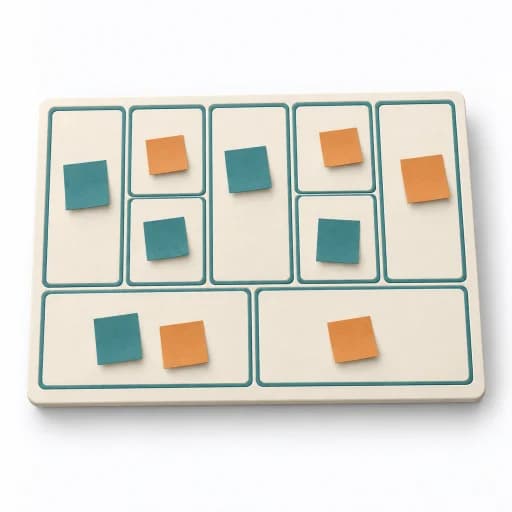
The Business Model Canvas connects customer value, delivery, and economic logic. It makes the assumptions for the next investigation explicit.
Fictional example · untested assumptions
Fictional example: neighborhood tool rental. All entries are model assumptions used for explanation.
Who enables delivery?
Local repair services and tool suppliers
What must reliably happen?
Organize collection, returns and maintenance
Which resources are required?
Tool stock, storage space and a booking overview
What value does the segment receive?
Reliably borrow suitable tools by the day
How is the relationship created and maintained?
Personal instructions and accessible support
How do customers find and receive the offer?
Local website, reservations and collection point
For whom is value created?
Neighborhood households with occasional tool needs
What costs does the model incur?
Purchasing, maintenance, premises and support
Who pays for what, and how?
Daily rental fees; membership as another hypothesis
Business Model Canvas by Strategyzer · original educational rendering
Scope
Goal
Everyone works on the same business model.
Inputs for this step
Actions
Output
Model frame
Purpose · scope · segment · version
Quality check
Is the model being described clear? Can the group name the open decision?
Pitfall
Several offers or proposed models end up on one canvas. Choose one alternative and create separate canvases for the others.
Timing: 10 to 15 minutes as a starting guide.
Value
Goal
The customer side tells a clear story.
Inputs for this step
Actions
Output
Customer side of the canvas
Segment · value · channel · relationship
Quality check
Does the value proposition fit the segment? Can customer evidence be distinguished from team assumptions?
Pitfall
The value proposition remains a generic product characteristic. Describe a concrete customer situation and the expected benefit.
Timing: 15 to 25 minutes; obtain missing customer evidence separately.
Delivery
Goal
Delivery has a traceable operational basis.
Inputs for this step
Actions
Output
Operational side of the model
Activity · resource · partner contribution
Quality check
Can the promised service be delivered this way? Are critical dependencies visible?
Pitfall
A long resource list has no clear connection to customer value. Link each major resource to a necessary activity.
Timing: 15 to 25 minutes for an initial coherence check.
Coherence
Goal
Viability can be described as a testable assumption.
Inputs for this step
Actions
Output
Coherent canvas
Paying customer · payment logic · cost drivers · unknown quantities
Quality check
Does revenue fit the service and segment? Are effort and major cost drivers covered?
Pitfall
A completed canvas is already treated as a viable business. Test willingness to pay and economic quantities using suitable evidence.
Timing: 15 to 25 minutes; reliable calculations require additional work.
Learning

Goal
The most important uncertainty has a testable follow-up.
Inputs for this step
Actions
Output
Prioritized test plan
Assumption · test · decision criterion · owner · date
Quality check
Does the test address a critical model assumption? Is it clear how its result could change the canvas?
Pitfall
Many tests are collected without preparing a next decision. Choose one priority assumption and the associated decision criterion.
Timing: 10 to 20 minutes for planning; run the test separately.
What comes out at the end
Sketch: what the artifact looks like
A dated canvas containing its purpose, segments, nine connected fields, source notes, open assumptions and a prioritized test plan.
Give each version a date, scope and owner. Link changes to new observations or decisions and retain comparison versions.
Prepare a model discussion or one selected step. Take your plan and blank canvas worksheet into the work.
To be confirmed
To be confirmed
Work through one business model Time: 60 to 120 minutes for a first draft; further appointments as needed
Complete this worksheet on paper or in your own document during the work.
Who enables delivery?
...
What must reliably happen?
...
Which resources are required?
...
What value does the segment receive?
...
How is the relationship created and maintained?
...
How do customers find and receive the offer?
...
For whom is value created?
...
What costs does the model incur?
...
Who pays for what, and how?
...
Business Model Canvas by Strategyzer · original educational rendering
Expected artifact: Model frame
Purpose · scope · segment · version
Entry:
...
Expected artifact: Customer side of the canvas
Segment · value · channel · relationship
Entry:
...
Expected artifact: Operational side of the model
Activity · resource · partner contribution
Entry:
...
Expected artifact: Coherent canvas
Paying customer · payment logic · cost drivers · unknown quantities
Entry:
...
Expected artifact: Prioritized test plan
Assumption · test · decision criterion · owner · date
Entry:
...
...
Method guide: https://methodatlas.meierhoff-systems.de/en/methods/business-model-canvas/run-sheet
Concrete filled scenario, fictional example
Fictional example for orientation. Counts and timings describe this case and are not universal requirements.
Concrete filled scenario, fictional example
Model question: Could daily tool rental work for households with occasional needs?
Connection: Reliable collection needs available stock, maintenance and support. Daily fees would need to cover the associated costs.
Critical assumption: Enough households book repeatedly. The canvas does not yet provide evidence for this.
Next test: Run a small, manually supported rental trial and observe demand and repeat bookings. Agree on continuation or revision criteria, an owner and a review date before the trial.
Recognize symptoms and steer against them
Quick overview, the full text is in the matching phase in the flow
Several offers or proposed models end up on one canvas.
Choose one alternative and create separate canvases for the others.
The value proposition remains a generic product characteristic.
Describe a concrete customer situation and the expected benefit.
A long resource list has no clear connection to customer value.
Link each major resource to a necessary activity.
A completed canvas is already treated as a viable business.
Test willingness to pay and economic quantities using suitable evidence.
Many tests are collected without preparing a next decision.
Choose one priority assumption and the associated decision criterion.
When to pause, resolve prerequisites, or choose another approach
Go to the profile for purpose, similar methods, and sources or continue to the next method in the catalog.