Complete firstConcrete application
Name the decisions and teams that the profiles should support.
Without an application, a persona can become a decorative description.
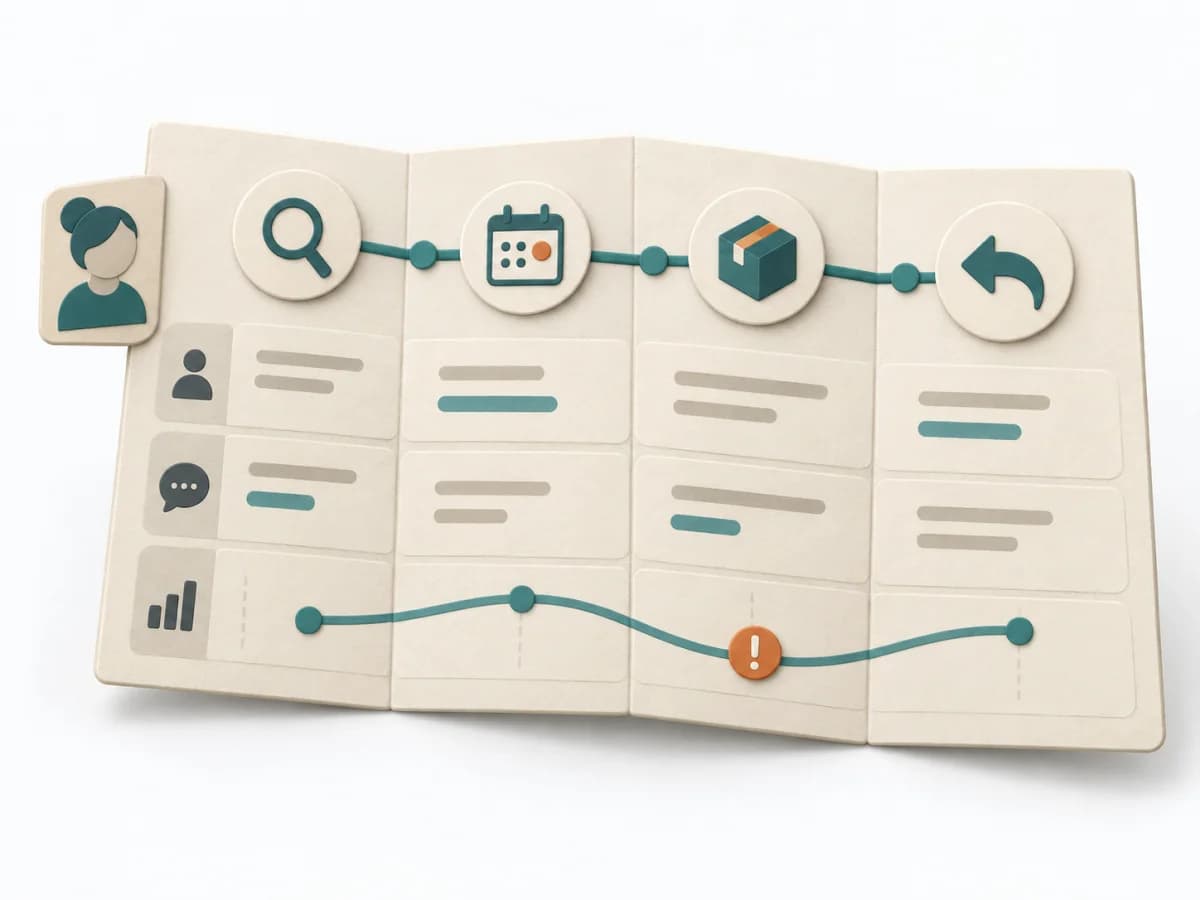
A practical method guide: clarify prerequisites and materials, understand the complete process, and look up outputs, pitfalls, and stop criteria.
What needs to be finished first
Name the decisions and teams that the profiles should support.
Qualitative and quantitative sources have traceable provenance, context, and limits.
A person or team owns source links, validity checks, and updates.
What needs to be ready before start
Interview and observation notes, usage patterns, support and service insights, source register, and decision questions.
Research lead synthesizes sources. Product and service teams check relevance and blind spots; people in direct user contact contribute counter-examples.
Gather the decision, audience, use situations, available sources, and any existing user profiles.
Multi-step initiative. Scope and duration follow available evidence, relevant behavior patterns, and the decisions to support.
Prepare a source inventory and shared pattern view. Protect personal data; clarify roles and permitted reuse.
The one question this method answers
Which recurring needs and behaviors must decisions account for, and who is not represented by the current evidence?
Phases with goal, actions, output and pitfall
Personas summarize recurring goals, behaviors, and contexts from user research. They help teams align decisions with different needs. A persona is a research representation, not a real individual or a substitute for ongoing user research.
Fictional teaching example
A compact profile with provenance, behavior pattern, needs, and limits.
Which decision and use situation should the profile support? Which group remains outside?
Fictional example: reserving neighborhood tools. The profile provisionally applies only to planning stock and pickup together.
Name sources, date, research method, sample context, and limits. Separate observation from interpretation.
Fictional note F1: one person checks opening hours before traveling. Fictional counter-example F2: another person borrows spontaneously without reserving. Both are invented; no real study was conducted.
Gather evidence for recurring goals, situations, and strategies. Do not infer stereotypes from isolated attributes.
Fictional pattern: planned borrowing. F1 describes checking opening hours; F2 shows a spontaneous loan. Two cases do not establish a stable segment.
State the need, barrier, and its evidence or open status.
Fictional synthesis: reliable stock and pickup time may support planned borrowing; counter-example F2 keeps spontaneous borrowing visible as a different situation. Open: possible barriers from opening hours.
Which decision might the pattern change? Name the assumption that needs testing.
Fictional link: show stock and pickup windows together and check whether this supports planned borrowing without obscuring spontaneous access.
Record counter-evidence, unrepresented groups, profile owner, and update triggers.
Fictional synthesis from two invented notes, not a real study and not representative. Research owner checks patterns with real research and documents additional contexts.
A persona is an evidence-linked synthesis, not a real individual.
Frame

Goal
Clarify which product decision and user group the profiles should support.
Inputs for this step
Actions
Output
Bounded persona question and evidence inventory.
Bounded persona question and evidence inventory.
Quality check
Sources are recent enough and relate to relevant use situations.
Pitfall
Personas are commissioned before enough research exists. Make evidence gaps visible and label profiles as hypotheses or segments.
Timing: Evidence inventory depends on scope
Patterns

Goal
Compare goals, situations, strategies, needs, and barriers across sources.
Inputs for this step
Actions
Output
Traceable patterns with sources and divergent cases.
Traceable patterns with sources and divergent cases.
Quality check
Patterns concern behavior or needs, not demographics or team opinion alone.
Pitfall
Demographic similarity is treated as identical user behavior. Compare tasks, contexts, and strategies; treat personal attributes as explanatory only when evidence supports them.
Timing: Synthesis time depends on sources and question
Profile

Goal
Describe goals, context, needs, and constraints for each relevant behavior pattern.
Inputs for this step
Actions
Output
Compact profile with source links, needs, barriers, and open questions.
Compact profile with source links, needs, barriers, and open questions.
Quality check
Every central claim traces to research; assumptions and quotes are clearly marked.
Pitfall
A fictional biography fills evidence gaps and looks like real knowledge. Remove biographical details or label them illustrative; never invent quotes.
Timing: Profile drafting as part of synthesis
Apply

Goal
Connect profiles to concrete product decisions and open research questions.
Inputs for this step
Actions
Output
Application notes with decision, unrepresented needs, and update requirement.
Application notes with decision, unrepresented needs, and update requirement.
Quality check
Profiles support discussion but do not replace current research or individual users’ voices.
Pitfall
The profile becomes a rigid checklist for everyone in a group. Use it as a bounded reminder of evidenced patterns and check decisions with real users.
Timing: Ongoing application; review when new evidence arrives
What comes out at the end
Sketch: what the artifact looks like
Versioned persona profiles with evidence links, needs, constraints, open questions, and documented use in decisions.
State research version, date, evidence scope, and owner. Names or images are illustrative aids and must not expose actual participants.
Plan source review, synthesis, profile creation, and actual use as a multi-step research initiative.
To be confirmed
To be confirmed
One persona synthesis initiative Time: Multi-step initiative; effort depends on sources and question, with no assumed fixed duration.
Complete this worksheet on paper or in your own document during the work.
Which decision and use situation should the profile support? Which group remains outside?
...
Name sources, date, research method, sample context, and limits. Separate observation from interpretation.
...
Gather evidence for recurring goals, situations, and strategies. Do not infer stereotypes from isolated attributes.
...
State the need, barrier, and its evidence or open status.
...
Which decision might the pattern change? Name the assumption that needs testing.
...
Record counter-evidence, unrepresented groups, profile owner, and update triggers.
...
Blank template: answer prompts and mark each claim with a source or assumption status.
Expected artifact: Bounded persona question and evidence inventory.
Bounded persona question and evidence inventory.
Entry:
...
Expected artifact: Traceable patterns with sources and divergent cases.
Traceable patterns with sources and divergent cases.
Entry:
...
Expected artifact: Compact profile with source links, needs, barriers, and open questions.
Compact profile with source links, needs, barriers, and open questions.
Entry:
...
Expected artifact: Application notes with decision, unrepresented needs, and update requirement.
Application notes with decision, unrepresented needs, and update requirement.
Entry:
...
...
Method guide: https://methodatlas.meierhoff-systems.de/en/methods/personas/run-sheet
Concrete filled scenario, fictional example
Fictional example for orientation. Counts and timings describe this case and are not universal requirements.
Concrete filled scenario, fictional example
All notes, observations, and people are invented. No real study was conducted.
Fictional sources: F1, paraphrased interview note: one person checks opening hours before traveling to the lending site. F2, paraphrased observation: another person takes an available tool spontaneously without reserving in advance.
Pattern and counter-example: F1 suggests planned borrowing; F2 shows that a spontaneous route may also occur. Two invented cases do not establish a stable user group.
Provisional need: Reliable stock and pickup-time information may help planned borrowing. Keep spontaneous access in view as a different situation.
Possible barrier: Unclear opening hours or unavailable stock might delay a planned repair. This is a hypothesis, not a collected experience.
Decision link: Show stock and pickup windows together while checking whether spontaneous availability remains clear.
Limit and next research: Compare interview and observation notes with real users. Do not infer demographic attributes or representativeness from the fictional examples.
Recognize symptoms and steer against them
Quick overview, the full text is in the matching phase in the flow
Personas are commissioned before enough research exists.
Make evidence gaps visible and label profiles as hypotheses or segments.
Demographic similarity is treated as identical user behavior.
Compare tasks, contexts, and strategies; treat personal attributes as explanatory only when evidence supports them.
A fictional biography fills evidence gaps and looks like real knowledge.
Remove biographical details or label them illustrative; never invent quotes.
The profile becomes a rigid checklist for everyone in a group.
Use it as a bounded reminder of evidenced patterns and check decisions with real users.
When to pause, resolve prerequisites, or choose another approach
Go to the profile for purpose, similar methods, and sources or continue to the next method in the catalog.