Complete firstBounded subject
The scope and purpose of NeOn Methodology are stated as a concrete question.
Without scope, NeOn project route becomes arbitrary.
A practical method guide: clarify prerequisites and materials, understand the complete process, and look up outputs, pitfalls, and stop criteria.
What needs to be finished first
The scope and purpose of NeOn Methodology are stated as a concrete question.
Ontology requirements specification, source and ontology inventory, reuse and governance goals and domain decision makers are available.
What needs to be ready before start
Ontology requirements specification, source and ontology inventory, reuse and governance goals, shared workspace, source links, and decision log.
Ontology lead · domain experts · data stewards · integration owners
Collect Ontology requirements specification, source and ontology inventory, reuse and governance goals in advance and mark open assumptions.
2–4 hours planning; initiative over multiple iterations
Prepare project-specific combination of the nine NeOn scenarios with explicit deliverables visibly and calibrate assessment terms before starting.
The one question this method answers
Which NeOn scenarios and activities lead from our sources to a maintainable ontology network?
Phases with goal, actions, output and pitfall
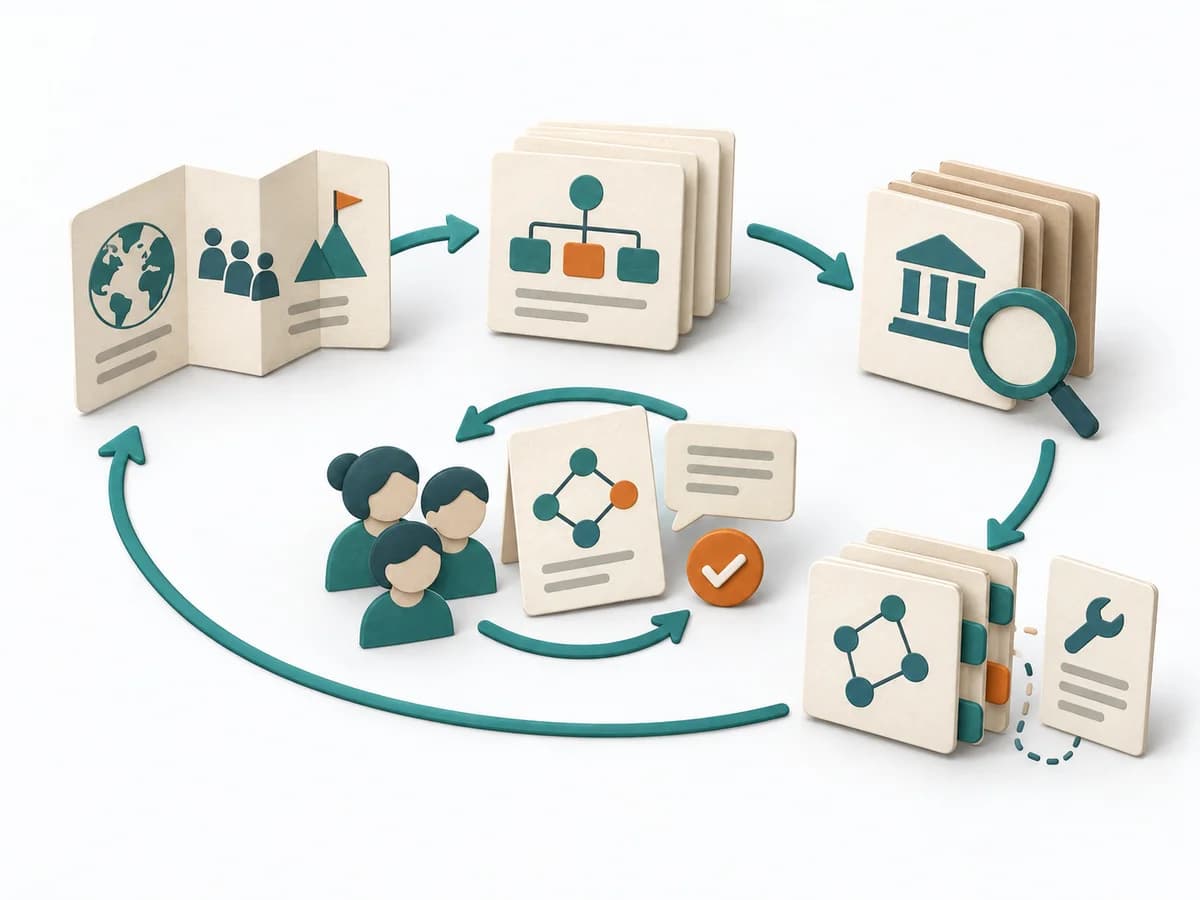
NeOn treats ontologies as networks and provides nine scenarios rather than one linear process. A project selects scenarios, outputs, dependencies, and lifecycle to fit its context.
Fictional worked example
project-specific combination of the nine NeOn scenarios with explicit deliverables as a precise working structure with a fictional example.
CQ · scope · non-goal
Project actions, no finance ontology.
Number · purpose · input
S2: reuse and re-engineer CSV; S3: reuse ORG.
Output · test · owner
Mapping tests; ontology lead.
Module · version · alignment
Reuse W3C ORG; Person↔Member mapping.
The example demonstrates the domain logic of NeOn Methodology; worksheets remain blank.
Requirements
Goal
Produce ORSD so the core question “Which NeOn scenarios and activities lead from our sources to a maintainable ontology network?” can be answered with stronger support.
Inputs for this step
Actions
Output
ORSD
ORSD · source · uncertainty · next decision
Quality check
Are competency questions and non-goals included?
Pitfall
The nine scenarios are treated as mandatory phases or assigned incorrectly. Select only needed scenarios, define entry and exit outputs, and evaluate external artefacts before adoption.
Timing: 10–20 minutes
Select scenarios
Goal
Produce scenario route so the core question “Which NeOn scenarios and activities lead from our sources to a maintainable ontology network?” can be answered with stronger support.
Inputs for this step
Actions
Output
scenario route
scenario route · source · uncertainty · next decision
Quality check
Are the nine NeOn scenarios distinguished according to the primary list?
Pitfall
The nine scenarios are treated as mandatory phases or assigned incorrectly. Select only needed scenarios, define entry and exit outputs, and evaluate external artefacts before adoption.
Timing: 10–20 minutes
Plan activities
Goal
Produce work plan so the core question “Which NeOn scenarios and activities lead from our sources to a maintainable ontology network?” can be answered with stronger support.
Inputs for this step
Actions
Output
work plan
work plan · source · uncertainty · next decision
Quality check
Does every deliverable have an acceptance criterion?
Pitfall
The nine scenarios are treated as mandatory phases or assigned incorrectly. Select only needed scenarios, define entry and exit outputs, and evaluate external artefacts before adoption.
Timing: 10–20 minutes
Govern lifecycle
Goal
Produce release route so the core question “Which NeOn scenarios and activities lead from our sources to a maintainable ontology network?” can be answered with stronger support.
Inputs for this step
Actions
Output
release route
release route · source · uncertainty · next decision
Quality check
Are dependencies and backward compatibility checked?
Pitfall
The nine scenarios are treated as mandatory phases or assigned incorrectly. Select only needed scenarios, define entry and exit outputs, and evaluate external artefacts before adoption.
Timing: 10–20 minutes
What comes out at the end
Sketch: what the artifact looks like
Versioned NeOn project route with date, sources, owners, and next review.
Retain date, source, assumption state, and decision for every version of NeOn project route.
Plan NeOn Methodology around its domain steps and the concrete decision question.
To be confirmed
To be confirmed
Full initiative Time: 2–4 hours planning; initiative over multiple iterations
Complete this worksheet on paper or in your own document during the work.
CQ · scope · non-goal
...
Number · purpose · input
...
Output · test · owner
...
Module · version · alignment
...
Enter only real input, sources, and decisions.
NeOn Methodology for Building Ontology Networks
Expected artifact: ORSD
ORSD · source · uncertainty · next decision
Entry:
...
Expected artifact: scenario route
scenario route · source · uncertainty · next decision
Entry:
...
Expected artifact: work plan
work plan · source · uncertainty · next decision
Entry:
...
Expected artifact: release route
release route · source · uncertainty · next decision
Entry:
...
...
Method guide: https://methodatlas.meierhoff-systems.de/en/methods/neon-methodology/run-sheet
Concrete filled scenario, fictional example
Fictional example for orientation. Counts and timings describe this case and are not universal requirements.
Concrete filled scenario, fictional example
Scenario 1 for the project ontology from requirements, scenario 2 to reuse and re-engineer the CSV vocabulary, scenario 3 to reuse W3C ORG, and scenario 5 to reuse and merge person ontologies. List: S1 specification; S2 non-ontology reuse/reengineering; S3 ontology reuse; S4 ontology reuse/reengineering; S5 reuse/merging; S6 reuse/merging/reengineering; S7 ODP reuse; S8 restructuring; S9 localisation. Deliverables: ORSD, reuse decision, mapping tests, and module releases.
Recognize symptoms and steer against them
Quick overview, the full text is in the matching phase in the flow
The nine scenarios are treated as mandatory phases or assigned incorrectly.
Select only needed scenarios, define entry and exit outputs, and evaluate external artefacts before adoption.
The nine scenarios are treated as mandatory phases or assigned incorrectly.
Select only needed scenarios, define entry and exit outputs, and evaluate external artefacts before adoption.
The nine scenarios are treated as mandatory phases or assigned incorrectly.
Select only needed scenarios, define entry and exit outputs, and evaluate external artefacts before adoption.
The nine scenarios are treated as mandatory phases or assigned incorrectly.
Select only needed scenarios, define entry and exit outputs, and evaluate external artefacts before adoption.
When to pause, resolve prerequisites, or choose another approach
Go to the profile for purpose, similar methods, and sources or continue to the next method in the catalog.