Complete firstFocus question
The question bounds topic, purpose and perspective.
Without focus, the result becomes an unsorted topic map.
A practical method guide: clarify prerequisites and materials, understand the complete process, and look up outputs, pitfalls, and stop criteria.
What needs to be finished first
The question bounds topic, purpose and perspective.
Sources or domain experts can test concepts and relationships.
What needs to be ready before start
Large workspace, focus question, source material, concept cards and markers for linking phrases.
People with domain knowledge, a facilitator and a documentation owner.
Focus question, context and reliable sources or observations.
60–120 minutes
Prepare the workspace from general to specific and a parking area for unconnected concepts.
The one question this method answers
Which concepts and propositions answer our focus question?
Phases with goal, actions, output and pitfall
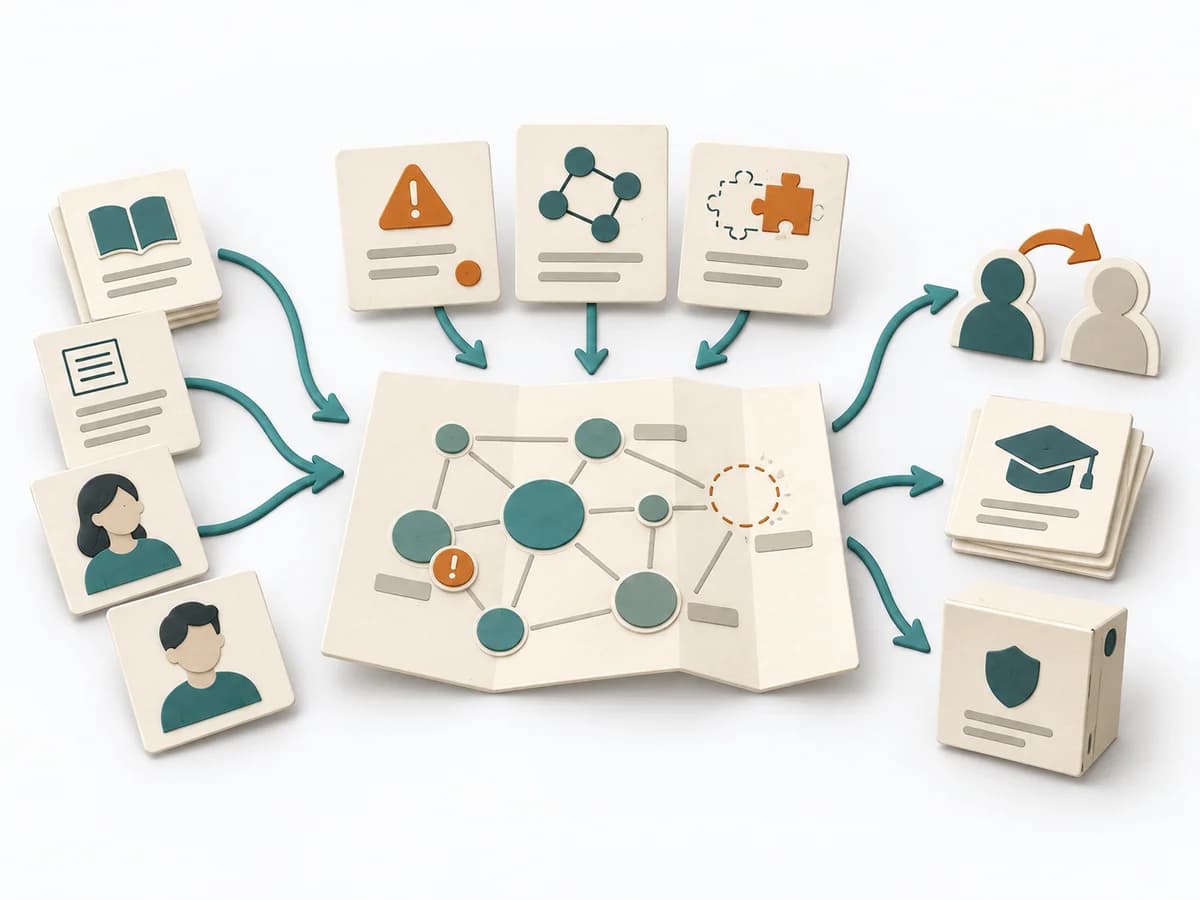
A Concept Map answers a focus question with hierarchically arranged concepts. Labelled links form readable propositions, while cross-links reveal relationships between knowledge domains.
Fictional example
The worksheet separates focus, concepts, propositions, cross-links and revision.
What open question should the map answer, in what context?
How is a reliable course-booking confirmation produced?
Which 15 to 25 terms are central, and which are more general or specific?
Booking request, participation rules, capacity, reservation, confirmation.
Which concepts connect through what linking phrase to form a meaningful statement?
Booking request is checked against participation rules.
Which relationship across branches adds explanatory meaning?
Corporate seat limit constrains capacity.
Which propositions are uncertain, redundant or open? Which source or person can resolve them?
Expiry of unpaid reservations is open; Operations resolves by Friday.
The document describes the parts; build the map spatially with directed, labelled edges.
Focus

Goal
Clear focus question
Inputs for this step
Actions
Output
Focus question
Question, context and purpose
Quality check
Can the completed map be read as an answer?
Pitfall
The heading only names a topic. Turn the topic into an answerable focus question.
Timing: 10–15 minutes
Concepts
Goal
Concept parking lot
Inputs for this step
Actions
Output
Ordered concept list
Short, unambiguous labels
Quality check
Does each card name a concept rather than a statement? Are the most inclusive concepts present?
Pitfall
Cards contain sentences or activities. Reduce them to the key concept and express the relation later as a linking phrase.
Timing: 15–20 minutes
Hierarchy
Goal
Provisional knowledge structure
Inputs for this step
Actions
Output
Concept hierarchy
Levels and clusters
Quality check
Does placement express a meaningful generalisation? Does the hierarchy remain tied to the focus question?
Pitfall
The map is only sorted as a process sequence. Build a knowledge hierarchy; use sequence only when it carries domain meaning.
Timing: 15–25 minutes
Propositions
Goal
Meaningful Concept Map
Inputs for this step
Actions
Output
Labelled propositions
Concept, linking phrase, concept
Quality check
Does every connection form a meaningful statement? Is edge direction explicit?
Pitfall
Lines indicate proximity but no meaning. Add a precise linking phrase or remove the line.
Timing: 20–35 minutes
Cross-links
Goal
Integrated, reviewed map
Inputs for this step
Actions
Output
Revised Concept Map
Cross-links, open questions and version
Quality check
Does each cross-link create new meaning? Are uncertain statements visibly marked?
Pitfall
Extra cross-links increase density without clarity. Keep only relationships that can be stated as relevant propositions.
Timing: 15–25 minutes
What comes out at the end
Sketch: what the artifact looks like
Versioned Concept Map with focus question, hierarchy, labelled propositions, cross-links and open questions.
Include focus question and date in the title; retain major restructures as separate versions.
Write a focus question that defines the purpose and boundary of the map.
To be confirmed
To be confirmed
Complete workflow Time: 60–120 minutes
Complete this worksheet on paper or in your own document during the work.
What open question should the map answer, in what context?
...
Which 15 to 25 terms are central, and which are more general or specific?
...
Which concepts connect through what linking phrase to form a meaningful statement?
...
Which relationship across branches adds explanatory meaning?
...
Which propositions are uncertain, redundant or open? Which source or person can resolve them?
...
Leave examples blank. Record every proposition as concept, linking phrase, concept.
Novak & Cañas: Theory Underlying Concept Maps
Expected artifact: Focus question
Question, context and purpose
Entry:
...
Expected artifact: Ordered concept list
Short, unambiguous labels
Entry:
...
Expected artifact: Concept hierarchy
Levels and clusters
Entry:
...
Expected artifact: Labelled propositions
Concept, linking phrase, concept
Entry:
...
Expected artifact: Revised Concept Map
Cross-links, open questions and version
Entry:
...
...
Method guide: https://methodatlas.meierhoff-systems.de/en/methods/concept-mapping/run-sheet
Concrete filled scenario, fictional example
Fictional example for orientation. Counts and timings describe this case and are not universal requirements.
Concrete filled scenario, fictional example
Focus question: How is a reliable course-booking confirmation produced?
Propositions: “Booking request is checked against participation rules.” “Participation rules include capacity and corporate seat limit.” “Valid check creates reservation.” “Reservation triggers confirmation.”
Cross-link: “Corporate seat limit constrains capacity” connects contract logic and seat management.
Open question: When does an unpaid reservation expire? The relationship remains marked until resolved.
Recognize symptoms and steer against them
Quick overview, the full text is in the matching phase in the flow
The heading only names a topic.
Turn the topic into an answerable focus question.
Cards contain sentences or activities.
Reduce them to the key concept and express the relation later as a linking phrase.
The map is only sorted as a process sequence.
Build a knowledge hierarchy; use sequence only when it carries domain meaning.
Lines indicate proximity but no meaning.
Add a precise linking phrase or remove the line.
Extra cross-links increase density without clarity.
Keep only relationships that can be stated as relevant propositions.
When to pause, resolve prerequisites, or choose another approach
Go to the profile for purpose, similar methods, and sources or continue to the next method in the catalog.