View methods side by side.
Choose up to four methods. Add them using the search and share the comparison by copying its link.
| Criterion |  UX Research User Interviews |  Knowledge Modeling Concept Mapping |  Knowledge Modeling Event Modeling |
|---|---|---|---|
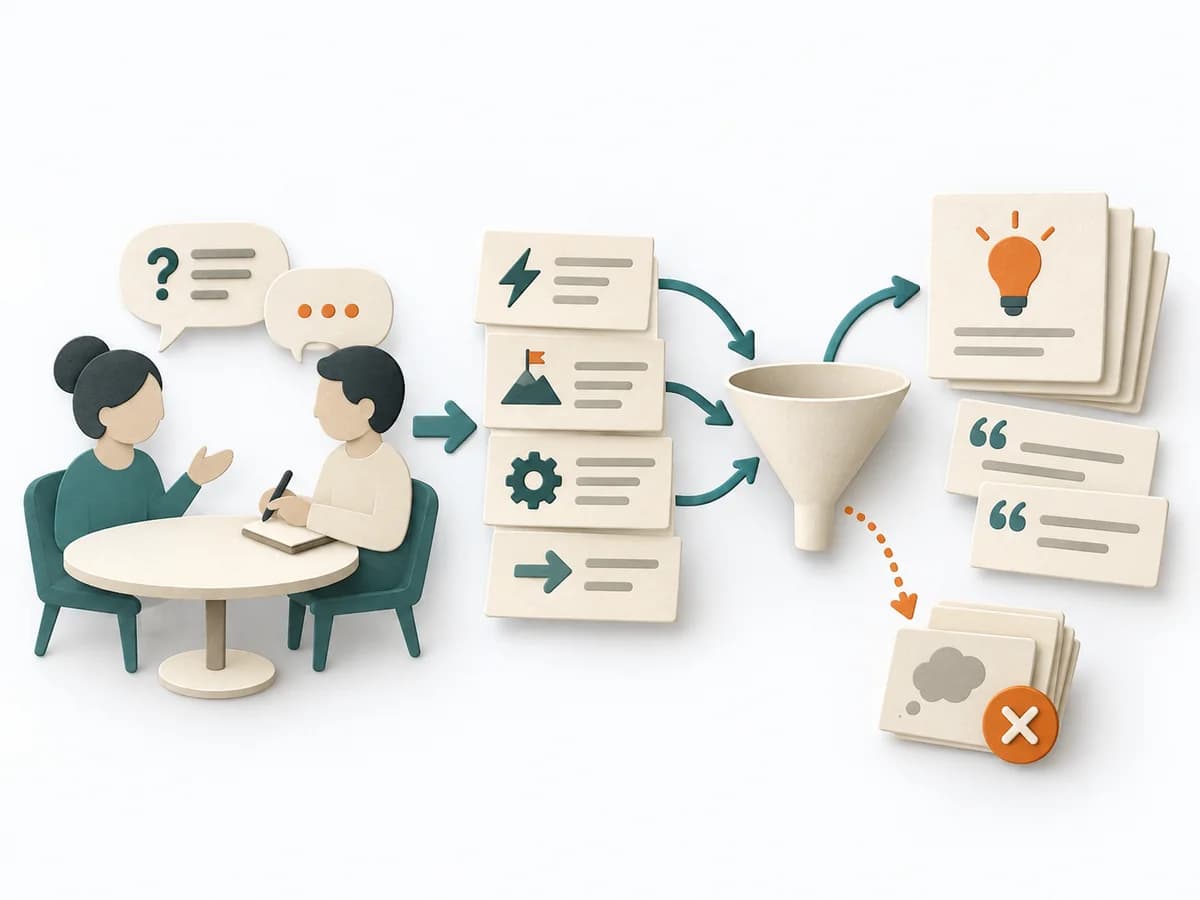
Purposedifferent | When teams derive needs only from assumptions and real motives are missing, user interviews give direct access to behavior and meaning. Conversations from the target group's everyday life make patterns, tensions, and open questions solidly visible. | Concept Mapping arranges terms and relationships in a network that makes subject-matter connections tangible. It fits when a topic needs to be understood structurally rather than linearly. | Event Modeling connects business workflows with commands, events, and views into one coherent mental model. It helps design behavior, UI, and technical slices from the same underlying logic. |
Complexitydifferent | Low | Medium | Medium |
Timedifferent | 30–60 min per interview | 1-2 h | 2-6 h |
Participantsdifferent | 1 participant per interview | 1-8 | 2-8 |
Formatsame | Workshop + async | Workshop + async | Workshop + async |
Outputdifferent | Interview Notes, Themes, Insight Summary | Concept Map, Relationship Labels, Knowledge Gaps | Event Model, UI Flow, Commands, Read Models |
Tagsno overlap | QualitativeResearchCustomerDiscovery | KnowledgeConceptsMappingSensemaking | EventsBlueprintDomain-Driven DesignBehavior |
Often compared together
Methods with strong topical overlap with the current selection, not yet in the comparison.