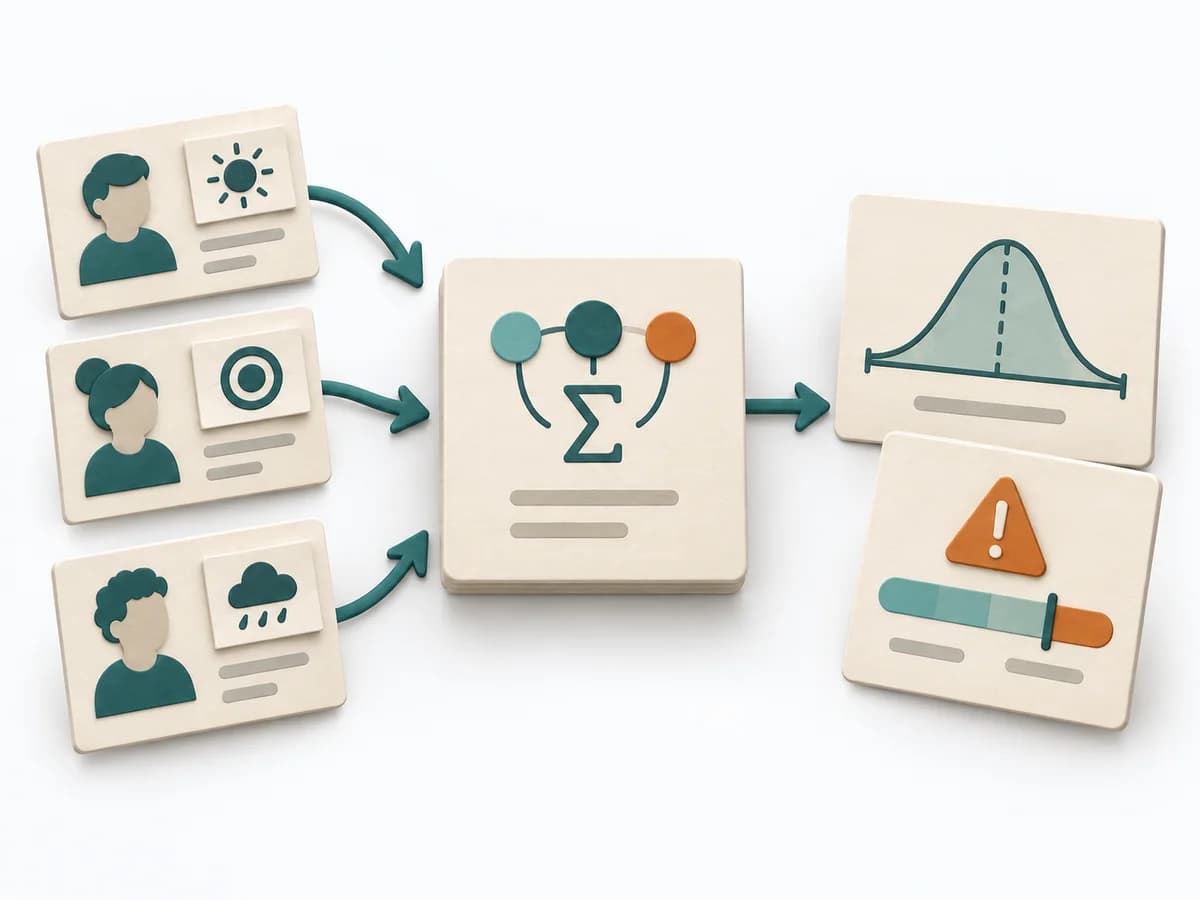
View methods side by side.
Choose up to four methods. Add them using the search and share the comparison by copying its link.
| Criterion |  Systems Thinking Polarity Mapping |  Decision Making Wideband Delphi |  Decision Making Three-Point Estimation |
|---|---|---|---|
Purposedifferent | Polarity Mapping makes tensions between two opposing poles tangible, such as standardization and adaptation or control and autonomy. The method guards against making apparent either-or decisions prematurely. | A single opinion rarely holds up for planning when the future is genuinely uncertain. It separates options, evaluation criteria, and open risks. The result is captured as an Estimate Range, Assumption Log, and Expert Consensus Notes. | A single estimate for effort, time, or risk often looks too smooth for the real uncertainty behind it. It separates options, evaluation criteria, and open risks. The result is captured as a Three-Point Estimate, Risk Range, and Assumption Notes. |
Complexitydifferent | Medium | High | Medium |
Timedifferent | 1-2 h | 1-4 h or multiple rounds | 10-30 min je Item |
Participantsdifferent | 3-12 | 4-12 Experten | 1-8 |
Formatdifferent | Workshop | Workshop + async | Workshop + async |
Outputdifferent | Polarity Map, Warning Signs, Balance Actions | Estimate Range, Assumption Log, Expert Consensus Notes | Three-Point Estimate, Risk Range, Assumption Notes |
Tagsno overlap | Systems thinkingTradeoffsLeadership | EstimationExpertsForecasting | EstimationUncertaintyForecasting |
Often compared together
Methods with strong topical overlap with the current selection, not yet in the comparison.