View methods side by side.
Choose up to four methods. Add them using the search and share the comparison by copying its link.
| Criterion |  UX Research Personas | 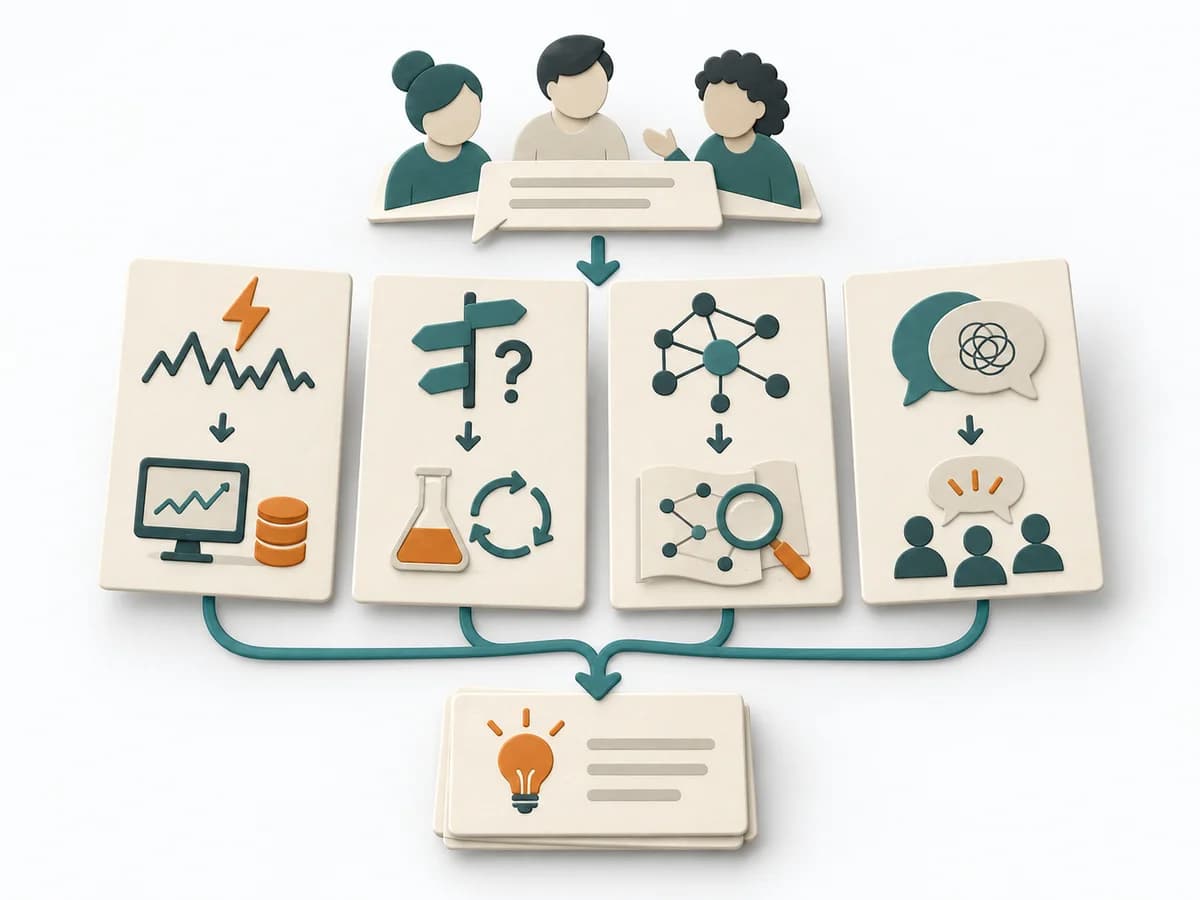 Systems Thinking VUCA Scan |  Product Strategy DIBB |
|---|---|---|---|
Purposedifferent | When target groups stay too vague and teams talk about the same people differently, personas create a shared, solid picture of usage. Condensed profiles make needs, contexts, and differences tangible enough for decisions. | The VUCA Scan helps read difficult situations more precisely. Instead of treating unclarity as generally complicated, the method separates fast change, missing knowledge, systemic entanglement, and ambiguous interpretation. | DIBB helps clarify target groups, value, goals, and priorities by making the logic behind a decision explicit. It captures results as a DIBB document, belief list, bet list, and learning report. |
Complexitydifferent | Medium | Low | Low |
Timedifferent | 1-3 Tage | 30-90 min | 1-2 h |
Participantsdifferent | Internes Team | 1-10 | 2-8 |
Formatsame | Workshop + async | Workshop + async | Workshop + async |
Outputdifferent | Persona Profiles, Needs Summary, Scenario Notes | VUCA Map, Response Options, Signal and Learning Plan | DIBB document, Belief list, Bet list, Learning report |
Tagsno overlap | ResearchCustomerSynthesis | SensemakingUncertaintyComplexityStrategyForesight | StrategyDecisionAssumptionsHypothesis |
Often compared together
Methods with strong topical overlap with the current selection, not yet in the comparison.