View methods side by side.
Choose up to four methods. Add them using the search and share the comparison by copying its link.
| Criterion | 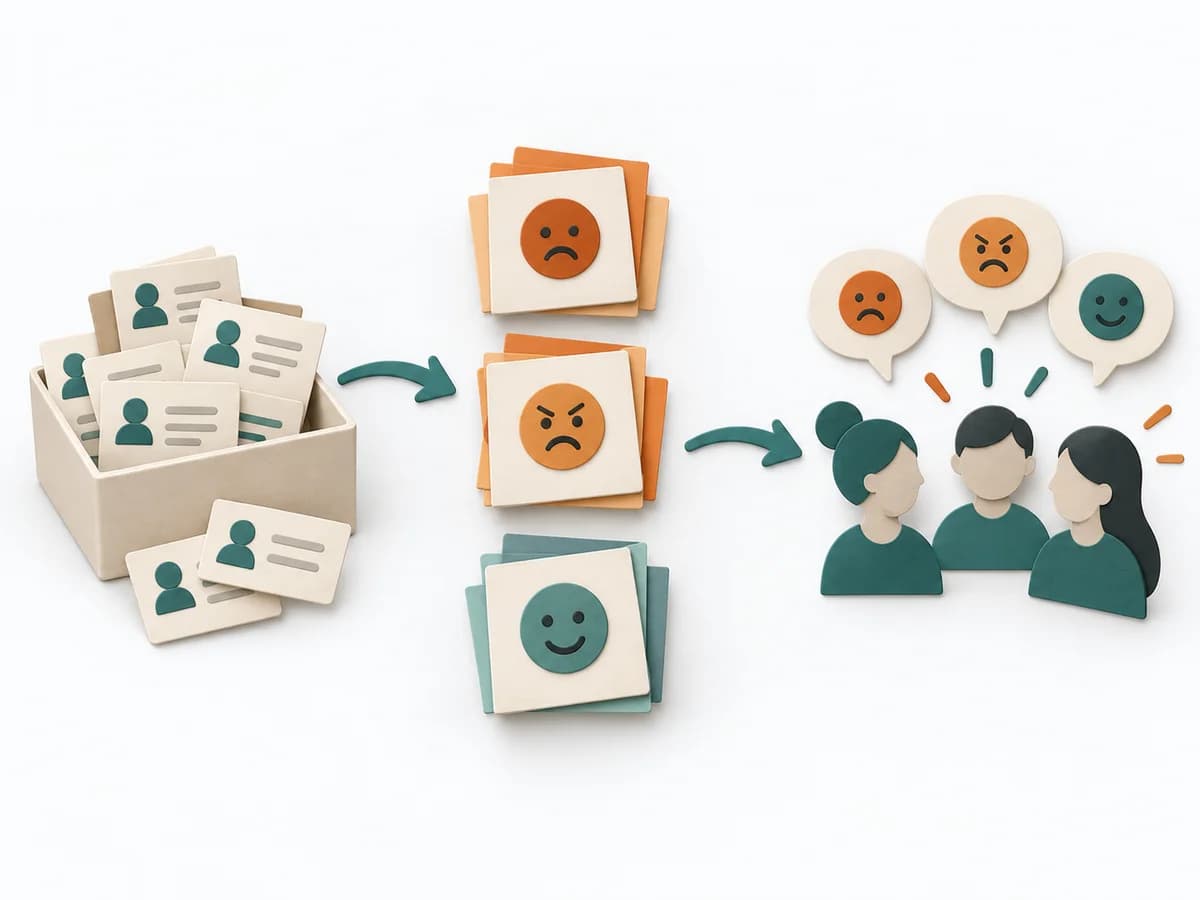 Agile Mad Sad Glad |  Product Discovery Fake Door Test |  Product Discovery Experiment Canvas |
|---|---|---|---|
Purposedifferent | When a team's or workshop's mood needs to become readable, it structures emotional signals with little setup. It makes strain, relief, and sources of energy tangible. | When demand is still unclear, it measures interest in a feature before it is built. It separates real behavior from polite agreement and deliberately keeps build effort small. | When experiments become unreadable after the fact, it arranges hypothesis, signal, and learning goal on a single canvas. It separates problem, assumption, solution, and evidence. The result is captured as a Completed Experiment Canvas and a Success Metric. |
Complexitydifferent | Low | Medium | Low |
Timedifferent | 30-60 min | 1-5 Tage | 30-60 min |
Participantsdifferent | 3-10 | Nutzertraffic | 1-5 |
Formatdifferent | Workshop | Async | Workshop + async |
Outputdifferent | Emotion Board, Themes, Action Items | Click Data, Interest Signal, Learning Decision | Completed Experiment Canvas, Success Metric |
Tagsno overlap | RetrospectiveTeamReflection | ValidationExperimentsDemandDiscovery | ExperimentsValidationDiscoveryHypothesis |
Often compared together
Methods with strong topical overlap with the current selection, not yet in the comparison.