View methods side by side.
Choose up to four methods. Add them using the search and share the comparison by copying its link.
| Criterion |  UX Design Lean UX Canvas |  Knowledge Modeling Peer Instruction | 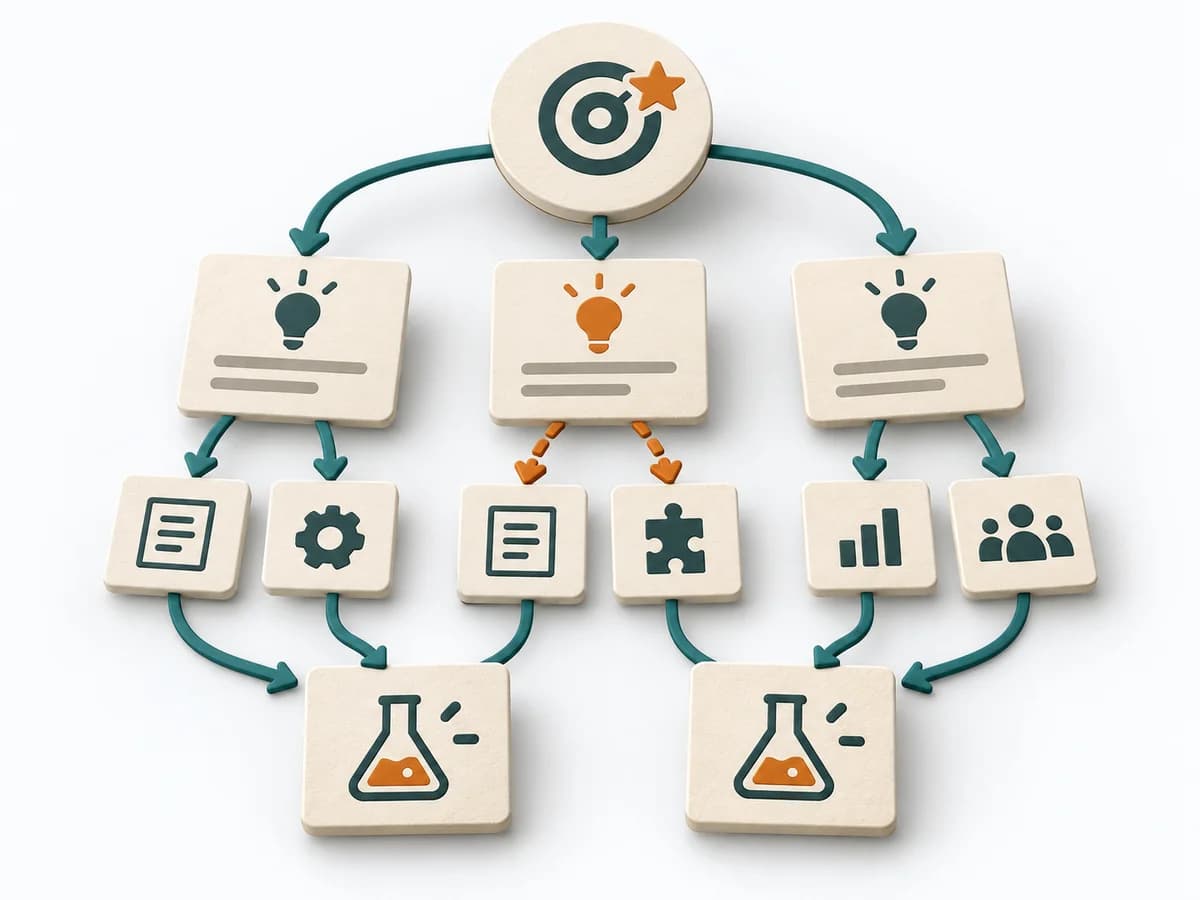 Product Discovery Opportunity Solution Tree |
|---|---|---|---|
Purposedifferent | The Lean UX Canvas helps clarify user behavior, touchpoints, and concept decisions. It makes assumptions and desired outcomes visible and captures the result as a completed canvas, hypothesis list, and first experiment. | Peer Instruction uses group thinking to clarify difficult terms or concepts faster. The method combines individual reflection with social correction and shared precision. | When discovery keeps swinging between goals, ideas, and learning loops, it creates clear steering logic. It connects the desired outcome, opportunities, and experiments into a legible structure. |
Complexitysame | Medium | Medium | Medium |
Timedifferent | 2-3 h | 10-20 min je Frage | 1-2 h Setup, laufend |
Participantsdifferent | 3-8 | 6-50 | 2-6 |
Formatdifferent | Workshop + async | Workshop | Workshop + async |
Outputdifferent | Completed Lean UX Canvas, Hypothesis list, First experiment | Concept Questions, Vote Results, Learning Notes | Opportunity Solution Tree, Experiment Backlog, Learning Log |
Tagsno overlap | CanvasHypothesisOutcomesDiscovery | LearningDialogueFacilitation | DiscoveryOutcomesExperimentsOpportunity |
Often compared together
Methods with strong topical overlap with the current selection, not yet in the comparison.