View methods side by side.
Choose up to four methods. Add them using the search and share the comparison by copying its link.
| Criterion | 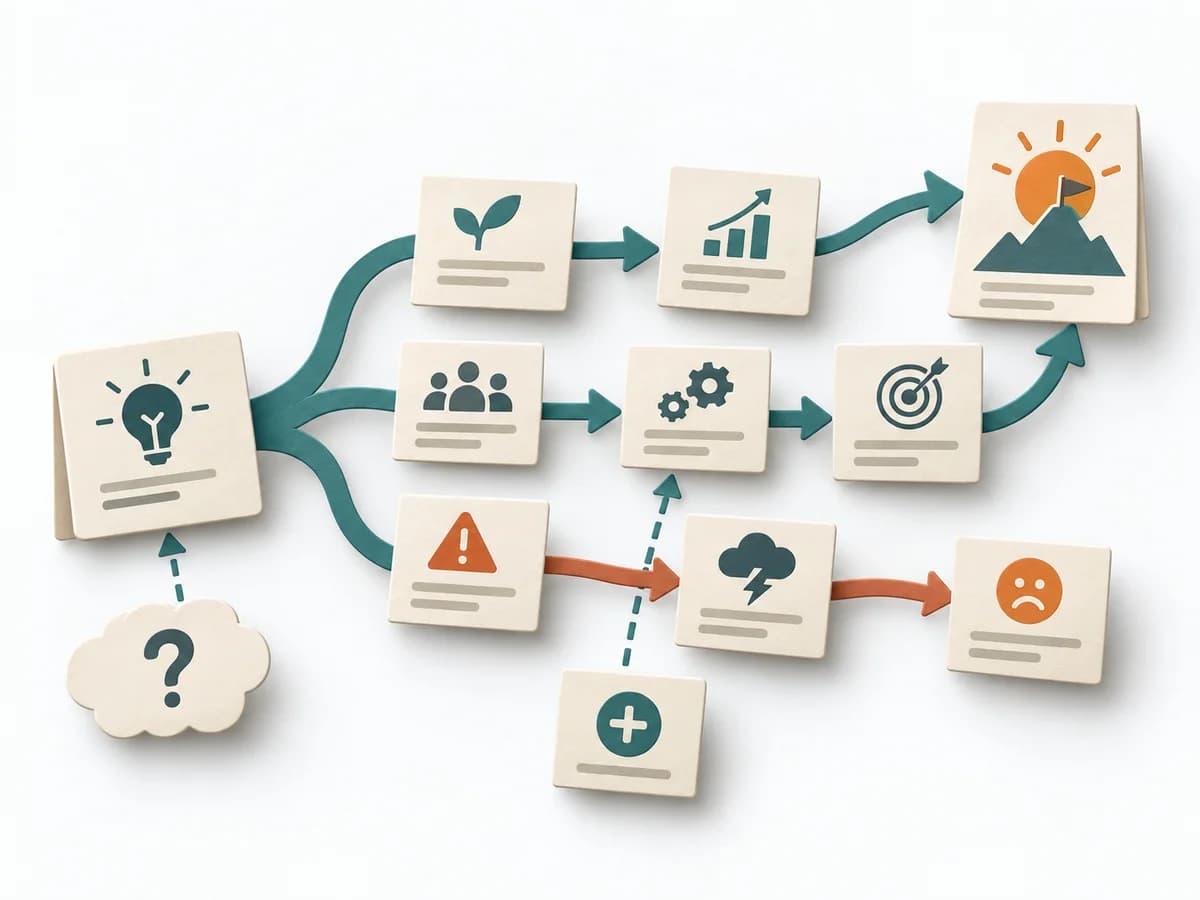 Systems Thinking Future Reality Tree |  Facilitation Nominal Group Technique |  Facilitation Alignment Mapping |
|---|---|---|---|
Purposedifferent | A Future Reality Tree shows how desired actions are meant to lead to a better system state. The method checks whether a path of change holds together logically before time flows into implementation. | When loud voices could dominate a round, Nominal Group Technique protects individual thinking time from group effects. It collects ideas separately first and only then enables shared weighting. | When several people work toward one goal but hold different mental maps, Alignment Mapping makes the discrepancies visible. It arranges goals, assumptions, and priorities so shared direction becomes verifiable. |
Complexitydifferent | High | Medium | Medium |
Timedifferent | 2-4 h | 60-120 min | 1-2 h |
Participantsdifferent | 3-8 | 5-12 | 4-12 |
Formatsame | Workshop | Workshop | Workshop |
Outputdifferent | Future Reality Tree, Negative Branches, Assumption List, Improved Injections | Ranked Ideas, Clarified Options, Group Priority | Alignment Map, Open Issues, Decision Questions |
Tagsno overlap | Theory of ConstraintsSystems thinkingChange | FacilitationPrioritizationVotingInclusion | AlignmentStakeholdersStrategyFacilitation |
Often compared together
Methods with strong topical overlap with the current selection, not yet in the comparison.