View methods side by side.
Choose up to four methods. Add them using the search and share the comparison by copying its link.
| Criterion |  Growth Funnel Analysis | 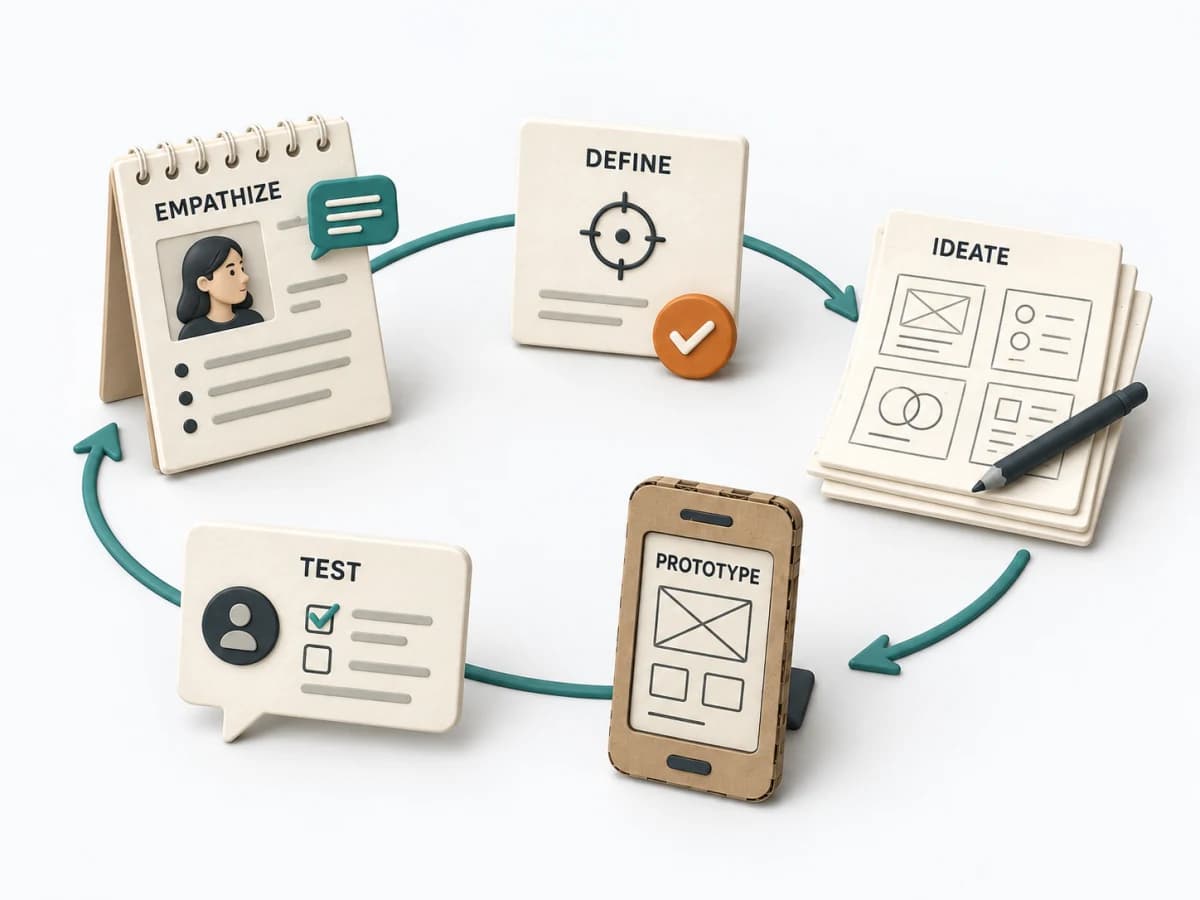 Innovation Design Thinking |  Product Discovery Smoke Test |
|---|---|---|---|
Purposedifferent | When many visitors or users drop off along the way, the reason behind the number often stays hidden. Funnel Analysis exposes these transitions and makes visible exactly where the path collapses. | For complex user problems with an uncertain cause, the method connects observation, interpretation, and experiment into a learning cycle. It keeps the focus on real needs and avoids premature solution language. This produces robust decisions for product and service. | When demand only needs to be roughly verified, it tests interest with minimal effort. It measures whether people would take a next step at all. |
Complexitydifferent | Medium | High | Low |
Timedifferent | 1-3 h | 1 Tag bis mehrere Wochen | 1-5 Tage |
Participantsdifferent | 1-5 | 4-10 | Nutzertraffic |
Formatdifferent | Async | Workshop | Async |
Outputdifferent | Funnel report, Drop-off analysis, Optimization hypotheses | Problem Statement, Prototype, Test Learnings | Interest Metrics, Conversion Signal, Learning Note |
Tagsno overlap | AnalyticsConversionGrowth | InnovationPrototypeResearch | ValidationExperimentsDemandGrowth |
Often compared together
Methods with strong topical overlap with the current selection, not yet in the comparison.