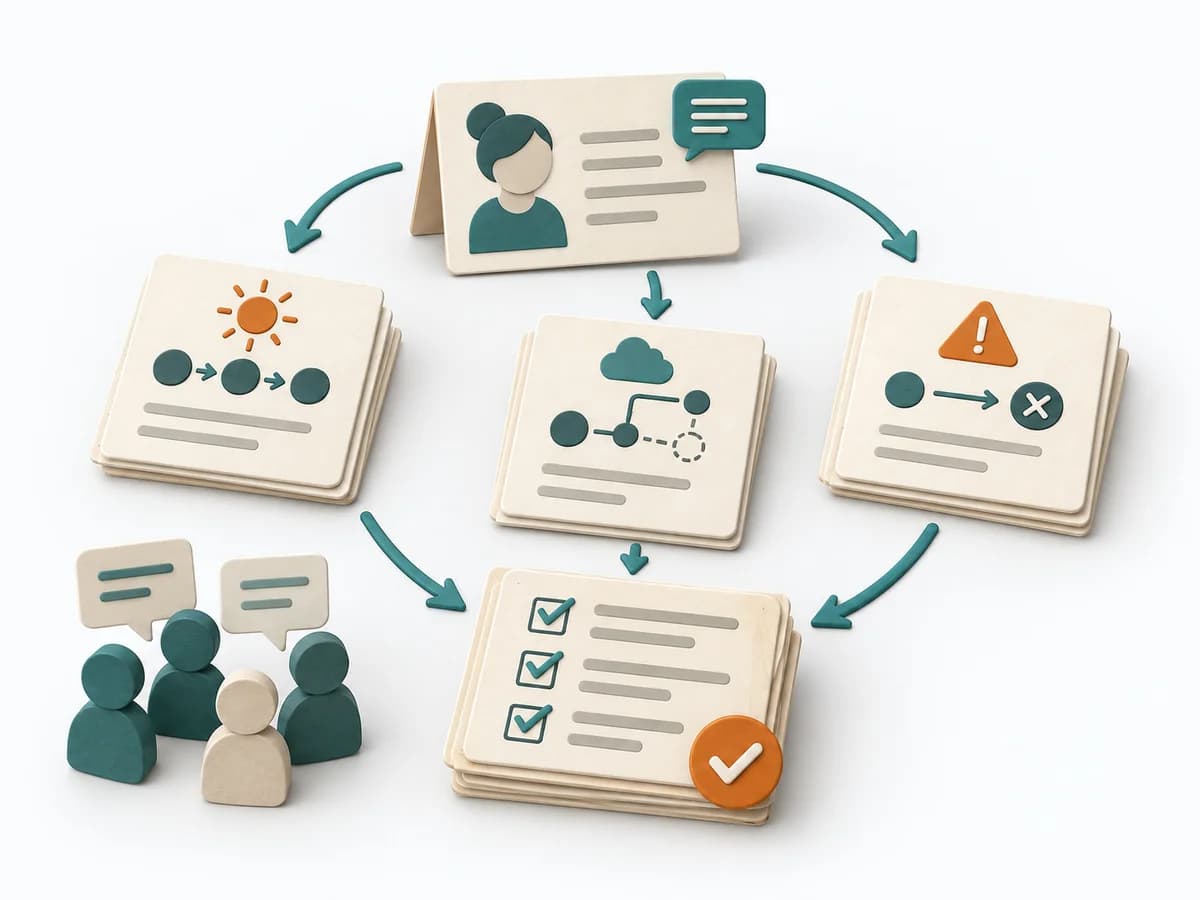
View methods side by side.
Choose up to four methods. Add them using the search and share the comparison by copying its link.
| Criterion |  Agile Example Mapping |  Decision Making Decision Rights Mapping |  Facilitation Stakeholder Salience Model |
|---|---|---|---|
Purposedifferent | When a story carries business rules and exceptions, it brings clarity before implementation. It makes examples, open questions, and boundaries visible enough that the logic becomes jointly sound. | In organizations with many stakeholders, it often blurs who actually decides and who is merely consulted. It separates options, evaluation criteria, and open risks. The result is captured as a Decision Rights matrix and an agreement. | When stakeholders appear to matter very differently, the Stakeholder Salience Model rates their actual priority through power, legitimacy, and urgency. It turns individual contributions into a visible selection. The result is captured as a Salience diagram and a class-based strategy. |
Complexitydifferent | Low | Medium | Medium |
Timedifferent | 30-60 min | 90-180 min | 60-90 min |
Participantsdifferent | 3-7 | 4-12 | 3-6 |
Formatsame | Workshop | Workshop | Workshop |
Outputdifferent | Example Map, Acceptance Criteria, Open Questions | Decision Rights Matrix, Agreement | Salience Diagram, Strategy per Class |
Tagsno overlap | Behavior-Driven DevelopmentRequirementsExamplesRefinement | DecisionGovernanceAlignmentResponsibility | StakeholdersFacilitationAlignmentGovernance |
Often compared together
Methods with strong topical overlap with the current selection, not yet in the comparison.