View methods side by side.
Choose up to four methods. Add them using the search and share the comparison by copying its link.
| Criterion |  Product Strategy DIBB | 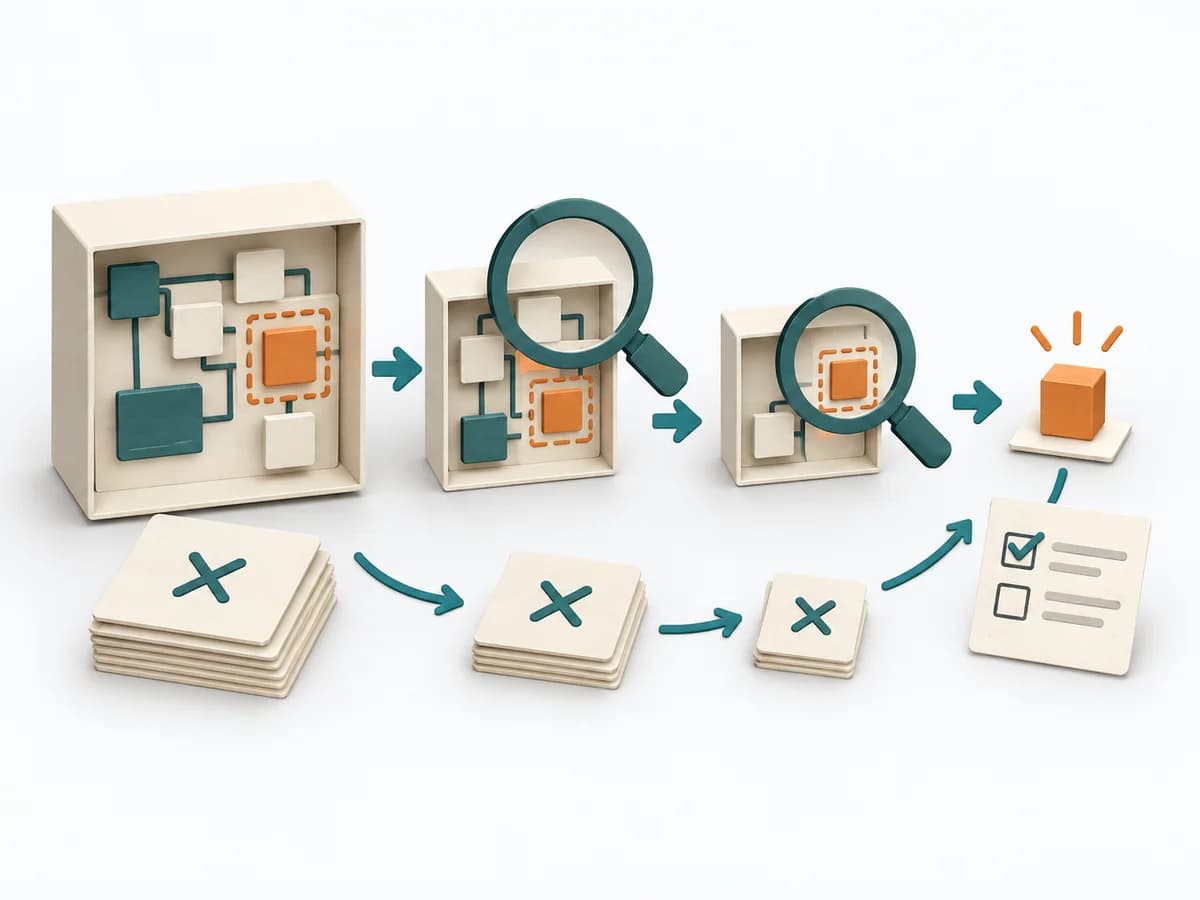 Engineering Fault Isolation |  Facilitation Stakeholder Salience Model |
|---|---|---|---|
Purposedifferent | DIBB helps clarify target groups, value, goals, and priorities by making the logic behind a decision explicit. It captures results as a DIBB document, belief list, bet list, and learning report. | In technical failures, the visible symptom often gets mixed up with the actual cause. Fault Isolation narrows the fault space and progressively reduces which part of the system is truly affected. | When stakeholders appear to matter very differently, the Stakeholder Salience Model rates their actual priority through power, legitimacy, and urgency. It turns individual contributions into a visible selection. The result is captured as a Salience diagram and a class-based strategy. |
Complexitydifferent | Low | Medium | Medium |
Timedifferent | 1-2 h | 30-180 min | 60-90 min |
Participantsdifferent | 2-8 | 1-6 | 3-6 |
Formatdifferent | Workshop + async | Workshop + async | Workshop |
Outputdifferent | DIBB document, Belief list, Bet list, Learning report | Fault Isolation Map, Test Log, Excluded Hypotheses, Narrowed Fault Area | Salience Diagram, Strategy per Class |
Tagsno overlap | StrategyDecisionAssumptionsHypothesis | TroubleshootingDiagnosisEngineering | StakeholdersFacilitationAlignmentGovernance |
Often compared together
Methods with strong topical overlap with the current selection, not yet in the comparison.



