View methods side by side.
Choose up to four methods. Add them using the search and share the comparison by copying its link.
| Criterion |  Product Strategy DIBB | 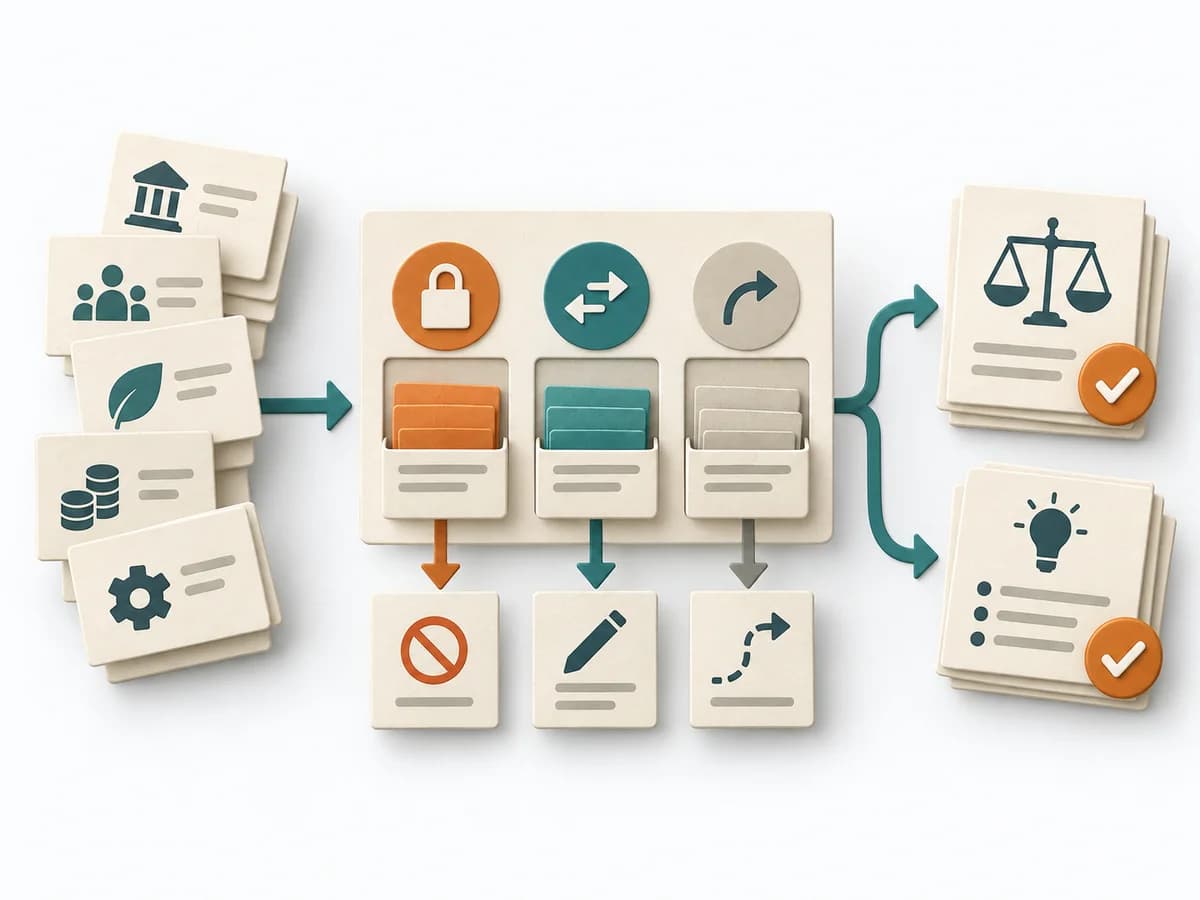 Decision Making Constraint Analysis |  Decision Making OODA Loop |
|---|---|---|---|
Purposedifferent | DIBB helps clarify target groups, value, goals, and priorities by making the logic behind a decision explicit. It captures results as a DIBB document, belief list, bet list, and learning report. | When an initiative stalls, the limit often lies not in the idea but in hard or soft boundary conditions. Constraint Analysis separates these limits and shows which of them can actually be shaped. | In dynamic situations, decisions become outdated faster than they can be prepared. The OODA Loop holds observing, orienting, deciding, and acting together as a recurring rhythm so reaction does not slide into inertia. |
Complexitydifferent | Low | Low | Medium |
Timedifferent | 1-2 h | 30-90 min | 15-60 min je Zyklus |
Participantsdifferent | 2-8 | 2-8 | 1-8 |
Formatsame | Workshop + async | Workshop + async | Workshop + async |
Outputdifferent | DIBB document, Belief list, Bet list, Learning report | Constraint List, Hard/Soft Classification, Option Impact Notes, Decision Boundaries | Situation Assessment, Decision Loop, Action Updates |
Tags1 shared | StrategyDecisionAssumptionsHypothesis | ConstraintsDecisionPlanningOptions | DecisionChangeLearningStrategy |
Often compared together
Methods with strong topical overlap with the current selection, not yet in the comparison.