View methods side by side.
Choose up to four methods. Add them using the search and share the comparison by copying its link.
| Criterion |  Innovation Design Thinking | 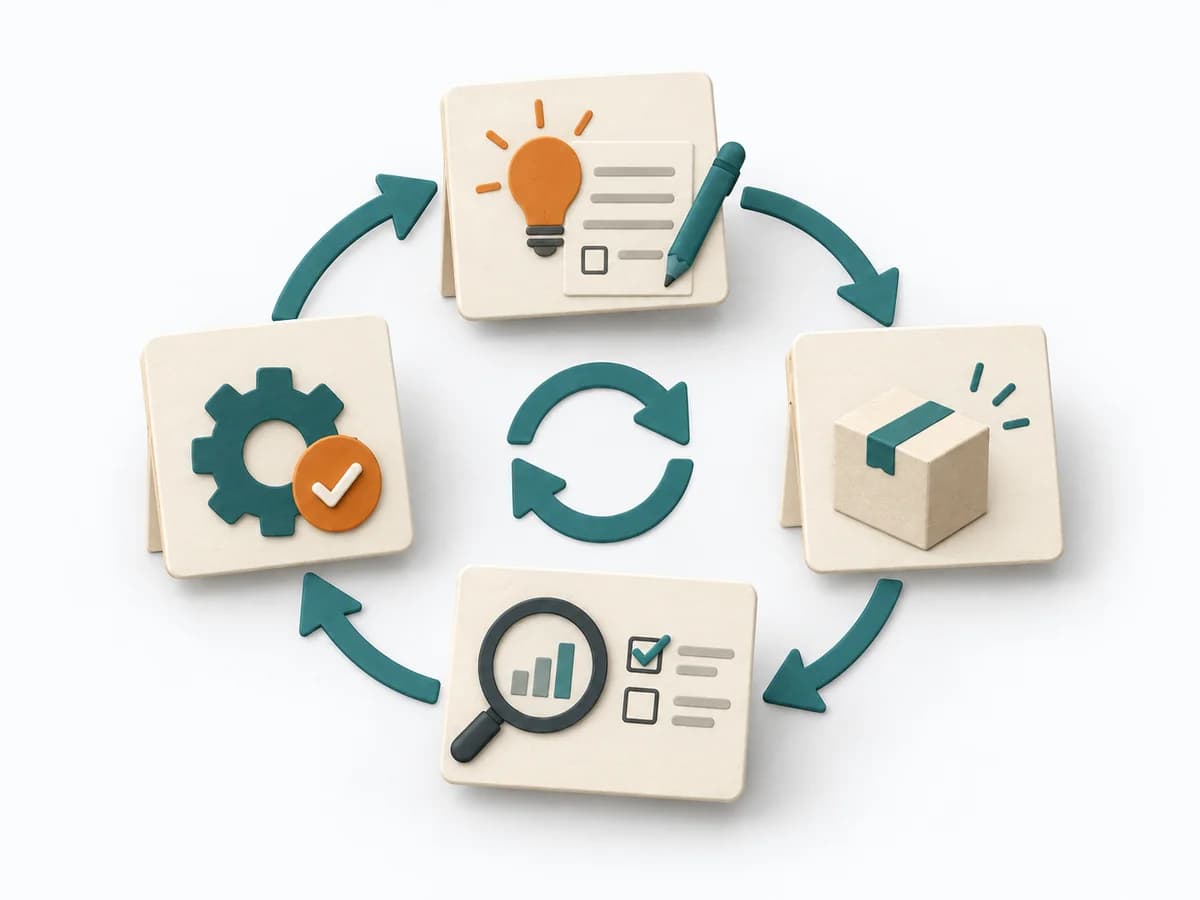 Operations PDCA Cycle |  Product Discovery Smoke Test |
|---|---|---|---|
Purposedifferent | For complex user problems with an uncertain cause, the method connects observation, interpretation, and experiment into a learning cycle. It keeps the focus on real needs and avoids premature solution language. This produces robust decisions for product and service. | For an improvement that still has to prove itself in everyday work, the method runs it through small learning loops. It connects planning, checking, and standardization into a repeatable learning mode. | When demand only needs to be roughly verified, it tests interest with minimal effort. It measures whether people would take a next step at all. |
Complexitydifferent | High | Low | Low |
Timedifferent | 1 Tag bis mehrere Wochen | 1 h bis mehrere Wochen | 1-5 Tage |
Participantsdifferent | 4-10 | 1-8 | Nutzertraffic |
Formatdifferent | Workshop | Workshop + async | Async |
Outputdifferent | Problem Statement, Prototype, Test Learnings | PDCA Log, Experiment Plan, Learning Outcome, Standard Change | Interest Metrics, Conversion Signal, Learning Note |
Tagsno overlap | InnovationPrototypeResearch | Continuous improvementLeanExperiments | ValidationExperimentsDemandGrowth |
Often compared together
Methods with strong topical overlap with the current selection, not yet in the comparison.



