methodatlas
Playbook

Rapidly Co-Create the User Experience

Move from lightweight UX assumptions through a visible journey to converged solution sketches for the most critical touchpoints.

Steps3 methods
Time2-3 days
FormatWorkshop
Outcome

Converged solution sketches for the most critical touchpoints, grounded in explicit assumptions and a visible journey.

At the end you have

Lean UX CanvasCustomer Journey CanvasDesign studio sketches

Decision point

You can decide which sketch is elaborated further for which touchpoint.

Next step

Turn the selected sketches into a prototype and test it with real users.
Ideal for

  • Fast, lightweight UX work without a large research runway
  • Teams who want to make assumptions about the user experience explicit
  • Preparation for a design sprint or feature kickoff

Not good for

  • Situations that require in-depth primary user research
  • Already fully validated, fully worked-out solutions
Preparation

What should be clear before you start

Roles

  • UX or product design owner
  • Cross-functional team

Inputs

  • Existing knowledge about the target audience
  • Drawing material or a digital whiteboard

Setup

  • Plan time for three consecutive design steps
Flow

Method path

3 methods
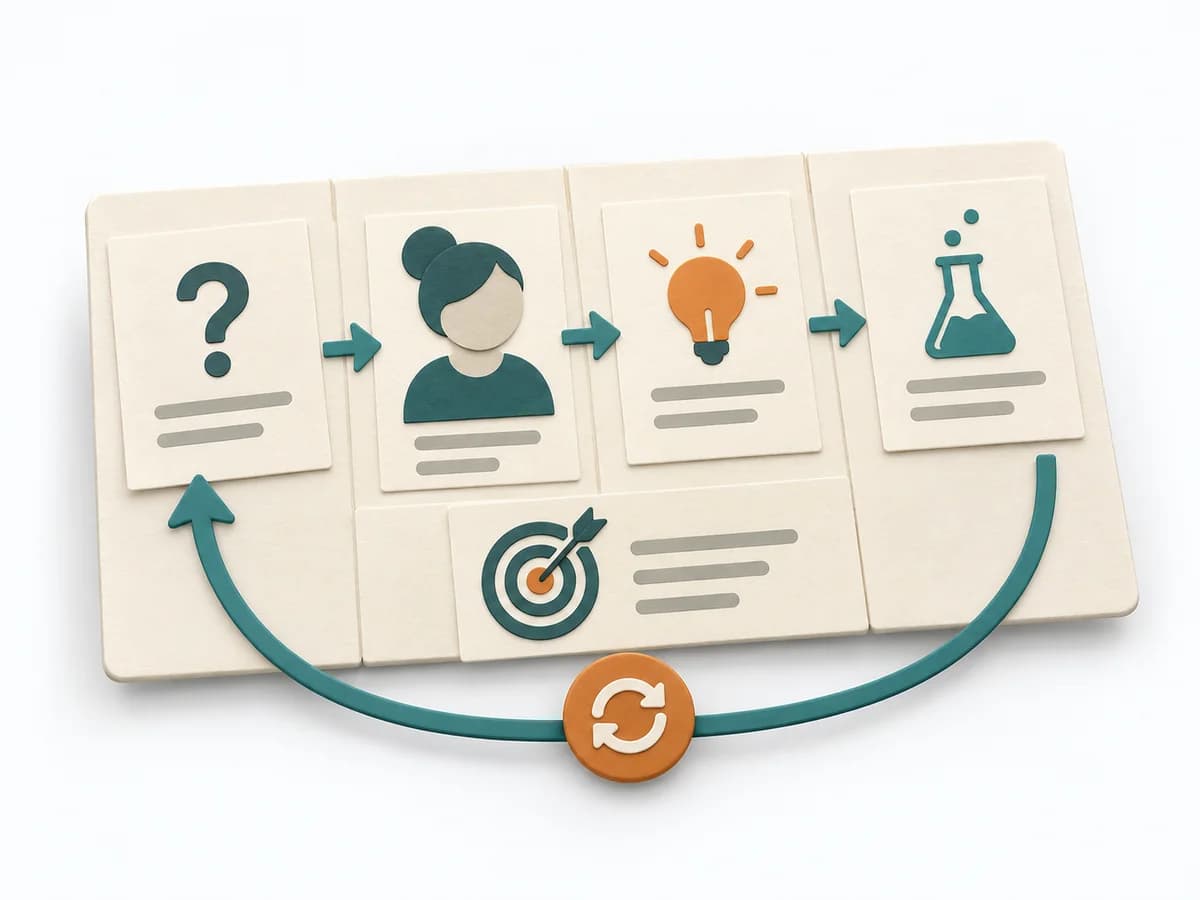
  1. 1UX DesignLean UX Canvas

    Lean UX Canvas

    Which assumption must hold for a solution to move user and business outcomes, and how will we learn?

    Why this step?

    The Lean UX Canvas makes implicit assumptions explicit before time is invested in elaboration.

    The assumptions about the user experience are then placed along the actual journey.

    Paper illustration of Lean UX Canvas with its method-specific working model.
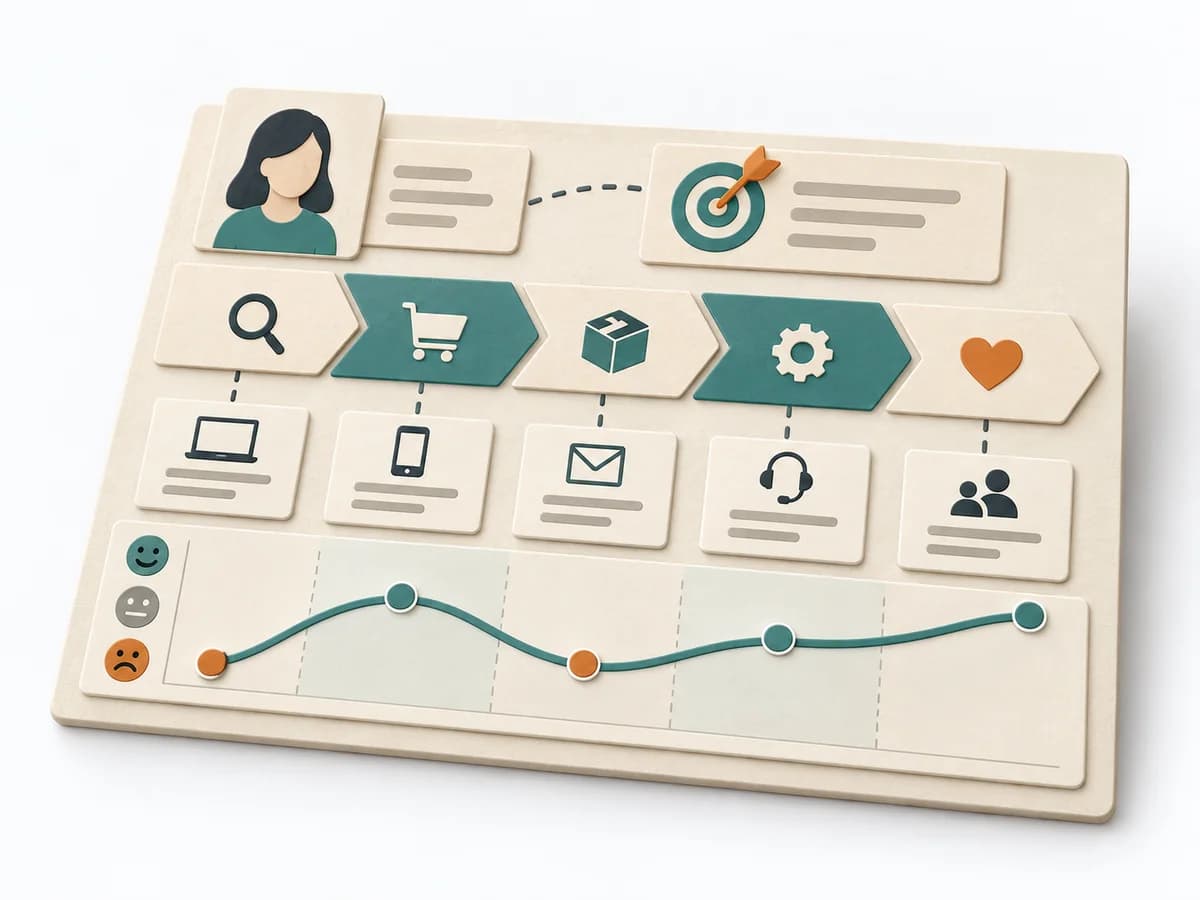
  2. 2UX DesignCustomer Journey Canvas

    Customer Journey Canvas

    What does the customer do, think, and feel across this journey?

    Why this step?

    The journey shows at which touchpoints the formulated assumptions actually meet real pain points.

    The most critical touchpoints are then worked on with focused design effort.

    A paper-based illustration representing Customer Journey Canvas with its core stages and visible working result.
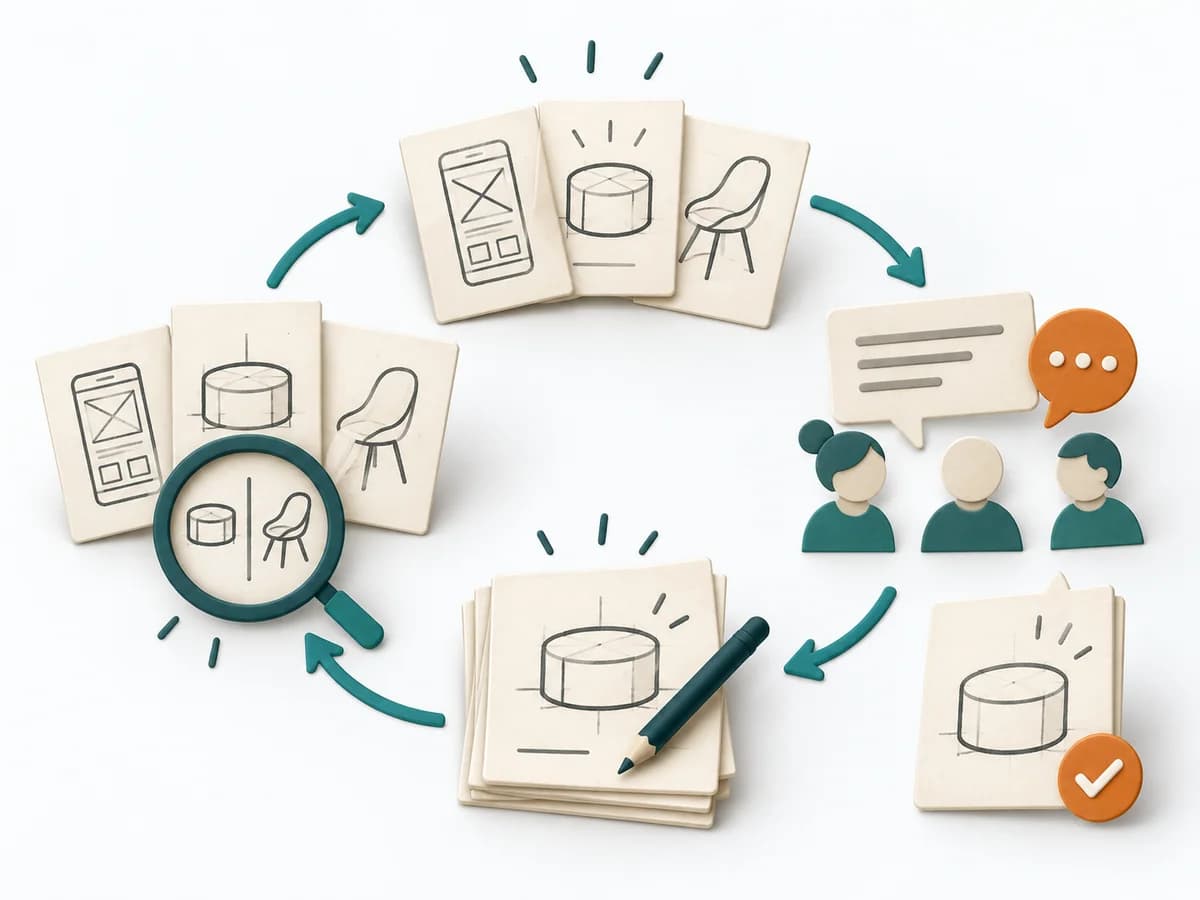
  3. 3UX DesignDesign studio sketches

    Design Studio

    Which design best addresses the concrete user problem and what do alternatives teach us?

    Why this step?

    Design studio produces and compares several solution approaches in parallel instead of settling on one idea too early.

    The converged sketches become the basis for prototyping and user testing.

    Paper illustration for Design Studio
Completion criteria
Templates

Artifacts for this playbook

Artifacts stay collapsed until you actually need them.

CanvasShow template

Lean UX Canvas: Worksheet

Plan Lean UX Canvas around its domain steps and the concrete decision question.

# Lean UX Canvas: Worksheet

## Question
To be confirmed

## Desired outcome
To be confirmed

## Scope
Establish and review the practice
Time: 90–120 minutes

Complete this worksheet on paper or in your own document during the work.

## Preparation for this scope

### Method setup
- **Materials:** Business problem and baseline, user research, solution options and test access, shared workspace, source links, and decision log.
- **Roles:** Product · Design/Research · Engineering · Business/Data
- **Advance information:** Collect Business problem and baseline, user research, solution options and test access in advance and mark open assumptions.
- **Overall time needed:** 90–120 minutes
- **Setup:** Prepare eight canvas fields from business problem to learning plan visibly and calibrate assessment terms before starting.

### Prepare for the work steps

#### Problem: Problem/outcomes
- Business problem and baseline
- user research
- solution options and test access

#### Users/needs: Users/needs
- outcome frame
- user research
- solution options and test access

#### Test hypotheses: Test hypotheses
- user frame
- user research
- solution options and test access

#### Risk/learning: Risk/learning
- hypothesis set
- user research
- solution options and test access


## Lean UX Canvas

### Business Problem
Measured current disadvantage, context, and cause.

...

### Business Outcomes
Measurable desired business change with horizon.

...

### Users
Concrete users or customers in the affected context.

...

### User Outcomes & Benefits
Observable user behaviour and resulting benefit.

...

### Solutions
Several possible solutions, still uncommitted.

...

### Hypotheses
If-then-because hypothesis linking solution and outcomes.

...

### Riskiest Assumption
Assumption with highest impact and weakest evidence.

...

### Learning Plan
Method, population, signal, threshold, and next decision.

...

[Jeff Gothelf: Lean UX Canvas v2](https://jeffgothelf.com/blog/leanuxcanvas-v2/)


## Problem: Problem/outcomes
Expected artifact: outcome frame

outcome frame · source · uncertainty · next decision

Entry:

...

- [ ] Are baseline and target measurable?

## Users/needs: Users/needs
Expected artifact: user frame

user frame · source · uncertainty · next decision

Entry:

...

- [ ] Does outcome describe behaviour?

## Test hypotheses: Test hypotheses
Expected artifact: hypothesis set

hypothesis set · source · uncertainty · next decision

Entry:

...

- [ ] Do solutions remain replaceable?

## Risk/learning: Risk/learning
Expected artifact: learning plan

learning plan · source · uncertainty · next decision

Entry:

...

- [ ] Does the plan test the assumption directly?

## Open questions and next steps

...

Method guide: https://methodatlas.meierhoff-systems.de/en/methods/lean-ux-canvas/run-sheet
CanvasShow template

Customer Journey Canvas: Worksheet

Prepare the decision, source evidence and next review.

# Customer Journey Canvas: Worksheet

## Question
To be confirmed

## Desired outcome
To be confirmed

## Scope
Run the method
Time: See catalog planning range; no universal duration.

Complete this worksheet on paper or in your own document during the work.

## Preparation for this scope

### Method setup
- **Materials:** Shared visual workspace, source evidence, and an agreed decision question.
- **Roles:** Facilitator, customer research, frontline staff, journey/service owner.
- **Advance information:** Collect existing data, examples, constraints and relevant stakeholder perspectives.
- **Overall time needed:** 90–150 min for one journey; research and service changes take additional time.
- **Setup:** Specify customer segment, situation, journey goal and boundary. Name meaningful stages and actions from the customer’s perspective. Add actual channels/interactions and cite research for observed behavior. Mark pains, emotions or needs only with evidence or an explicit hypothesis label. Identify opportunities and evidence gaps; select next validation or service change.

### Prepare for the work steps

#### Segment: Bound journey and segment
- User group, goal and lifecycle situation

#### Stages: Map stages and actions
- Interviews, observation and event data

#### Touchpoints: Add touchpoints and experience
- Channels, artefacts and interview notes

#### Opportunities: Select and validate opportunities
- Map, outcome goal and evidence gaps


## Customer Journey Canvas: an evidenced experience

### Goal and context
Whose goal, in which situation?

...

### Stages and actions
What does the person do in sequence?

...

### Touchpoints
Which channels create contact?

...

### Evidence
What observation or hypothesis is available?

...

### Opportunities
Which barrier merits investigation?

...

[When and How to Create Customer Journey Maps · Nielsen Norman Group](https://www.nngroup.com/articles/customer-journey-mapping/)


## Segment: Bound journey and segment
Expected artifact: Journey question and scope

Journey question and scope

Entry:

...

- [ ] Is the journey bounded to one context?

## Stages: Map stages and actions
Expected artifact: Evidence-backed stage and action row

Evidence-backed stage and action row

Entry:

...

- [ ] Are stages customer-led and actions observed?

## Touchpoints: Add touchpoints and experience
Expected artifact: Touchpoint and pain-point view

Touchpoint and pain-point view

Entry:

...

- [ ] Does every feeling have evidence or a hypothesis label?

## Opportunities: Select and validate opportunities
Expected artifact: Prioritized opportunities and check

Prioritized opportunities and check

Entry:

...

- [ ] Can each opportunity be traced to journey evidence?

## Open questions and next steps

...

Method guide: https://methodatlas.meierhoff-systems.de/en/methods/customer-journey-canvas/run-sheet
MarkdownShow template

Design Studio: Worksheet

Prepare a visible scenario, need, constraints and criteria; drawing skill is not required.

# Design Studio: Worksheet

## Question
To be confirmed

## Desired outcome
To be confirmed

## Scope
Complete cycle
Time: 60–120 minutes; user testing separately

Complete this worksheet on paper or in your own document during the work.

## Preparation for this scope

### Method setup
- **Materials:** Paper, thick pens, scenario, criteria and space for multiple sketches.
- **Roles:** Cross-functional team, facilitator and user-knowledge representative.
- **Advance information:** Prepare a visible scenario, need, constraints and criteria; drawing skill is not required.
- **Overall time needed:** 60–120 minutes; user testing separately
- **Setup:** Display the brief; give everyone equal sketching time and space for alternatives and critique.

### Prepare for the work steps

#### Briefing: Briefing
- User knowledge
- Scenario

#### Sketching: Sketch in parallel
- Design brief
- Paper and pens

#### Critique: Present and critique
- Sketches
- Criteria

#### Redesign: Redesign
- Critique
- Alternatives

#### Learning test: Plan learning
- Concept
- Open assumptions


## Design Studio· worksheet

### Design brief
Which scenario and goal bound the sketches?

...

### Initial concepts
Describe or sketch at least two different approaches with flows.

...

### Critique
What strength, weakness and open question follow for each concept?

...

### Revision
Which elements are combined and how does the new flow work?

...

### Test question
Which uncertain assumption is tested through which observable behaviour?

...

Answer the prompts with your own information. Explicitly mark unknowns and assumptions.

[NN/g: Facilitating an Effective Design Studio Workshop](https://www.nngroup.com/articles/facilitating-design-studio-workshop/)


## Briefing: Briefing
Expected artifact: Shared design brief

Can everyone restate the user goal?

Entry:

...

- [ ] Can everyone restate the user goal?

## Sketching: Sketch in parallel
Expected artifact: Sketch alternatives

Are there different approaches rather than only layout variants?

Entry:

...

- [ ] Are there different approaches rather than only layout variants?

## Critique: Present and critique
Expected artifact: Annotated concepts

Does critique address user goal and criteria?

Entry:

...

- [ ] Does critique address user goal and criteria?

## Redesign: Redesign
Expected artifact: Revised concept

Is the revised concept internally coherent?

Entry:

...

- [ ] Is the revised concept internally coherent?

## Learning test: Plan learning
Expected artifact: Prototype test brief

Is the selection marked as a hypothesis to test?

Entry:

...

- [ ] Is the selection marked as a hypothesis to test?

## Open questions and next steps

...

Method guide: https://methodatlas.meierhoff-systems.de/en/methods/design-studio/run-sheet