1-2-4-All: Worksheet
Plan subject, participation, complete flow, and review.
# 1-2-4-All: Worksheet

## Question
To be confirmed

## Desired outcome
To be confirmed

## Scope
Complete run
Time: 12–20 minutes per focus question.

Complete this worksheet on paper or in your own document during the work.

## Preparation for this scope

### Method setup
- **Materials:** One clear focus question, timer, notes or digital board, and space for groups
- **Roles:** Facilitator · all participants · scribe for plenary patterns
- **Advance information:** Phrase one open, concrete focus question everyone can answer without extra context; prepare timer and groups of four. Prepare real cases, sources, and boundaries.
- **Overall time needed:** 12–20 minutes per focus question.
- **Setup:** Create a workspace with Focus question · Individual ideas · Pair patterns · Group synthesis · Plenary patterns; keep example values separate from live data.

### Prepare for the work steps

#### Question: Focus question
- Phrase one open, concrete focus question everyone can answer without extra context; prepare timer and groups of four.
- One clear focus question, timer, notes or digital board, and space for groups

#### Alone: Individual ideas
- Focus question

#### Pairs: Pair patterns
- Individual ideas

#### Fours: Group synthesis
- Pair patterns

#### Share: Plenary patterns
- Group synthesis


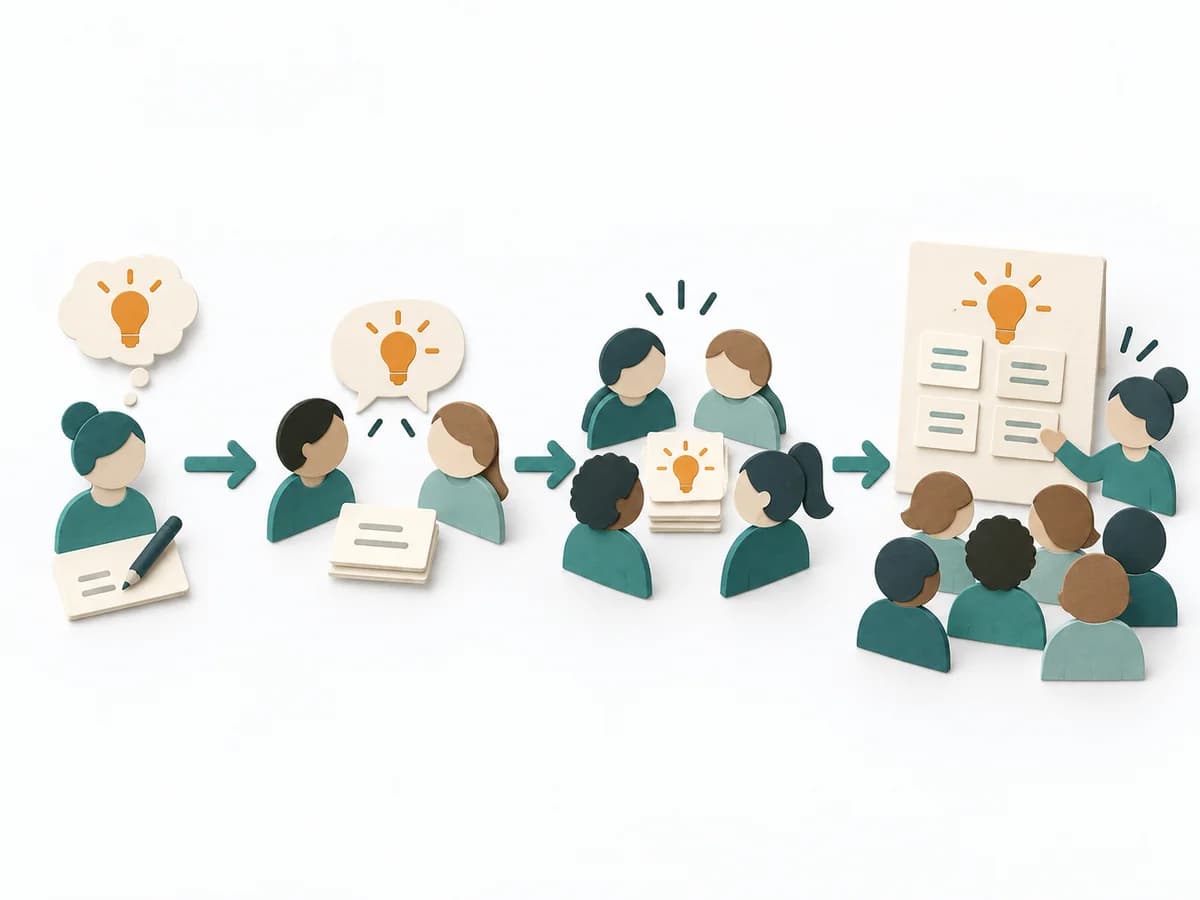
## 1-2-4-All · working structure

### Focus question
Pose a focus question with shared meaning and desired result

...

### Individual ideas
Write ideas silently and individually for one minute

...

### Pair patterns
Compare differences and common ground in pairs for two minutes

...

### Group synthesis
Synthesize key insights and new combinations in fours for four minutes

...

### Plenary patterns
Share one important point per group of four and capture plenary patterns

...

The blank worksheet contains prompts only.

[Reference source · original teaching example](https://www.liberatingstructures.com/1-2-4-all)


## Question: Focus question
Expected artifact: Focus question

Pose a focus question with shared meaning and desired result

Entry:

...

- [ ] Is the question open, concrete, and answerable without extra context?

## Alone: Individual ideas
Expected artifact: Individual ideas

Write ideas silently and individually for one minute

Entry:

...

- [ ] Does everyone have their own notes before discussion?

## Pairs: Pair patterns
Expected artifact: Pair patterns

Compare differences and common ground in pairs for two minutes

Entry:

...

- [ ] Are both perspectives represented in every pair?

## Fours: Group synthesis
Expected artifact: Group synthesis

Synthesize key insights and new combinations in fours for four minutes

Entry:

...

- [ ] Does each group of four synthesize instead of appending four lists?

## Share: Plenary patterns
Expected artifact: Plenary patterns

Share one important point per group of four and capture plenary patterns

Entry:

...

- [ ] Are a few patterns shared without restarting long presentations?

## Open questions and next steps

...

Method guide: https://methodatlas.meierhoff-systems.de/en/methods/1-2-4-all/run-sheet
Mind Mapping: Worksheet
Prepare the whole flow or one selected phase with real inputs.
# Mind Mapping: Worksheet

## Question
To be confirmed

## Desired outcome
To be confirmed

## Scope
Complete mind map
Time: 15–45 minutes

Complete this worksheet on paper or in your own document during the work.

## Preparation for this scope

### Method setup
- **Materials:** Large landscape sheet or free digital canvas, colored pens and optional image symbols.
- **Roles:** One person can work alone; in groups one person facilitates while everyone contributes visibly.
- **Advance information:** Review existing notes, questions or sources without prescribing the branch structure.
- **Overall time needed:** 15–45 minutes
- **Setup:** Keep the center open, agree color cues and leave sufficient space between main branches.

### Prepare for the work steps

#### Center: Place the core question at the center
- Topic or problem
- Purpose of the map

#### Branches: Grow main and sub-branches
- Central focus
- Initial associations or known areas

#### Links: Mark cross-links and gaps
- Growing mind map
- Additional sources or viewpoints

#### Focus: Select priorities for further work
- Connected mind map
- Selection criterion


## Radial mind map

### People
Who is involved?

...

### Content
What must be understood?

...

### Center
Central question or image

...

### Friction
What makes starting harder?

...

### Signals
How will progress be visible?

...

[Tony Buzan International · Laws of Mind Mapping](https://tonybuzan.com/courses/mind-mapping-on-demand-foundation-course/lessons/lesson-mind-map-foundation-1copy/)


## Center: Place the core question at the center
Expected artifact: Central focus

Keyword · image · purpose

Entry:

...

- [ ] Can every later branch relate unambiguously to the same center?

## Branches: Grow main and sub-branches
Expected artifact: Radial thought structure

Main branches · sub-branches · keywords

Entry:

...

- [ ] Does each connection show a clear parent-child relationship?

## Links: Mark cross-links and gaps
Expected artifact: Connected mind map

Links · gaps · questions

Entry:

...

- [ ] Are cross-links labeled and distinct from the hierarchy?

## Focus: Select priorities for further work
Expected artifact: Focused follow-up

Priorities · questions · next steps

Entry:

...

- [ ] Is it clear why these branches were selected for continuation?

## Open questions and next steps

...

Method guide: https://methodatlas.meierhoff-systems.de/en/methods/mind-mapping/run-sheet
World Café: Worksheet
Plan subject, participation, complete flow, and review.
# World Café: Worksheet

## Question
To be confirmed

## Desired outcome
To be confirmed

## Scope
Complete run
Time: 60–120 minutes.

Complete this worksheet on paper or in your own document during the work.

## Preparation for this scope

### Method setup
- **Materials:** Guiding question, visible agenda, work surfaces, timer, and result repository
- **Roles:** Facilitator · participants · hosts or session owners · scribe
- **Advance information:** Set the purpose and two or three connected questions; prepare small tables, writable surfaces, and hosts. Prepare real cases, sources, and boundaries.
- **Overall time needed:** 60–120 minutes.
- **Setup:** Create a workspace with Guiding questions · Table setup · Table record · Connected patterns · Harvest; keep example values separate from live data.

### Prepare for the work steps

#### Questions: Guiding questions
- Set the purpose and two or three connected questions; prepare small tables, writable surfaces, and hosts.
- Guiding question, visible agenda, work surfaces, timer, and result repository

#### Tables: Table setup
- Guiding questions

#### Dialogue: Table record
- Table setup

#### Rotate: Connected patterns
- Table record

#### Harvest: Harvest
- Connected patterns


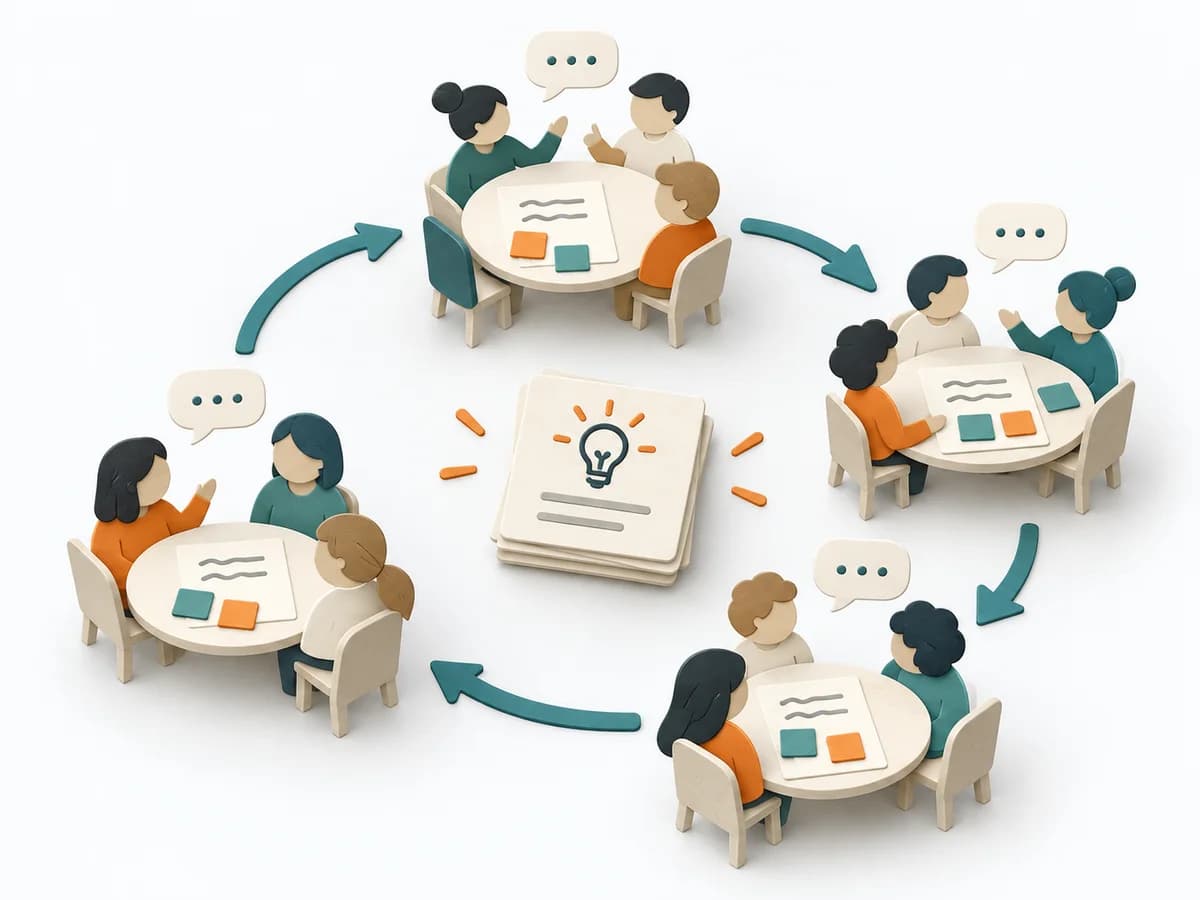
## World Café · working structure

### Guiding questions
Define context, purpose, and two or three connected guiding questions

...

### Table setup
Prepare small tables, writable table surfaces, and host roles

...

### Table record
Run the first dialogue round and connect ideas visibly on the table surface

...

### Connected patterns
Participants rotate; the host welcomes the new group and shares earlier patterns

...

### Harvest
Harvest insights in plenary, name tensions, and secure next steps

...

The blank worksheet contains prompts only.

[Reference source · original teaching example](https://theworldcafe.com/key-concepts-resources/world-cafe-method/)


## Questions: Guiding questions
Expected artifact: Guiding questions

Define context, purpose, and two or three connected guiding questions

Entry:

...

- [ ] Do the questions build on the purpose and open genuine dialogue?

## Tables: Table setup
Expected artifact: Table setup

Prepare small tables, writable table surfaces, and host roles

Entry:

...

- [ ] Do table size, materials, and host role enable shared thinking?

## Dialogue: Table record
Expected artifact: Table record

Run the first dialogue round and connect ideas visibly on the table surface

Entry:

...

- [ ] Are ideas connected and visible directly on the table surface?

## Rotate: Connected patterns
Expected artifact: Connected patterns

Participants rotate; the host welcomes the new group and shares earlier patterns

Entry:

...

- [ ] Does every rotation carry forward earlier patterns without merely repeating dialogue?

## Harvest: Harvest
Expected artifact: Harvest

Harvest insights in plenary, name tensions, and secure next steps

Entry:

...

- [ ] Does the harvest distill recurring patterns, tensions, and next steps?

## Open questions and next steps

...

Method guide: https://methodatlas.meierhoff-systems.de/en/methods/world-cafe/run-sheet
Lean Coffee: Worksheet
Prepare the whole flow or one selected phase with real inputs.
# Lean Coffee: Worksheet

## Question
To be confirmed

## Desired outcome
To be confirmed

## Scope
Complete Lean Coffee
Time: 30–90 minutes

Complete this worksheet on paper or in your own document during the work.

## Preparation for this scope

### Method setup
- **Materials:** Three-column board, cards, pens, two voting dots per person, timer and visible remaining time.
- **Roles:** Facilitator for rules and timer, participants as topic contributors and discussants, optional scribe.
- **Advance information:** Clarify overall theme, duration, participants and handling of confidential content; do not prepare a content agenda.
- **Overall time needed:** 30–90 minutes
- **Setup:** Create To Discuss, Discussing and Discussed. Set WIP 1 for Discussing, an initial five minutes per topic and a thumb-vote rule.

### Prepare for the work steps

#### Topics: Build a visible topic backlog
- Shared theme or open reason
- Cards and three-column board

#### Order: Order the backlog democratically
- Introduced topic cards
- Equal number of votes per person

#### Talk: Timebox and steer one topic
- Prioritized backlog
- Timer and three-column board

#### Capture: Capture value and close
- Discussed cards
- Notes from the timeboxes


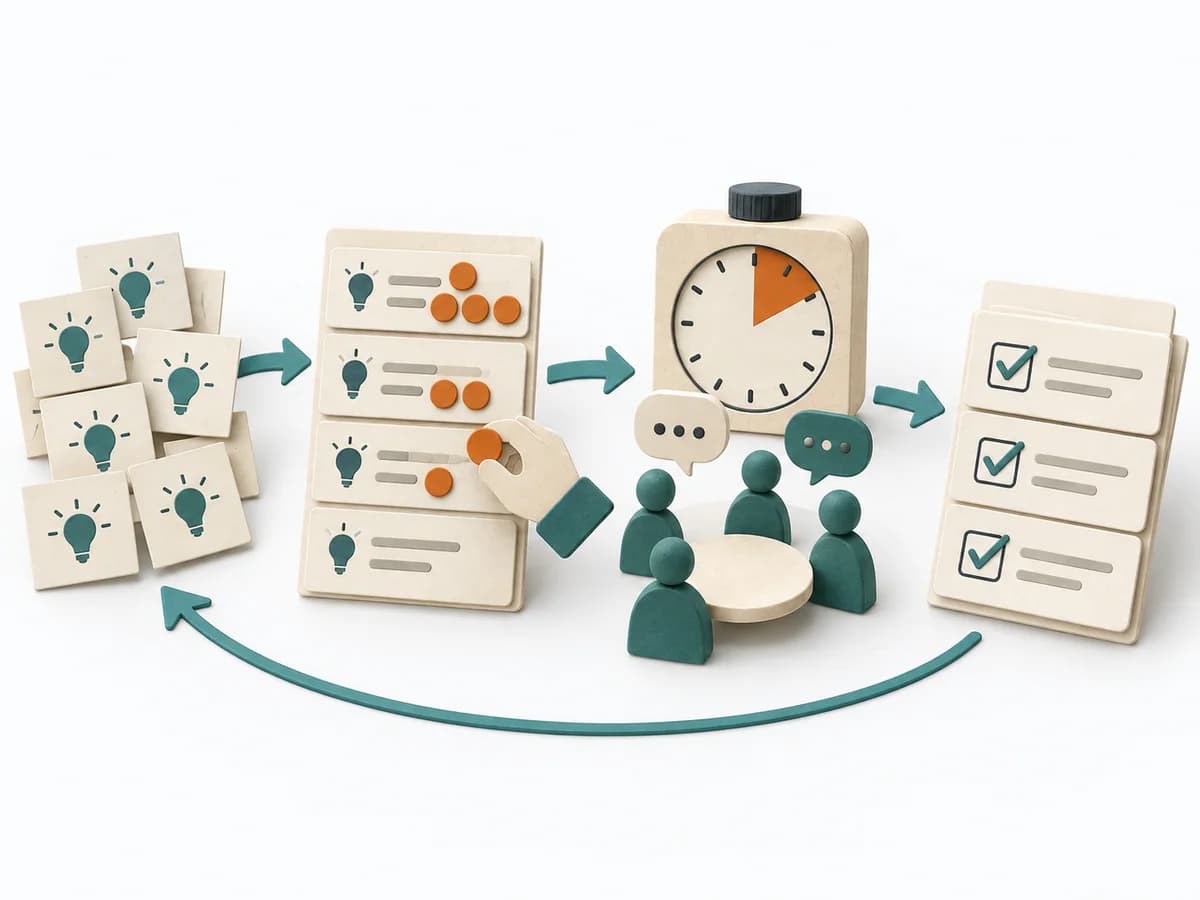
## Lean Coffee Board

### To Discuss

...

### Discussing
Limit: ...

...

### Discussed

...

### Working policies

**Agenda is built in the room**
...

**One active discussion**
...

**Timer and vote**
...

**Value**
...

[Lean Coffee · official format](https://leancoffee.org/)


## Topics: Build a visible topic backlog
Expected artifact: Topic backlog

One question per card · brief introduction

Entry:

...

- [ ] Can everyone understand what would actually be discussed for each card?

## Order: Order the backlog democratically
Expected artifact: Prioritized backlog

Votes · order · tie rule

Entry:

...

- [ ] Did everyone receive equal votes, and is the order visible?

## Talk: Timebox and steer one topic
Expected artifact: Guided conversation

Discussing · timer · extension decision

Entry:

...

- [ ] Is only one card in Discussing, and does every timebox end with a visible decision?

## Capture: Capture value and close
Expected artifact: Conversation log

Topic · learning · open question · voluntary action

Entry:

...

- [ ] Are actions explicitly agreed rather than inferred from discussion?

## Open questions and next steps

...

Method guide: https://methodatlas.meierhoff-systems.de/en/methods/lean-coffee/run-sheet