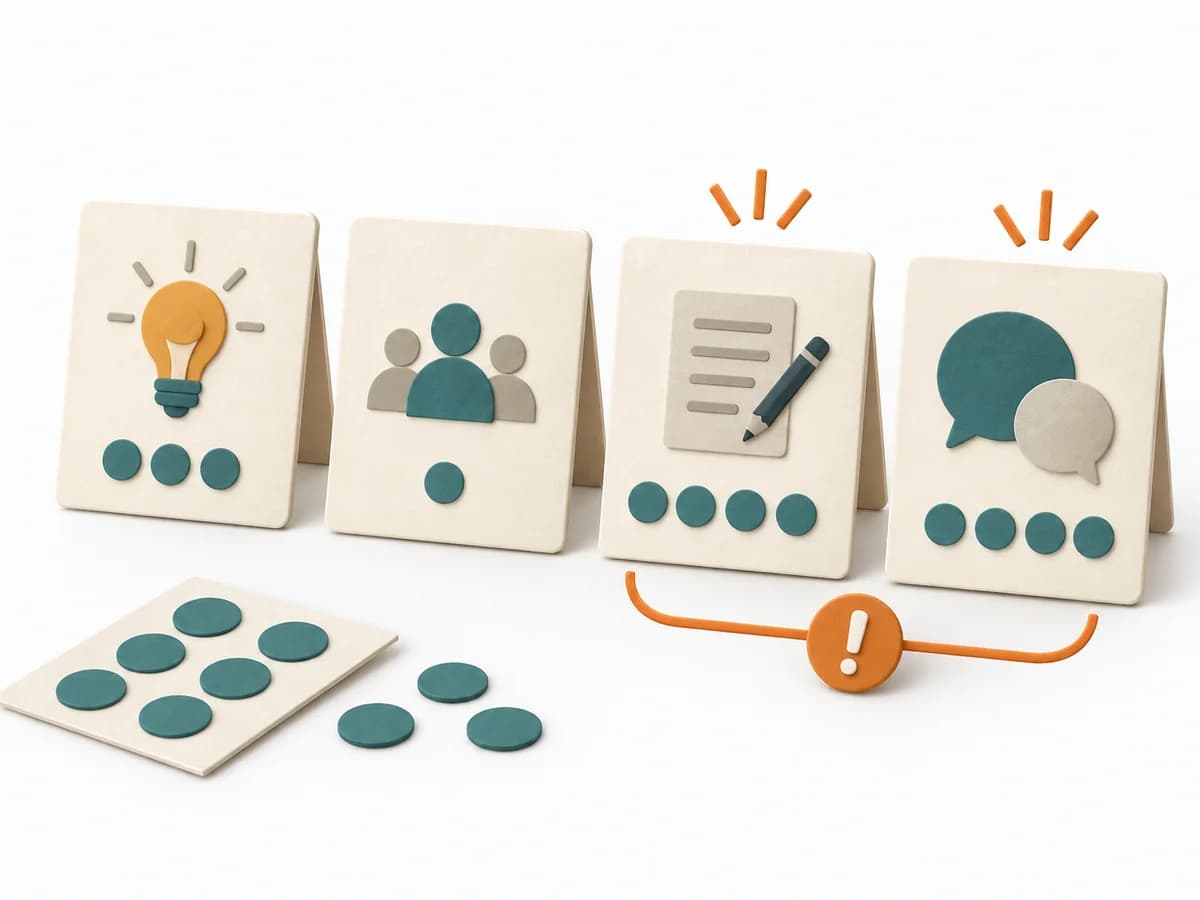
Complete firstRight to contribute
Participants may add and prioritize topics.
Without real participation the format becomes a hidden agenda.
A practical method guide: clarify prerequisites and materials, understand the complete process, and look up outputs, pitfalls, and stop criteria.
What needs to be finished first
Participants may add and prioritize topics.
Total duration and extension rule are known.
What needs to be ready before start
Three-column board, cards, pens, two voting dots per person, timer and visible remaining time.
Facilitator for rules and timer, participants as topic contributors and discussants, optional scribe.
Clarify overall theme, duration, participants and handling of confidential content; do not prepare a content agenda.
30–90 minutes
Create To Discuss, Discussing and Discussed. Set WIP 1 for Discussing, an initial five minutes per topic and a thumb-vote rule.
The one question this method answers
Which topics matter to the people present now, and how should we use the available conversation time together?
Phases with goal, actions, output and pitfall
Lean Coffee is a structured, agenda-less conversation. Participants collect topics, prioritize them democratically and discuss exactly one at a time. A three-column board shows To Discuss, Discussing and Discussed; short timeboxes end with a vote on extension.
Fictional current state
Fictional board for a 45-minute course portal exchange. Exactly one topic is discussed at a time.
How can we reduce drop-offs?
5 votes
Which data is missing?
3 votes
What causes first-login failures?
Round 2 · 5 more minutes
Do we need a tutorial?
Learning: test access before explanation
Topics
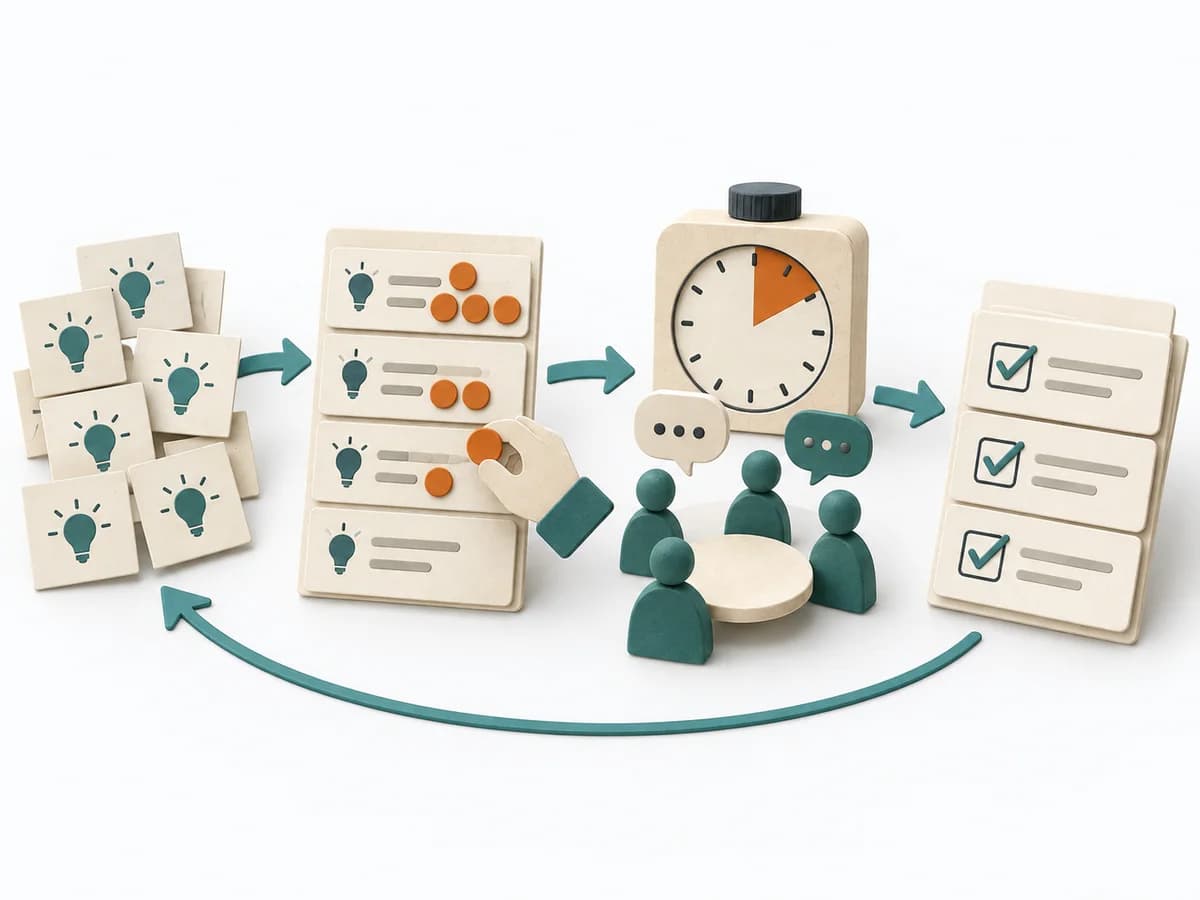
Goal
Participants build the agenda from their own concrete questions.
Inputs for this step
Actions
Output
Topic backlog
One question per card · brief introduction
Quality check
Can everyone understand what would actually be discussed for each card?
Pitfall
Cards contain only labels such as strategy or process without a concrete question. Ask the author to add the reason and desired discussion question in one sentence.
Timing: 5–10 minutes
Order
Goal
Interest among those present determines the initial conversation order.
Inputs for this step
Actions
Output
Prioritized backlog
Votes · order · tie rule
Quality check
Did everyone receive equal votes, and is the order visible?
Pitfall
The facilitator chooses topics based on personal preference or hierarchy. Redistribute equal votes and show the count openly on the board.
Timing: 3–5 minutes
Talk
Goal
Exactly one prioritized topic remains in focus at a time.
Inputs for this step
Actions
Output
Guided conversation
Discussing · timer · extension decision
Quality check
Is only one card in Discussing, and does every timebox end with a visible decision?
Pitfall
Several topics blend together and the timer continues without a decision. Park side topics as new cards and explicitly extend or switch at every signal.
Timing: 5 minutes per round, extended by vote
Capture
Goal
Key learning and voluntary follow-through remain useful after the conversation.
Inputs for this step
Actions
Output
Conversation log
Topic · learning · open question · voluntary action
Quality check
Are actions explicitly agreed rather than inferred from discussion?
Pitfall
The notes turn every conversation into mandatory tasks without consent. Distinguish learning, open questions and voluntarily owned actions.
Timing: 3–8 minutes
What comes out at the end
Sketch: what the artifact looks like
Prioritized topic backlog, visible conversation flow and log of learning, open questions and confirmed actions.
Record date, theme and participant group; preserve backlog and log as a snapshot per meeting.
Prepare the whole flow or one selected phase with real inputs.
To be confirmed
To be confirmed
Complete Lean Coffee Time: 30–90 minutes
Complete this worksheet on paper or in your own document during the work.
...
Limit: ...
...
...
Agenda is built in the room ...
One active discussion ...
Timer and vote ...
Value ...
Expected artifact: Topic backlog
One question per card · brief introduction
Entry:
...
Expected artifact: Prioritized backlog
Votes · order · tie rule
Entry:
...
Expected artifact: Guided conversation
Discussing · timer · extension decision
Entry:
...
Expected artifact: Conversation log
Topic · learning · open question · voluntary action
Entry:
...
...
Method guide: https://methodatlas.meierhoff-systems.de/en/methods/lean-coffee/run-sheet
Concrete filled scenario, fictional example
Fictional example for orientation. Counts and timings describe this case and are not universal requirements.
Concrete filled scenario, fictional example
To Discuss: “How can we reduce drop-offs?” (5 votes), “Which data is missing?” (3). Discussing: “What causes first-login failures?” After five minutes, the group votes for a second round. Discussed: “Do we need a tutorial?” Learning: test access first.
Voluntary action: Nia reviews ten login failures by Friday. The remaining backlog stays visible for the next meeting.
Recognize symptoms and steer against them
Quick overview, the full text is in the matching phase in the flow
Cards contain only labels such as strategy or process without a concrete question.
Ask the author to add the reason and desired discussion question in one sentence.
The facilitator chooses topics based on personal preference or hierarchy.
Redistribute equal votes and show the count openly on the board.
Several topics blend together and the timer continues without a decision.
Park side topics as new cards and explicitly extend or switch at every signal.
The notes turn every conversation into mandatory tasks without consent.
Distinguish learning, open questions and voluntarily owned actions.
When to pause, resolve prerequisites, or choose another approach
Go to the profile for purpose, similar methods, and sources or continue to the next method in the catalog.