Complete firstClear working frame
Bring one story, its user context and known open questions.
Without a bounded question or checkable evidence, the result will be unclear.
A practical method guide: clarify prerequisites and materials, understand the complete process, and look up outputs, pitfalls, and stop criteria.
What needs to be finished first
Bring one story, its user context and known open questions.
What needs to be ready before start
One story, domain rules or user evidence, existing acceptance examples and access to technical questions.
Business/product · engineering · test/quality; add other roles only for a specific need.
Choose materials, data access and participants to fit the research or decision question.
15–30 minutes per prepared story; separate research for unresolved questions.
Open the method-specific structure. Fictional examples are for orientation only; keep the blank worksheet separate from actual findings.
The one question this method answers
Which examples express business intent, technical feasibility and testable behavior?
Phases with goal, actions, output and pitfall
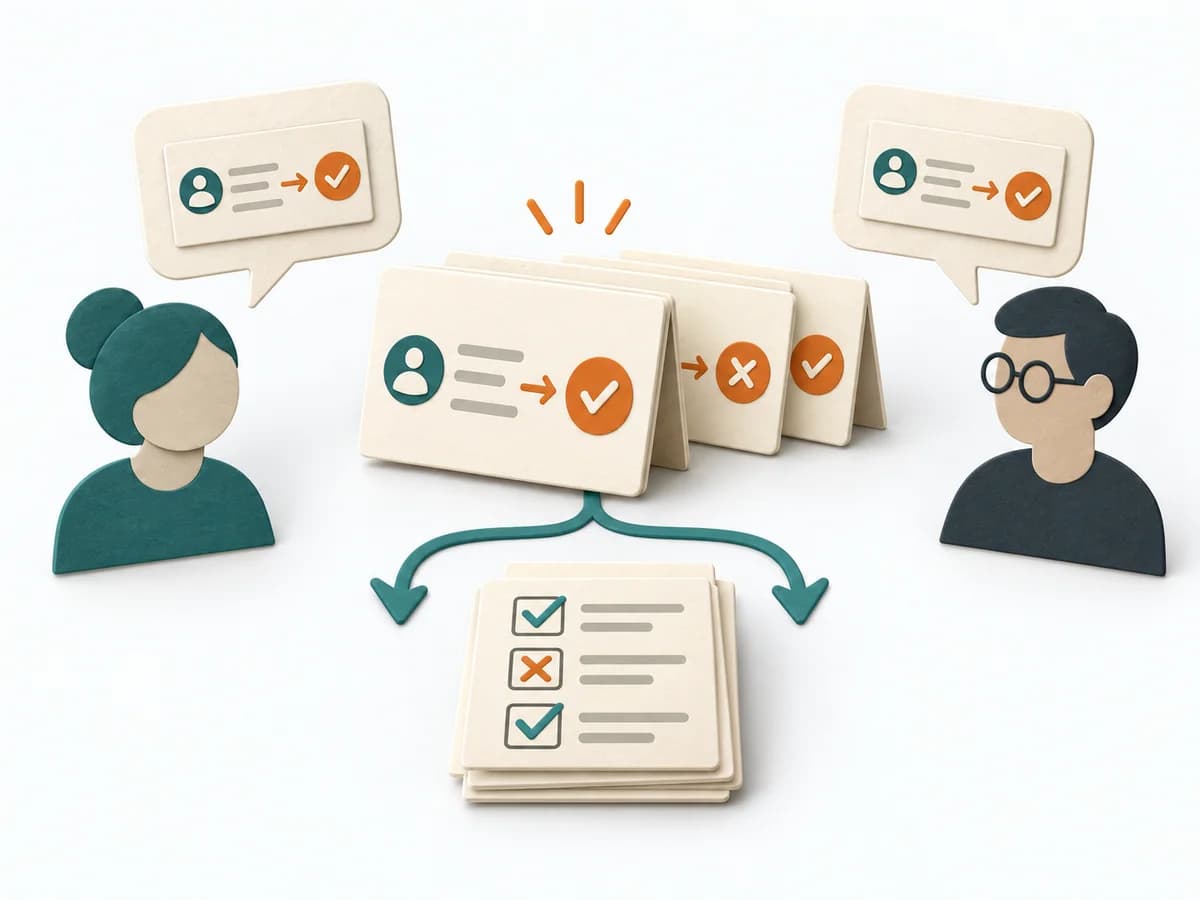
Three perspectives jointly examine one story: business intent, implementation and testability. Examples make assumptions visible before implementation.
Fictional example
Method-specific prompts and a fictional worked example; template prompts remain empty.
Choose one story that needs examples or rule clarification.
**Story:** “As a customer, I want to save a delivery address so that my next order takes less time.”
Walk through examples of expected behavior.
**Business example:** A valid address can be selected; an incomplete address cannot be saved.
Name relevant technical and operational constraints.
**Technical question:** Check the existing address model and user permissions before implementation.
State trigger and expected result for each example.
**Test examples:** Valid address → selection is available; missing postal code → clear error.
Agile Alliance describes a Three Amigos conversation across perspectives around a story; examples focus it before delivery.
Story

Goal
Choose one story that needs examples or rule clarification.
Inputs for this step
Actions
Output
Shared story focus
Shared story focus
Quality check
Is the discussion scope clear?
Pitfall
The group debates product strategy or an entire system. Narrow the item and clarify intent first.
Timing: About 10–20 minutes; schedule data or clarification work separately.
Business

Goal
Walk through examples of expected behavior.
Inputs for this step
Actions
Output
Examples of desired behavior
Examples of desired behavior
Quality check
Do examples reflect intent and rules?
Pitfall
Terms are assumed to mean the same thing. Explore concrete inputs, rules and outcomes.
Timing: About 10–20 minutes; schedule data or clarification work separately.
Engineering
Goal
Name relevant technical and operational constraints.
Inputs for this step
Actions
Output
Technical conditions and open questions
Technical conditions and open questions
Quality check
Are dependencies and data risks visible?
Pitfall
Implementation details crowd out user behavior. Record only decision-relevant risks; plan deeper design separately.
Timing: About 10–20 minutes; schedule data or clarification work separately.
Tests

Goal
State trigger and expected result for each example.
Inputs for this step
Actions
Output
Shared examples and next steps
Shared examples and next steps
Quality check
Can examples be checked reproducibly?
Pitfall
Acceptance criteria are vague. Write explicit condition and observable outcome.
Timing: About 10–20 minutes; schedule data or clarification work separately.
What comes out at the end
Sketch: what the artifact looks like
Versioned record of question, evidence, result, uncertainty, owners and next review date.
Track date, scope, sources, assumptions and changes; assign an owner and review for ongoing practice or initiatives.
Plan a session or initiative to match the actual scope of work.
To be confirmed
To be confirmed
Prepare the full method Time: 15–30 minutes per prepared story; separate research for unresolved questions.
Complete this worksheet on paper or in your own document during the work.
Choose one story that needs examples or rule clarification.
...
Walk through examples of expected behavior.
...
Name relevant technical and operational constraints.
...
State trigger and expected result for each example.
...
Blank worksheet contains prompts only, with no example data.
Expected artifact: Shared story focus
Shared story focus
Entry:
...
Expected artifact: Examples of desired behavior
Examples of desired behavior
Entry:
...
Expected artifact: Technical conditions and open questions
Technical conditions and open questions
Entry:
...
Expected artifact: Shared examples and next steps
Shared examples and next steps
Entry:
...
...
Method guide: https://methodatlas.meierhoff-systems.de/en/methods/three-amigos/run-sheet
Concrete filled scenario, fictional example
Fictional example for orientation. Counts and timings describe this case and are not universal requirements.
Concrete filled scenario, fictional example
Story: “As a customer, I want to save a delivery address so that my next order takes less time.”
Business example: A valid address can be selected; an incomplete address cannot be saved.
Technical question: Check the existing address model and user permissions before implementation.
Test examples: Valid address → selection is available; missing postal code → clear error.
Open: Does an address change affect orders already being prepared? Record an owner and follow-up date.
Recognize symptoms and steer against them
Quick overview, the full text is in the matching phase in the flow
The group debates product strategy or an entire system.
Narrow the item and clarify intent first.
Terms are assumed to mean the same thing.
Explore concrete inputs, rules and outcomes.
Implementation details crowd out user behavior.
Record only decision-relevant risks; plan deeper design separately.
Acceptance criteria are vague.
Write explicit condition and observable outcome.
When to pause, resolve prerequisites, or choose another approach
Go to the profile for purpose, similar methods, and sources or continue to the next method in the catalog.