Plan my session
Plan a concrete work block with agenda, roles, preparation, and a copyable result artifact.
Session: Three Amigos
The plan translates the method into a concrete facilitated work block. Your inputs flow directly into the session brief and work artifact.
Method session with 3. The plan uses the existing method logic and the runsheet.
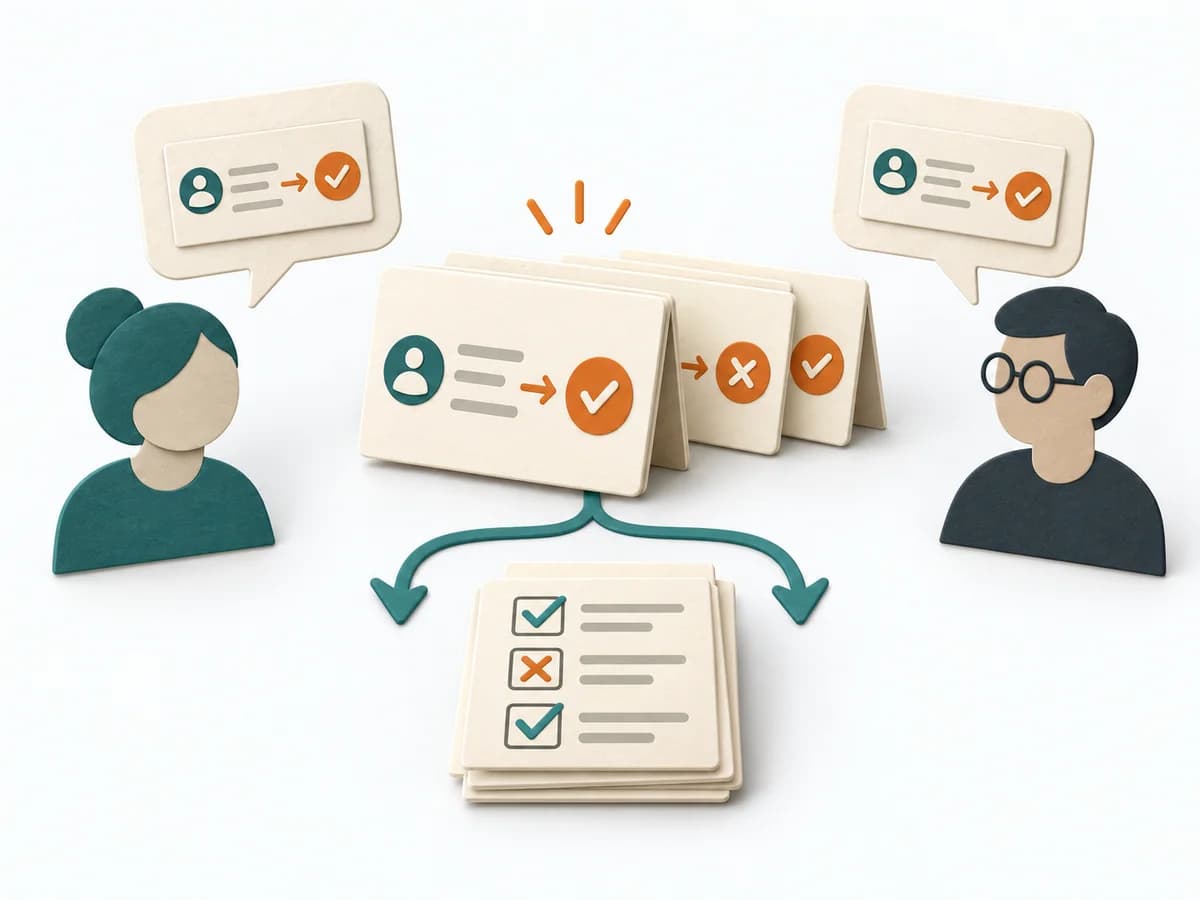
RunsheetUse the session for shared understanding. Contributions are collected visibly, assumptions are aligned, and open differences remain traceable in the artifact.
The session works directly toward Clarified Story. After the session, the artifact should be shareable, reviewable, or reusable.
- 1
Phase 1: Story walkthrough
5-10 minProduct explains the story, outcome, and why. Acceptance criteria are read aloud. First clarification questions from Dev and QA are collected. Hint: If the story description needs more than 5 min of explanation, it is not refinement-ready. Split the story or return it to the PO.
FacilitatorClarified Story - 2
Phase 2: Examples and edge cases
10-15 minCollect concrete examples (Given-When-Then) per acceptance criterion. QA actively asks about edge cases, failure cases, boundary values. Dev checks feasibility. Hint: Three Amigos work together on one story level. If only the PO speaks, the method slips back into briefing. Force active questions.
FacilitatorTest Examples - 3
Phase 3: Open questions and risks
5-10 minList open questions on the board. Mark assumptions. Mark risks (technical, business). Check against Definition of Ready. Hint: If more than 3 open questions are critical, the story is not ready. Better return it to the PO and do not take it into the sprint.
FacilitatorOpen Questions - 4
Phase 4: Story update
5-10 minUpdate the story: updated acceptance criteria, examples, open questions, possible Definition-of-Done additions. Create sub-task for open questions with owner. Hint: Without story update, the meeting evaporates. Update directly in the backlog tool, not only verbally. Decide who updates at the start.
OwnerClarified Story - 5
Publish artifact
10 minCheck the artifact for completeness, define location, set version or status, and name review recipients.
OwnerClarified Story
Session Brief
For invitations, boards, tickets, PR descriptions, or workshop notes.
session-brief.md
Session Brief: Three Amigos
Goal
Artifact: Clarified Story
Working Question
Are what, how, and what-can-break clear enough for the story to be implemented without further refinement?
Context
Story draft incl. acceptance criteria; relevant designs, mockups, API specifications; known edge cases; Definition of Ready.
Setup
- Format: Method session
- Duration: 20-45 min per story
- Mode: Workshop or async
- Participants: Three Amigos: one representative Business/Product (what and why), one representative Development (how), one representative Test/QA (what can break). Maximum four people, otherwise it becomes story refinement.
- Owner: Three Amigos: one representative Business/Product (what and why), one representative Development (how), one representative Test/QA (what can break)
- Participation mode: Team round, shared work and alignment
- Outcome logic: Finish artifact
Participation Logic
Use the session for shared understanding. Contributions are collected visibly, assumptions are aligned, and open differences remain traceable in the artifact.
Outcome Logic
The session works directly toward Clarified Story. After the session, the artifact should be shareable, reviewable, or reusable.
Input
Story in the backlog tool; whiteboard or Miro with columns (acceptance criteria, examples, questions); links to designs, APIs, data models; timer.
Preparation
Set timer. Share story URL. Rule: each person speaks from their perspective, no lifestyle talk. Result is a story update with clear acceptance criteria, examples, and open questions.
Agenda
-
Phase 1: Story walkthrough (5-10 min) Owner: Facilitator Action: Product explains the story, outcome, and why. Acceptance criteria are read aloud. First clarification questions from Dev and QA are collected. Hint: If the story description needs more than 5 min of explanation, it is not refinement-ready. Split the story or return it to the PO. Output: Clarified Story
-
Phase 2: Examples and edge cases (10-15 min) Owner: Facilitator Action: Collect concrete examples (Given-When-Then) per acceptance criterion. QA actively asks about edge cases, failure cases, boundary values. Dev checks feasibility. Hint: Three Amigos work together on one story level. If only the PO speaks, the method slips back into briefing. Force active questions. Output: Test Examples
-
Phase 3: Open questions and risks (5-10 min) Owner: Facilitator Action: List open questions on the board. Mark assumptions. Mark risks (technical, business). Check against Definition of Ready. Hint: If more than 3 open questions are critical, the story is not ready. Better return it to the PO and do not take it into the sprint. Output: Open Questions
-
Phase 4: Story update (5-10 min) Owner: Owner Action: Update the story: updated acceptance criteria, examples, open questions, possible Definition-of-Done additions. Create sub-task for open questions with owner. Hint: Without story update, the meeting evaporates. Update directly in the backlog tool, not only verbally. Decide who updates at the start. Output: Clarified Story
-
Publish artifact (10 min) Owner: Owner Action: Check the artifact for completeness, define location, set version or status, and name review recipients. Output: Clarified Story
Closeout
- Update result artifact: Clarified Story
- Define location, version, and review recipients.
- Define owner, next step, and review date.
Work artifact
Pre-filled starting point based on the matching template.
work-artifact.md
Clarified Story: Three Amigos
Working Question
Are what, how, and what-can-break clear enough for the story to be implemented without further refinement?
Context
Story draft incl. acceptance criteria; relevant designs, mockups, API specifications; known edge cases; Definition of Ready.
Participants
- Owner: Three Amigos: one representative Business/Product (what and why), one representative Development (how), one representative Test/QA (what can break)
- Participants: Three Amigos: one representative Business/Product (what and why), one representative Development (how), one representative Test/QA (what can break). Maximum four people, otherwise it becomes story refinement.
Input
Story in the backlog tool; whiteboard or Miro with columns (acceptance criteria, examples, questions); links to designs, APIs, data models; timer.
Template
Three Amigos Working Template
Goal
A short alignment session for a story from business, development, and test perspectives.
Context
When and for what do we use this method?
Input
Which data, observations, decisions, or materials are available?
Execution
Short notes along the runsheet.
Output artifacts
- Clarified Story:
- Test Examples:
- Open Questions:
Assumptions and open questions
- ...
Decision / Next step
Owner, date, and success signal.
Completion Check
- Clarified Story is complete enough for review:
- Location:
- Version / status:
- Review by:
- Next step:
Next Step
- Review result
- Mark open questions
- Schedule review or decision
Three Amigos Working Template
View templateCompact working template for Three Amigos with context, input, output artifacts, and next step.markdown
three-amigos-working-template.md
Compact working template for Three Amigos with context, input, output artifacts, and next step.
Three Amigos Working Template
Goal
A short alignment session for a story from business, development, and test perspectives.
Context
When and for what do we use this method?
Input
Which data, observations, decisions, or materials are available?
Execution
Short notes along the runsheet.
Output artifacts
- Clarified Story:
- Test Examples:
- Open Questions:
Assumptions and open questions
- ...
Decision / Next step
Owner, date, and success signal.
- Working question, owner, and target artifact are visible.
- The result fits Clarified Story.
- Track story changes through the backlog tool. Add Three-Amigos date, participants, and main result as comment or custom field. For larger changes, archive previous acceptance criteria.
- Open questions are noted as follow-ups.
- The next review or decision point is scheduled.