Complete firstBounded subject
The scope and purpose of Team Topologies Interaction Modes are stated as a concrete question.
Without scope, interaction mode map becomes arbitrary.
A practical method guide: clarify prerequisites and materials, understand the complete process, and look up outputs, pitfalls, and stop criteria.
What needs to be finished first
The scope and purpose of Team Topologies Interaction Modes are stated as a concrete question.
Team boundaries and APIs, concrete shared outcomes, dependency and flow data and domain decision makers are available.
What needs to be ready before start
Team boundaries and APIs, concrete shared outcomes, dependency and flow data, shared workspace, source links, and decision log.
Representatives of both teams · team leads · enabling team if needed
Collect Team boundaries and APIs, concrete shared outcomes, dependency and flow data in advance and mark open assumptions.
60 minutes
Prepare assign a team relationship to one of three modes using outcome, knowledge flow, and desired coupling visibly and calibrate assessment terms before starting.
The one question this method answers
Which interaction mode supports this outcome with the least persistent coupling?
Phases with goal, actions, output and pitfall
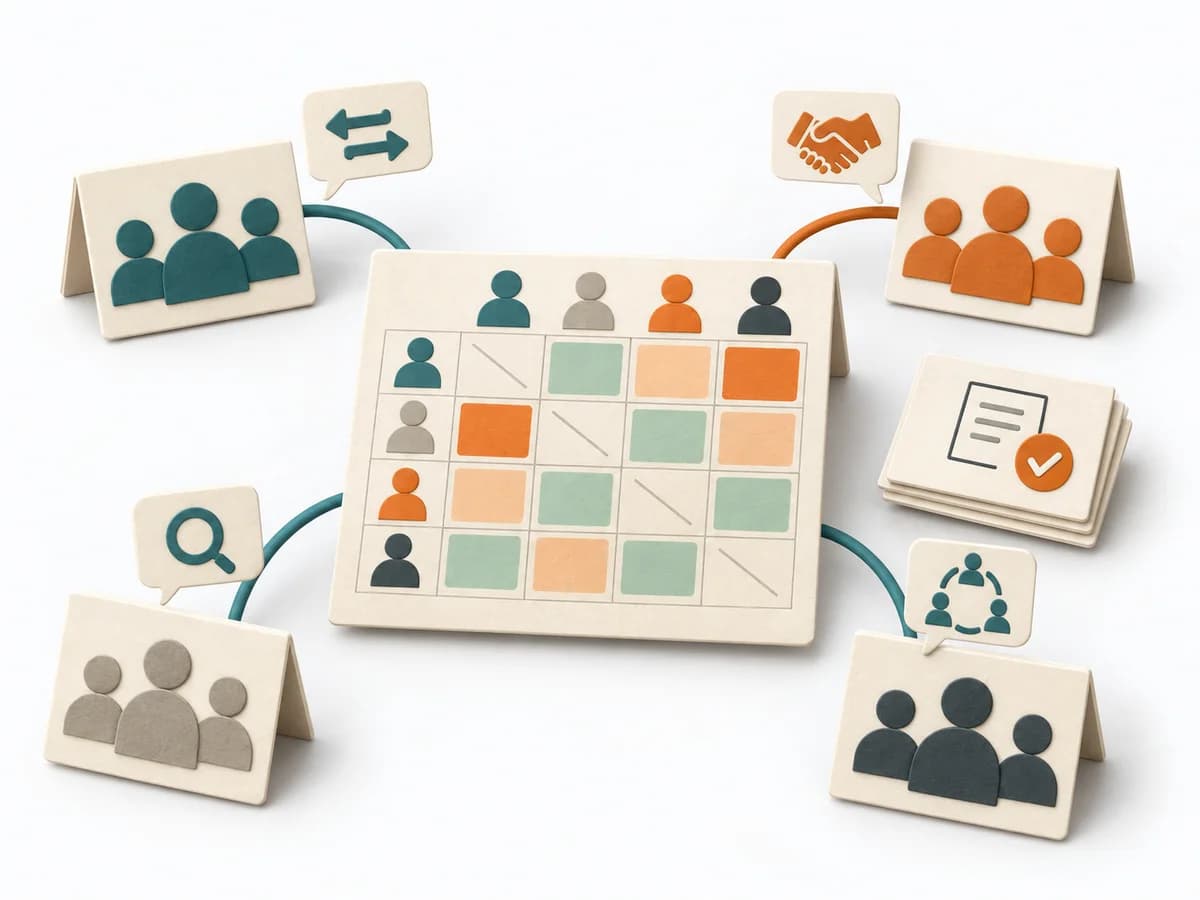
The three interaction modes describe a time-bounded working relationship. Collaboration needs a shared goal and end date, X-as-a-Service a clear interface, and Facilitating a specific capability gap.
Fictional worked example
assign a team relationship to one of three modes using outcome, knowledge flow, and desired coupling as a precise working structure with a fictional example.
| Subject | Team relationship | Mode | Frame | Exit |
|---|---|---|---|---|
| interaction mode mapWorked example | Product ↔ enabling: adopt observability. | Facilitating due to capability gap. | Four weeks; three standard dashboards. | Self-operation achieved; then XaaS. |
The example demonstrates the domain logic of Team Topologies Interaction Modes; worksheets remain blank.
Bound relationship
Goal
Produce relationship profile so the core question “Which interaction mode supports this outcome with the least persistent coupling?” can be answered with stronger support.
Inputs for this step
Actions
Output
relationship profile
relationship profile · source · uncertainty · next decision
Quality check
Is a concrete outcome named rather than generic cooperation?
Pitfall
Collaboration becomes the permanent default or X-as-a-Service lacks a usable interface. Re-establish outcome, knowledge gap, coupling need, and end date, then adjust the mode.
Timing: 10–20 minutes
Choose mode
Goal
Produce mode decision so the core question “Which interaction mode supports this outcome with the least persistent coupling?” can be answered with stronger support.
Inputs for this step
Actions
Output
mode decision
mode decision · source · uncertainty · next decision
Quality check
Does the mode fit the type of uncertainty?
Pitfall
Collaboration becomes the permanent default or X-as-a-Service lacks a usable interface. Re-establish outcome, knowledge gap, coupling need, and end date, then adjust the mode.
Timing: 10–20 minutes
Frame interaction
Goal
Produce interaction contract so the core question “Which interaction mode supports this outcome with the least persistent coupling?” can be answered with stronger support.
Inputs for this step
Actions
Output
interaction contract
interaction contract · source · uncertainty · next decision
Quality check
Are start, end, and expected capability clear?
Pitfall
Collaboration becomes the permanent default or X-as-a-Service lacks a usable interface. Re-establish outcome, knowledge gap, coupling need, and end date, then adjust the mode.
Timing: 10–20 minutes
Review mode
Goal
Produce review decision so the core question “Which interaction mode supports this outcome with the least persistent coupling?” can be answered with stronger support.
Inputs for this step
Actions
Output
review decision
review decision · source · uncertainty · next decision
Quality check
Does the next mode prevent unnecessary coupling?
Pitfall
Collaboration becomes the permanent default or X-as-a-Service lacks a usable interface. Re-establish outcome, knowledge gap, coupling need, and end date, then adjust the mode.
Timing: 10–20 minutes
What comes out at the end
Sketch: what the artifact looks like
Versioned interaction mode map with date, sources, owners, and next review.
Retain date, source, assumption state, and decision for every version of interaction mode map.
Plan Team Topologies Interaction Modes around its domain steps and the concrete decision question.
To be confirmed
To be confirmed
Establish and review the practice Time: 60 minutes
Complete this worksheet on paper or in your own document during the work.
| Subject | Team A · team B · outcome | Collaboration · XaaS · Facilitating + reason | Timebox · interface · responsibilities | Criterion · next mode · review |
|---|---|---|---|---|
| interaction mode map |
Enter only real input, sources, and decisions.
Team Topologies: Team Interaction Modeling
Expected artifact: relationship profile
relationship profile · source · uncertainty · next decision
Entry:
...
Expected artifact: mode decision
mode decision · source · uncertainty · next decision
Entry:
...
Expected artifact: interaction contract
interaction contract · source · uncertainty · next decision
Entry:
...
Expected artifact: review decision
review decision · source · uncertainty · next decision
Entry:
...
...
Method guide: https://methodatlas.meierhoff-systems.de/en/methods/team-topologies-interaction-modes/run-sheet
Concrete filled scenario, fictional example
Fictional example for orientation. Counts and timings describe this case and are not universal requirements.
Concrete filled scenario, fictional example
Product team ↔ enabling team: Facilitating for four weeks, goal: the team can operate three standard dashboards itself. Then platform team → product team as X-as-a-Service through a documented telemetry API. No permanent collaboration pairing.
Recognize symptoms and steer against them
Quick overview, the full text is in the matching phase in the flow
Collaboration becomes the permanent default or X-as-a-Service lacks a usable interface.
Re-establish outcome, knowledge gap, coupling need, and end date, then adjust the mode.
Collaboration becomes the permanent default or X-as-a-Service lacks a usable interface.
Re-establish outcome, knowledge gap, coupling need, and end date, then adjust the mode.
Collaboration becomes the permanent default or X-as-a-Service lacks a usable interface.
Re-establish outcome, knowledge gap, coupling need, and end date, then adjust the mode.
Collaboration becomes the permanent default or X-as-a-Service lacks a usable interface.
Re-establish outcome, knowledge gap, coupling need, and end date, then adjust the mode.
When to pause, resolve prerequisites, or choose another approach
Go to the profile for purpose, similar methods, and sources or continue to the next method in the catalog.