Complete firstSmall business change
The story or rule is small enough for concrete examples.
Oversized scope creates disconnected scenarios and hides rules.
A practical method guide: clarify prerequisites and materials, understand the complete process, and look up outputs, pitfalls, and stop criteria.
What needs to be finished first
The story or rule is small enough for concrete examples.
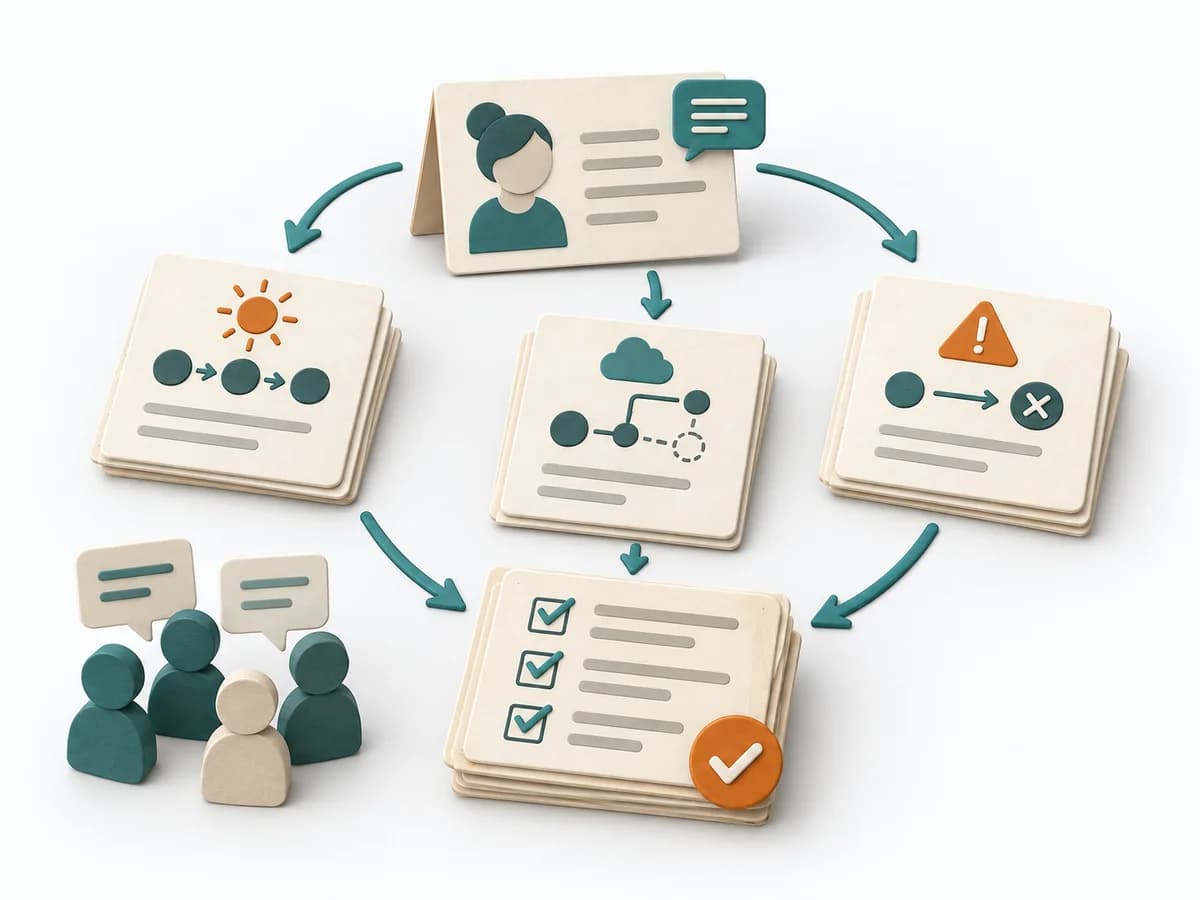
Domain/Product, Development, and Test contribute their perspectives.
What needs to be ready before start
Story or rule, real cases, four-colour Example Mapping cards, domain vocabulary, feature file, and test access.
Product/domain expert · developer · tester · optional facilitator
Select a small change, gather known rules and incidents, and invite a domain decision maker.
25–45 minutes of Discovery per small story; Formulation and Automation follow
Keep story, rules, examples, and questions separate; formulate Gherkin only after shared Discovery.
The one question this method answers
Which concrete examples show that the business rule is correctly, completely, and testably understood?
Phases with goal, actions, output and pitfall
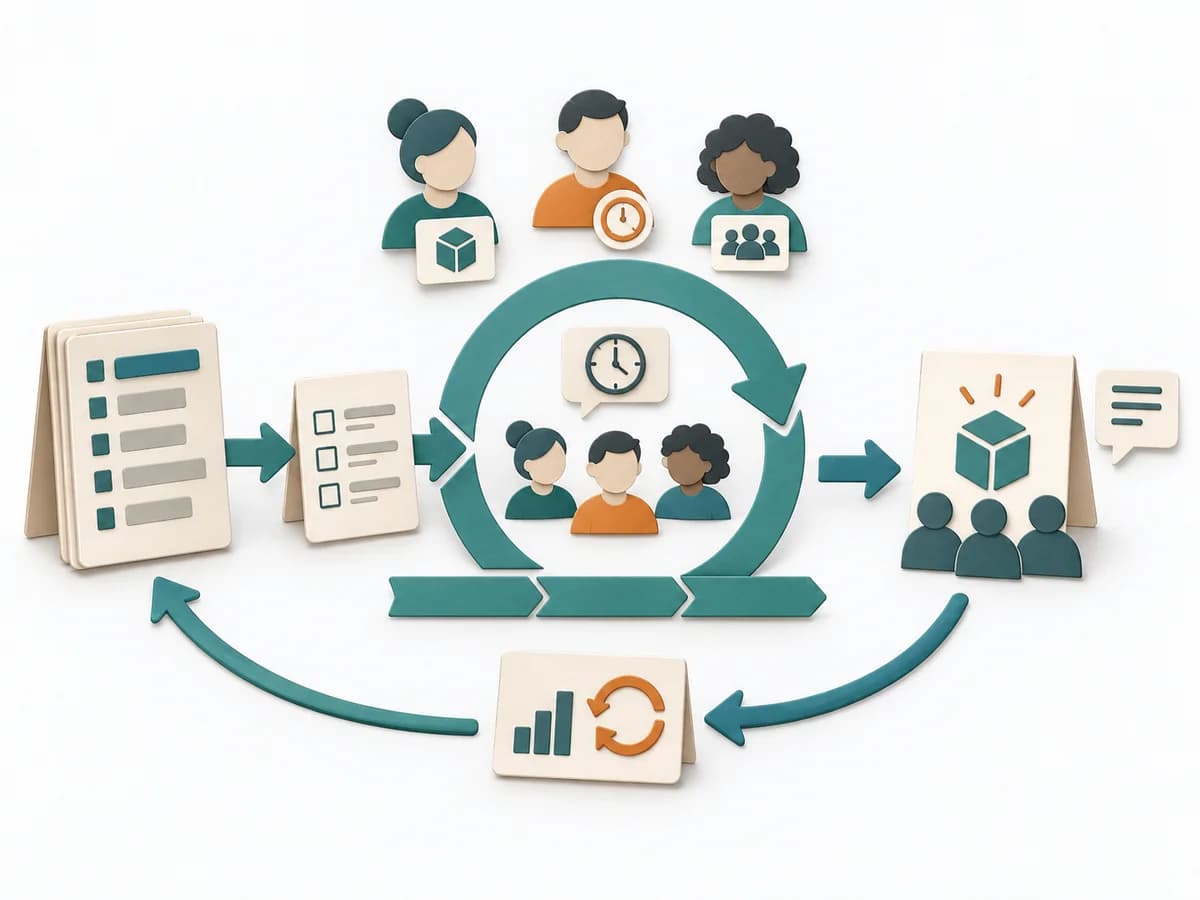
Specification by Example connects Discovery, Formulation, and Automation. Business, development, and test roles clarify rules with realistic examples, express them in domain language, and keep executable specifications aligned with system behaviour.
Fictional worked example
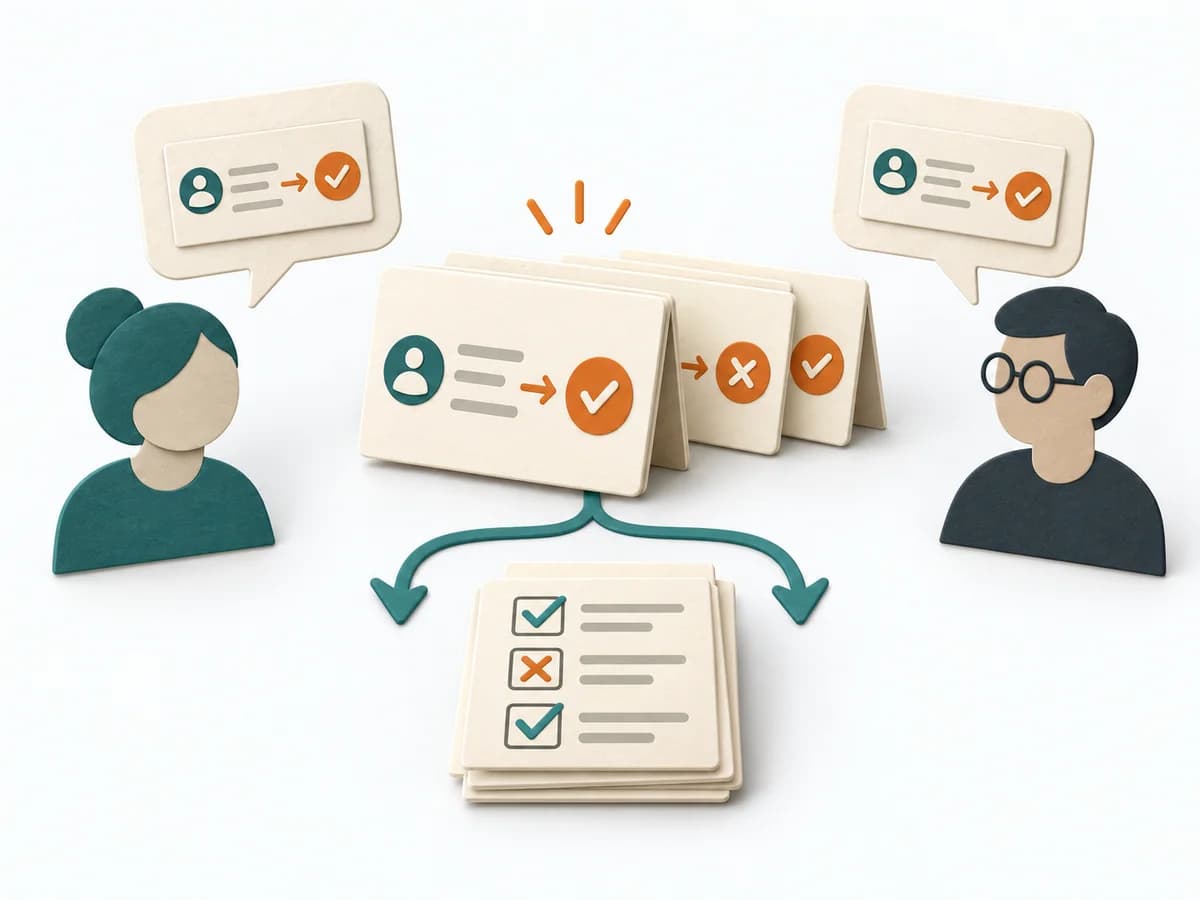
Each row connects a business rule to one concrete example and remaining clarification.
| Example | Business rule | Given: context | When: event | Then: outcome | Open question or boundary |
|---|---|---|---|---|---|
| Cancellation exactly 24 hours beforeBoundary example | Cancellation is free until and including 24 hours before start. | Appointment starts 20 June at 10:00; €120 paid. | Customer cancels 19 June at 10:00. | €120 is refunded in full; confirmation shows €0 fee. | Which timezone determines start and cancellation time? |
One example illustrates one rule. Resolve questions before Formulation or defer them visibly.
Discover
Goal
Build shared understanding of the rule, boundaries, and open questions.
Inputs for this step
Actions
Output
Example map
Rules · examples · questions · scope
Quality check
Does each example illustrate one rule?
Pitfall
The conversation jumps straight into Gherkin or click paths and hides domain uncertainty. Return to plain-language rules, examples, and expected effects.
Timing: 20–30 minutes
Formulate
Goal
Express selected examples with context, event, and expected outcome.
Inputs for this step
Actions
Output
Executable specification
Rule · Example · Given · When · Then
Quality check
Can a domain expert review behaviour without implementation knowledge?
Pitfall
Scenarios contain click paths and selectors, so a UI change breaks the business specification. Raise steps to domain actions and observable outcomes.
Timing: 15–30 minutes
Automate
Goal
Integrate executable examples as fast, reliable delivery feedback.
Inputs for this step
Actions
Output
Automated examples
Specification · test binding · result
Quality check
Does failure explain a business-relevant reason?
Pitfall
Every example is automated through a slow end-to-end UI and becomes brittle. Automate at the lowest level that still expresses the business behaviour.
Timing: Varies per example
Maintain
Goal
Synchronise rules, examples, automation, and system behaviour when change occurs.
Inputs for this step
Actions
Output
Living documentation
Current rules · examples · test status
Quality check
Does every green example still describe relevant behaviour?
Pitfall
Scenarios remain green but explain obsolete rules or implementation details only. Assign rule ownership and review specification with code.
Timing: Ongoing
What comes out at the end
Sketch: what the artifact looks like
Versioned Rule/Example specification with question log, automation binding, and test status.
Retain date, author, source state, and decision status for each revision; do not overwrite earlier results.
Plan Specification by Example with real scope, suitable roles, and a clear decision objective.
To be confirmed
To be confirmed
Establish and review the practice Time: 25–45 minutes of Discovery per small story; Formulation and Automation follow
Complete this worksheet on paper or in your own document during the work.
| Example | Rule | Initial context | Event | Observable outcome | Question · boundary |
|---|---|---|---|---|---|
| Cancellation exactly 24 hours before |
Describe business behaviour; omit UI and implementation detail.
Cucumber: Behaviour-Driven Development
Expected artifact: Example map
Rules · examples · questions · scope
Entry:
...
Expected artifact: Executable specification
Rule · Example · Given · When · Then
Entry:
...
Expected artifact: Automated examples
Specification · test binding · result
Entry:
...
Expected artifact: Living documentation
Current rules · examples · test status
Entry:
...
...
Method guide: https://methodatlas.meierhoff-systems.de/en/methods/specification-by-example/run-sheet
Concrete filled scenario, fictional example
Fictional example for orientation. Counts and timings describe this case and are not universal requirements.
Concrete filled scenario, fictional example
Fictional example: rule 'Free cancellation until 24 hours before start'. Example: start 20 June 10:00, cancellation 19 June 09:59, paid €120, expected refund €120. Boundary: cancellation at 19 June 10:00 is also free because it is exactly 24 hours. Question: which timezone applies?
Recognize symptoms and steer against them
Quick overview, the full text is in the matching phase in the flow
The conversation jumps straight into Gherkin or click paths and hides domain uncertainty.
Return to plain-language rules, examples, and expected effects.
Scenarios contain click paths and selectors, so a UI change breaks the business specification.
Raise steps to domain actions and observable outcomes.
Every example is automated through a slow end-to-end UI and becomes brittle.
Automate at the lowest level that still expresses the business behaviour.
Scenarios remain green but explain obsolete rules or implementation details only.
Assign rule ownership and review specification with code.
When to pause, resolve prerequisites, or choose another approach
Go to the profile for purpose, similar methods, and sources or continue to the next method in the catalog.