Plan my session
Plan a concrete work block with agenda, roles, preparation, and a copyable result artifact.
Session: Specification by Example
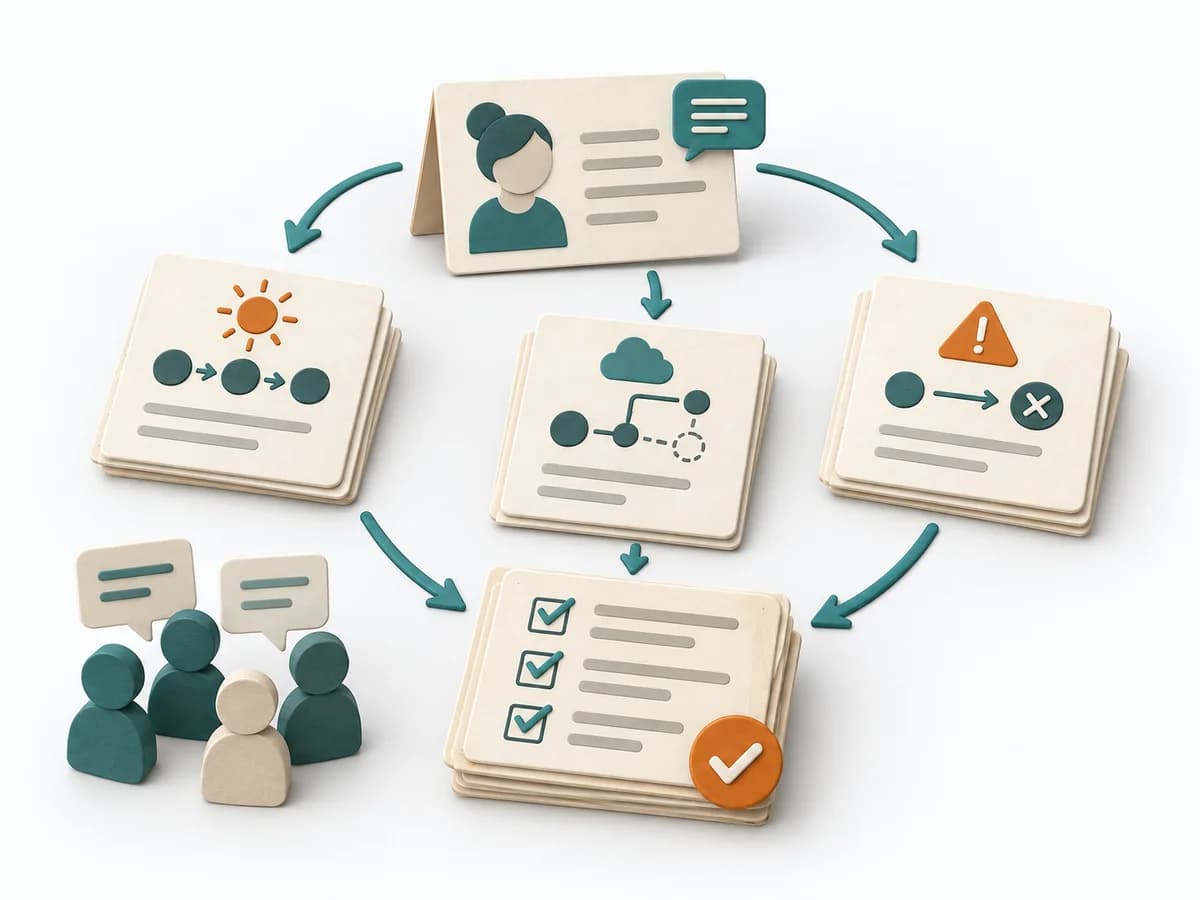
The plan translates the method into a concrete facilitated work block. Your inputs flow directly into the session brief and work artifact.
Method session with 3-6. The plan uses the existing method logic and the runsheet.
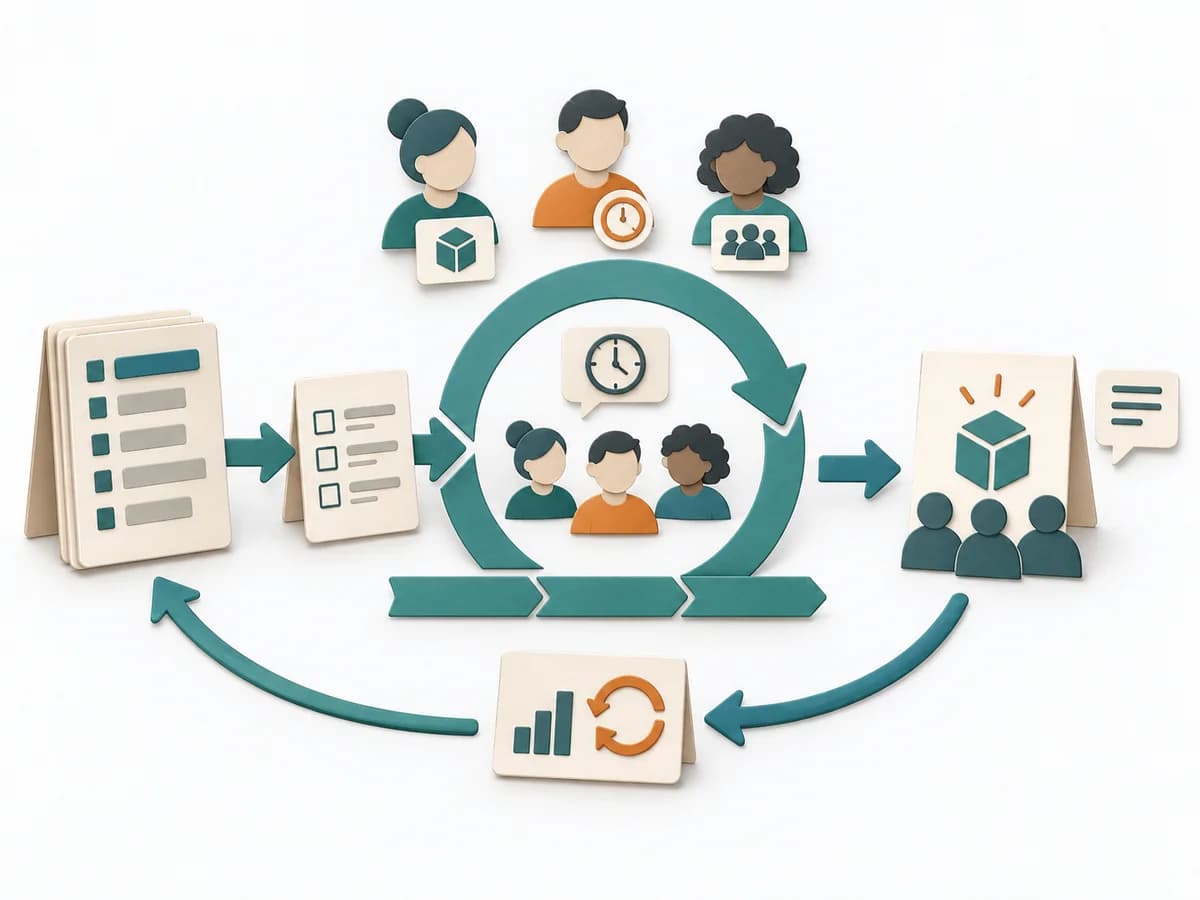
RunsheetUse the session for shared understanding. Contributions are collected visibly, assumptions are aligned, and open differences remain traceable in the artifact.
The session works directly toward Beispieltabelle. After the session, the artifact should be shareable, reviewable, or reusable.
- 1
Phase 1: Clarify story and rules
10-15 minPresent story or feature. Name 1-5 rules per story that describe the logic (for example "discount from EUR 100 order value"). Hint: If rules are not stable, the story is not ready for Specification by Example. Negotiate rules with PO first, then examples.
FacilitatorBeispieltabelle - 2
Phase 2: Happy-path examples
15-20 minFormulate at least one happy-path example per rule: concrete input values, expected output. Examples in table or Given-When-Then. Hint: Choose meaningful values (for example EUR 99.99, EUR 100.00, EUR 100.01 instead of only 50, 100, 200). Meaningless values hide boundaries.
FacilitatorAcceptance Tests - 3
Phase 3: Boundaries and edge cases
15-25 minActively search boundaries: null values, maximum values, empty lists, invalid inputs, parallel conditions. One example per edge case. Hint: Testers drive this phase. If no edge cases are found, the story was understood too superficially. Boundary search is the method's core.
FacilitatorBeispieltabelle - 4
Phase 4: Hand examples over as acceptance tests
10-15 minConvert examples into test-framework format (Gherkin, JSON, CSV). Engineering implements tests before code. Tester reviews coverage. Hint: If examples are not automatable, the step was cut short. Gold standard: examples become executable acceptance tests. Manual tests are a valid fallback.
OwnerAcceptance Tests - 5
Publish artifact
10 minCheck the artifact for completeness, define location, set version or status, and name review recipients.
OwnerBeispieltabelle
Session Brief
For invitations, boards, tickets, PR descriptions, or workshop notes.
session-brief.md
Session Brief: Specification by Example
Goal
Artifact: Beispieltabelle
Working Question
Which concrete examples describe the business logic unambiguously enough to serve as executable tests?
Context
Story description with acceptance criteria; existing business rules (for example from docs, legal texts); domain glossary; list of known special cases.
Setup
- Format: Method session
- Duration: 60-90 min per feature
- Mode: Workshop
- Participants: One facilitator (tester or BA); Product Owner or domain expert; engineer with implementation knowledge; optional tester for edge-case search.
- Owner: One facilitator (tester or BA)
- Participation mode: Team round, shared work and alignment
- Outcome logic: Finish artifact
Participation Logic
Use the session for shared understanding. Contributions are collected visibly, assumptions are aligned, and open differences remain traceable in the artifact.
Outcome Logic
The session works directly toward Beispieltabelle. After the session, the artifact should be shareable, reviewable, or reusable.
Input
Shared document or Confluence page with table structure; story or feature description; known rule sets from domain; examples from previous executable specifications; test framework reference (Gherkin, Cucumber, SpecFlow).
Preparation
One section per story in the document. Table with columns rule, example input, expected output, note. Gherkin template as optional structure. Glossary visible.
Agenda
-
Phase 1: Clarify story and rules (10-15 min) Owner: Facilitator Action: Present story or feature. Name 1-5 rules per story that describe the logic (for example "discount from EUR 100 order value"). Hint: If rules are not stable, the story is not ready for Specification by Example. Negotiate rules with PO first, then examples. Output: Beispieltabelle
-
Phase 2: Happy-path examples (15-20 min) Owner: Facilitator Action: Formulate at least one happy-path example per rule: concrete input values, expected output. Examples in table or Given-When-Then. Hint: Choose meaningful values (for example EUR 99.99, EUR 100.00, EUR 100.01 instead of only 50, 100, 200). Meaningless values hide boundaries. Output: Acceptance Tests
-
Phase 3: Boundaries and edge cases (15-25 min) Owner: Facilitator Action: Actively search boundaries: null values, maximum values, empty lists, invalid inputs, parallel conditions. One example per edge case. Hint: Testers drive this phase. If no edge cases are found, the story was understood too superficially. Boundary search is the method's core. Output: Beispieltabelle
-
Phase 4: Hand examples over as acceptance tests (10-15 min) Owner: Owner Action: Convert examples into test-framework format (Gherkin, JSON, CSV). Engineering implements tests before code. Tester reviews coverage. Hint: If examples are not automatable, the step was cut short. Gold standard: examples become executable acceptance tests. Manual tests are a valid fallback. Output: Acceptance Tests
-
Publish artifact (10 min) Owner: Owner Action: Check the artifact for completeness, define location, set version or status, and name review recipients. Output: Beispieltabelle
Closeout
- Update result artifact: Beispieltabelle
- Define location, version, and review recipients.
- Define owner, next step, and review date.
Work artifact
Pre-filled starting point based on the matching template.
work-artifact.md
Beispieltabelle: Specification by Example
Working Question
Which concrete examples describe the business logic unambiguously enough to serve as executable tests?
Context
Story description with acceptance criteria; existing business rules (for example from docs, legal texts); domain glossary; list of known special cases.
Participants
- Owner: One facilitator (tester or BA)
- Participants: One facilitator (tester or BA); Product Owner or domain expert; engineer with implementation knowledge; optional tester for edge-case search.
Input
Shared document or Confluence page with table structure; story or feature description; known rule sets from domain; examples from previous executable specifications; test framework reference (Gherkin, Cucumber, SpecFlow).
Template
Specification by Example Working Template
Goal
Concrete examples serve as an executable specification.
Context
When and for what do we use this method?
Input
Which data, observations, decisions, or materials are available?
Execution
Short notes along the runsheet.
Output artifacts
- Example table:
- Acceptance Tests:
Assumptions and open questions
- ...
Decision / next step
Owner, date, and success signal.
Completion Check
- Beispieltabelle is complete enough for review:
- Location:
- Version / status:
- Review by:
- Next step:
Next Step
- Review result
- Mark open questions
- Schedule review or decision
Specification by Example Working Template
View templateCompact working template for Specification by Example with context, input, output artifacts, and next step.markdown
specification-by-example-working-template.md
Compact working template for Specification by Example with context, input, output artifacts, and next step.
Specification by Example Working Template
Goal
Concrete examples serve as an executable specification.
Context
When and for what do we use this method?
Input
Which data, observations, decisions, or materials are available?
Execution
Short notes along the runsheet.
Output artifacts
- Example table:
- Acceptance Tests:
Assumptions and open questions
- ...
Decision / next step
Owner, date, and success signal.
- Working question, owner, and target artifact are visible.
- The result fits Beispieltabelle.
- Examples in code repo, same branch as implementation. Rule changes via pull request, examples versioned together. Glossary versioned in wiki.
- Open questions are noted as follow-ups.
- The next review or decision point is scheduled.