Complete firstBounded subject
The scope and purpose of Solo Brainstorming are stated as a concrete question.
Without scope, independent idea pack becomes arbitrary.
A practical method guide: clarify prerequisites and materials, understand the complete process, and look up outputs, pitfalls, and stop criteria.
What needs to be finished first
The scope and purpose of Solo Brainstorming are stated as a concrete question.
focused ideation prompt, research snapshot, submission format and deadline and domain decision makers are available.
What needs to be ready before start
focused ideation prompt, research snapshot, submission format and deadline, shared workspace, source links, and decision log.
Prompt owner · individual contributors · later facilitator
Collect focused ideation prompt, research snapshot, submission format and deadline in advance and mark open assumptions.
20–40 minutes plus synthesis
Prepare individual idea sprints with stimulus shifts and anonymised consolidation visibly and calibrate assessment terms before starting.
The one question this method answers
Which solution options can each person develop independently before collective synthesis?
Phases with goal, actions, output and pitfall
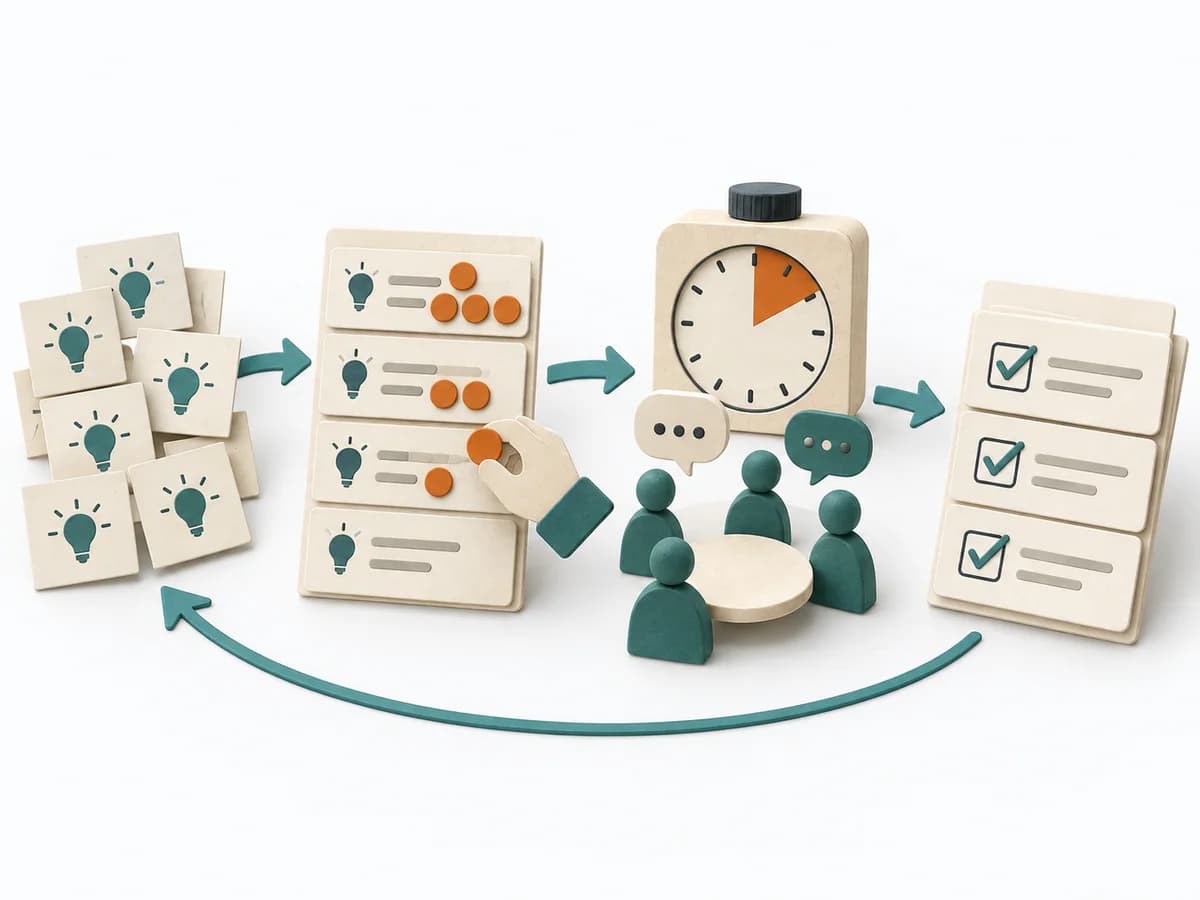
Solo brainstorming uses a clear prompt, short sprints, and deliberate perspective shifts. A later group sees all ideas anonymised and separates author status from content.
Fictional worked example
individual idea sprints with stimulus shifts and anonymised consolidation as a precise working structure with a fictional example.
Problem · user · constraint
Explain import mismatch without jargon.
Stimulus · mechanism · sketch
Support perspective: repairable diff.
Expectation · uncertainty
Users understand row comparison.
Cluster · contrast · test
Preview versus diff in usability test.
The example demonstrates the domain logic of Solo Brainstorming; worksheets remain blank.
Set prompt

Goal
Produce solo brief so the core question “Which solution options can each person develop independently before collective synthesis?” can be answered with stronger support.
Inputs for this step
Actions
Output
solo brief
solo brief · source · uncertainty · next decision
Quality check
Can the prompt be used without clarification?
Pitfall
The first idea dominates every sprint or later evaluation follows the author's authority. Introduce a new constraint or perspective prompt and anonymise submissions before synthesis.
Timing: 10–20 minutes
Run sprints
Goal
Produce idea set so the core question “Which solution options can each person develop independently before collective synthesis?” can be answered with stronger support.
Inputs for this step
Actions
Output
idea set
idea set · source · uncertainty · next decision
Quality check
Do mechanisms differ rather than just surfaces?
Pitfall
The first idea dominates every sprint or later evaluation follows the author's authority. Introduce a new constraint or perspective prompt and anonymise submissions before synthesis.
Timing: 10–20 minutes
Submit
Goal
Produce anonymous pack so the core question “Which solution options can each person develop independently before collective synthesis?” can be answered with stronger support.
Inputs for this step
Actions
Output
anonymous pack
anonymous pack · source · uncertainty · next decision
Quality check
Is authorship hidden for review?
Pitfall
The first idea dominates every sprint or later evaluation follows the author's authority. Introduce a new constraint or perspective prompt and anonymise submissions before synthesis.
Timing: 10–20 minutes
Synthesize
Goal
Produce test selection so the core question “Which solution options can each person develop independently before collective synthesis?” can be answered with stronger support.
Inputs for this step
Actions
Output
test selection
test selection · source · uncertainty · next decision
Quality check
Is selection based on learning value and problem fit?
Pitfall
The first idea dominates every sprint or later evaluation follows the author's authority. Introduce a new constraint or perspective prompt and anonymise submissions before synthesis.
Timing: 10–20 minutes
What comes out at the end
Sketch: what the artifact looks like
Versioned independent idea pack with date, sources, owners, and next review.
Retain date, source, assumption state, and decision for every version of independent idea pack.
Plan Solo Brainstorming around its domain steps and the concrete decision question.
To be confirmed
To be confirmed
Full workshop Time: 20–40 minutes plus synthesis
Complete this worksheet on paper or in your own document during the work.
Problem · user · constraint
...
Stimulus · mechanism · sketch
...
Expectation · uncertainty
...
Cluster · contrast · test
...
Enter only real input, sources, and decisions.
IDEO.org Design Kit: Brainstorm
Expected artifact: solo brief
solo brief · source · uncertainty · next decision
Entry:
...
Expected artifact: idea set
idea set · source · uncertainty · next decision
Entry:
...
Expected artifact: anonymous pack
anonymous pack · source · uncertainty · next decision
Entry:
...
Expected artifact: test selection
test selection · source · uncertainty · next decision
Entry:
...
...
Method guide: https://methodatlas.meierhoff-systems.de/en/methods/solo-brainstorming/run-sheet
Concrete filled scenario, fictional example
Fictional example for orientation. Counts and timings describe this case and are not universal requirements.
Concrete filled scenario, fictional example
Prompt: how can a user understand and fix an import mismatch? Sprint 1 free, sprint 2 constrained to no jargon, sprint 3 from support perspective. Result: six mechanisms collected anonymously; the group tests an explanatory preview and repairable diff.
Recognize symptoms and steer against them
Quick overview, the full text is in the matching phase in the flow
The first idea dominates every sprint or later evaluation follows the author's authority.
Introduce a new constraint or perspective prompt and anonymise submissions before synthesis.
The first idea dominates every sprint or later evaluation follows the author's authority.
Introduce a new constraint or perspective prompt and anonymise submissions before synthesis.
The first idea dominates every sprint or later evaluation follows the author's authority.
Introduce a new constraint or perspective prompt and anonymise submissions before synthesis.
The first idea dominates every sprint or later evaluation follows the author's authority.
Introduce a new constraint or perspective prompt and anonymise submissions before synthesis.
When to pause, resolve prerequisites, or choose another approach
Go to the profile for purpose, similar methods, and sources or continue to the next method in the catalog.