Complete firstShared destination
The team understands the desired next state and retrospective period.
Without a destination, wind and anchors are hard to interpret.
A practical method guide: clarify prerequisites and materials, understand the complete process, and look up outputs, pitfalls, and stop criteria.
What needs to be finished first
The team understands the desired next state and retrospective period.
What needs to be ready before start
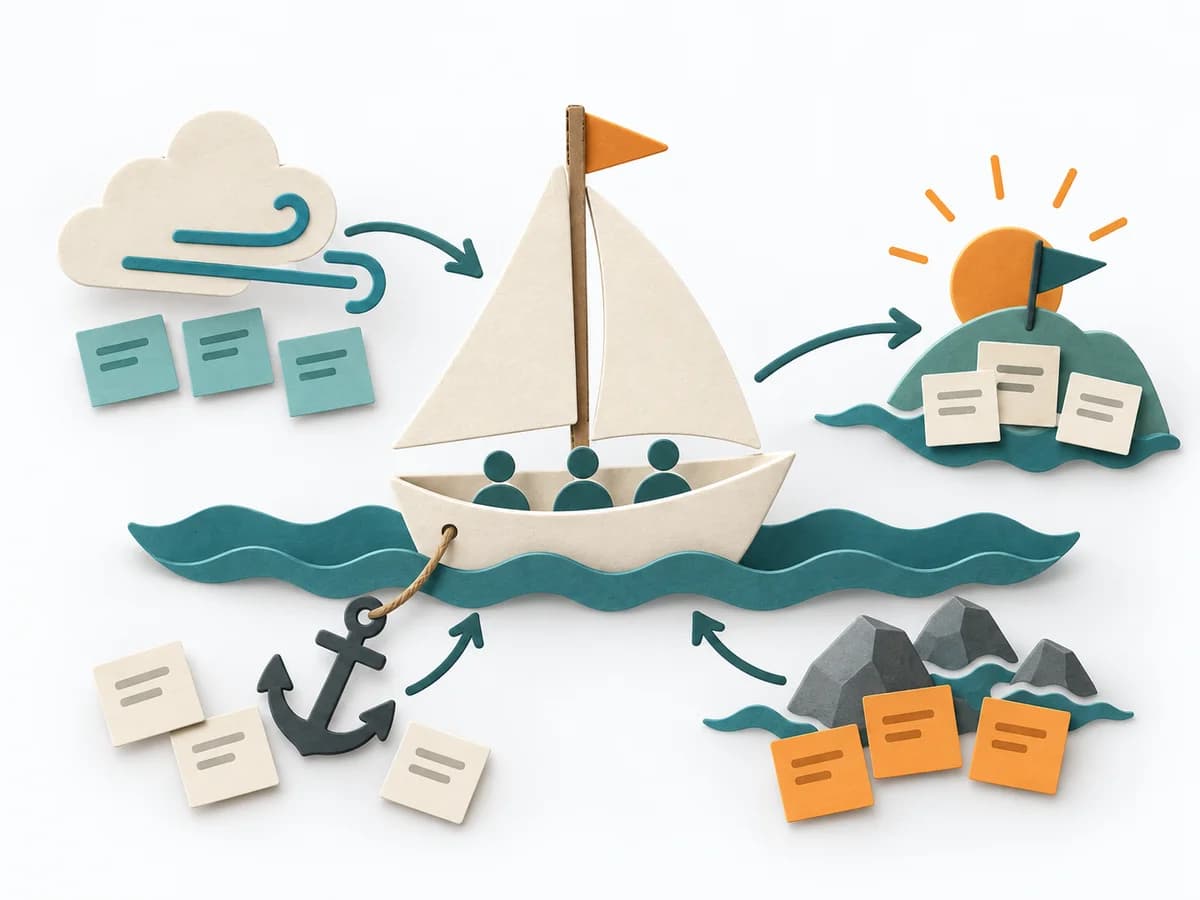
Boat image or four labelled fields: island, wind, anchors, rocks; cards and experiment note.
Affected team and facilitator; external dependencies later receive a named clarification contact.
Select the period and shared goal; explain the visual legend and respectful discussion rules before collecting notes.
45–75 minutes; impact review after the experiment
Clearly label island, wind, anchors and rocks; leave enough space for individual cards and a separate experiment area.
The one question this method answers
What helps our journey to the goal, what slows us today and what danger lies ahead?
Phases with goal, actions, output and pitfall
The team examines collaboration as a sailing journey: the island is the goal, wind represents helping forces, anchors are current constraints and rocks represent future risks. A bounded course correction follows.
Fictional example
The team examines collaboration as a sailing journey: the island is the goal, wind represents helping forces, anchors are current constraints and rocks represent future risks. A bounded course correction follows.
Which shared state do we want to reach?
Fictional: every course registration should be reliably confirmed before the start.
Which observed practice brings us closer to that goal?
Daily support-development pairing clarifies errors quickly.
What already slows us, with what concrete consequence?
Manual approvals wait in a shared mailbox for up to two days.
Which future development could threaten the goal?
Assumption: volume doubles at the next course launch and overloads approvals.
Which trial will we run with what owner, period and impact signal?
For two weeks use approval windows at 10:00 and 15:00, owner Lea; then compare waiting times and retain pairing.
All example details are fictional and illustrate the application.
Island and legend
Goal
Shared journey
Inputs for this step
Actions
Output
Shared journey
Does the island describe a shared outcome?
Quality check
Does the island describe a shared outcome?
Pitfall
The island remains a vague improve. Select a visible next state.
Timing: 5–10 minutes
Wind, anchors and rocks
Goal
Factors and risks
Inputs for this step
Actions
Output
Factors and risks
Are observations distinct from future risk hypotheses?
Quality check
Are observations distinct from future risk hypotheses?
Pitfall
Every negative point becomes an anchor without checking. Ask whether the effect is already happening or may occur later.
Timing: 10–15 minutes
Clarify impact and influence
Goal
Selected course lever
Inputs for this step
Actions
Output
Selected course lever
Are impact and agency named for the focus?
Quality check
Are impact and agency named for the focus?
Pitfall
Only the topic with most cards is addressed. Examine frequency, severity and agency separately.
Timing: 15–25 minutes
Agree a course correction
Goal
Course correction with review
Inputs for this step
Actions
Output
Course correction with review
Will we later review impact rather than only completion?
Quality check
Will we later review impact rather than only completion?
Pitfall
Several major improvements are promised at once. Choose one manageable trial and park other ideas.
Timing: 10–20 minutes
What comes out at the end
Sketch: what the artifact looks like
Sailboat with destination, helping and hindering factors, risks and an agreed course correction with review date.
Record date and scope; retain the previous version and reason when changing it.
Select the period and shared goal; explain the visual legend and respectful discussion rules before collecting notes.
To be confirmed
To be confirmed
Complete retrospective Time: 45–75 minutes; impact review after the experiment
Complete this worksheet on paper or in your own document during the work.
Which shared state do we want to reach?
...
Which observed practice brings us closer to that goal?
...
What already slows us, with what concrete consequence?
...
Which future development could threaten the goal?
...
Which trial will we run with what owner, period and impact signal?
...
Answer the prompts with your own information. Explicitly mark unknowns and assumptions.
Mark Summers: Sailboat Retrospective
Expected artifact: Shared journey
Does the island describe a shared outcome?
Entry:
...
Expected artifact: Factors and risks
Are observations distinct from future risk hypotheses?
Entry:
...
Expected artifact: Selected course lever
Are impact and agency named for the focus?
Entry:
...
Expected artifact: Course correction with review
Will we later review impact rather than only completion?
Entry:
...
...
Method guide: https://methodatlas.meierhoff-systems.de/en/methods/sailboat-retrospective/run-sheet
Concrete filled scenario, fictional example
Fictional example for orientation. Counts and timings describe this case and are not universal requirements.
Concrete filled scenario, fictional example
Island: destination: Fictional: every course registration should be reliably confirmed before the start.
Wind: support: Daily support-development pairing clarifies errors quickly.
Anchors: current constraints: Manual approvals wait in a shared mailbox for up to two days.
Rocks: future risks: Assumption: volume doubles at the next course launch and overloads approvals.
Course correction and review: For two weeks use approval windows at 10:00 and 15:00, owner Lea; then compare waiting times and retain pairing.
Recognize symptoms and steer against them
Quick overview, the full text is in the matching phase in the flow
The island remains a vague improve.
Select a visible next state.
Every negative point becomes an anchor without checking.
Ask whether the effect is already happening or may occur later.
Only the topic with most cards is addressed.
Examine frequency, severity and agency separately.
Several major improvements are promised at once.
Choose one manageable trial and park other ideas.
When to pause, resolve prerequisites, or choose another approach
Go to the profile for purpose, similar methods, and sources or continue to the next method in the catalog.