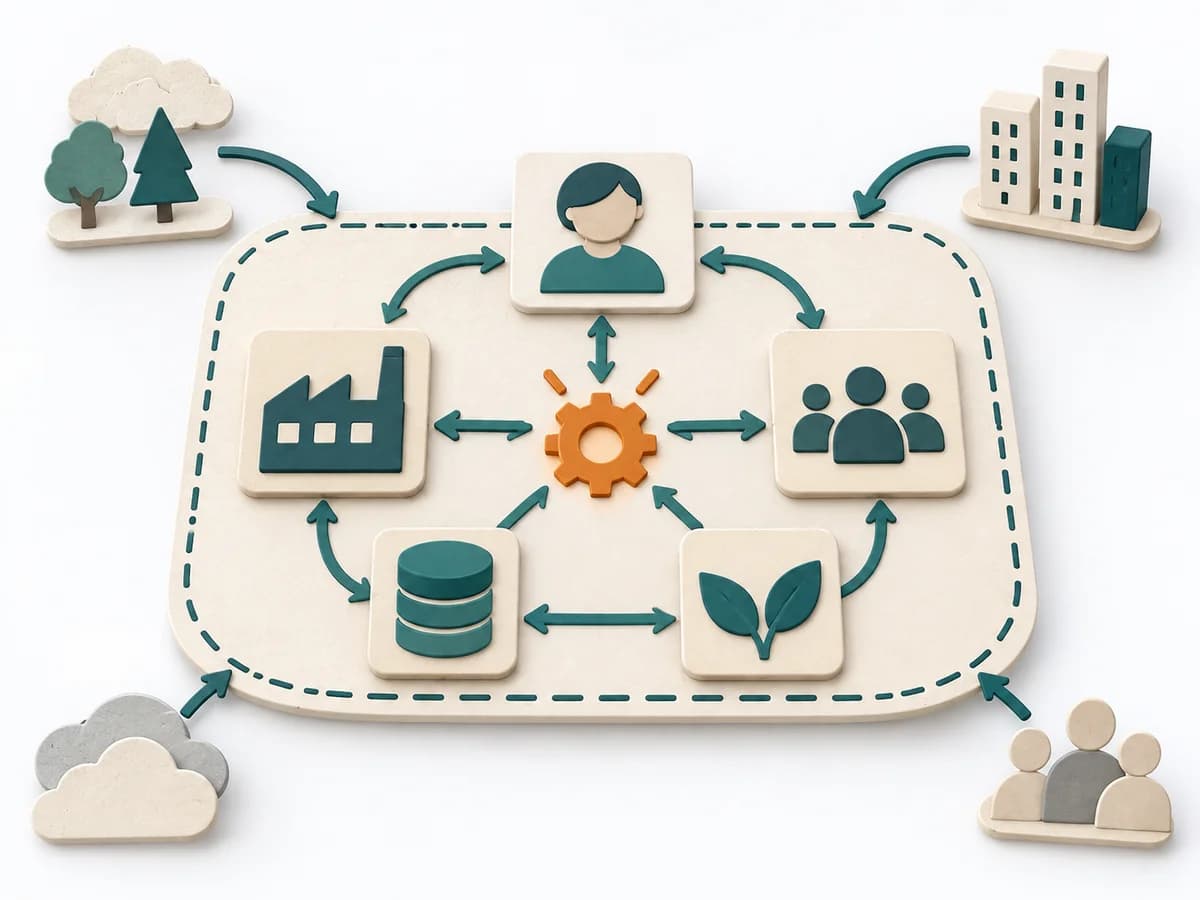
Complete firstClear scope
A complex or ambiguous situation where people hold different views and shared understanding is needed first.
Without a boundary, data, perspectives, or flows become mixed.
A practical method guide: clarify prerequisites and materials, understand the complete process, and look up outputs, pitfalls, and stop criteria.
What needs to be finished first
A complex or ambiguous situation where people hold different views and shared understanding is needed first.
Relevant people and sources can be included.
What needs to be ready before start
Shared workspace, accessible sources, and a decision log.
Stakeholder perspectives · facilitator · scribe
Clarify the question, timeframe, data access, roles, and known uncertainties in advance.
60–120 minutes for group exploration; needed perspectives may require multiple sessions.
Create a shared version. Label facts, assumptions, and decisions separately.
The one question this method answers
Which elements and differing perspectives shape the situation before we impose a premature structure?
Phases with goal, actions, output and pitfall
Rich Picture makes an unclear situation visible by placing facts, perspectives, relationships, conflicts, and open questions together. It supports a justified next step without imposing a system explanation.
Fictional worked example
Explore an unclear situation visually by placing facts, perspectives, relationships, conflicts, and open questions together.
Describe the open question and who/what it concerns.
Queue, self-checkout machine, advice desk, returns kiosk, missing books.
Draw elements, voices, places, and hard and soft information.
Fictional: students want fast checkout; staff see more advice needs than capacity.
Mark conflicts, relationships, and doubts as perspectives.
Speed of self-service ↔ personal help; statements are from an invented workshop.
Collect surprises and next questions without prescribing a solution.
Which failures extend queues? Which cases need personal advice?
Fictional city library: picture shows a long queue, time-pressed students, staff balancing checkout and advice, a faulty self-checkout machine, and the open question of missing books. Speech bubbles mark conflicting views; arrows only where participants suspect a relationship.
Situation
Goal
Does the inquiry stay open rather than solution-led?
Inputs for this step
Actions
Output
Open situation boundary and participants
Open situation boundary and participants
Quality check
Does the inquiry stay open rather than solution-led?
Pitfall
Picture formalized too early Collect perspectives before imposing boundaries or causes.
Timing: Part of the agreed work block; research may be separate.
Perspectives
Goal
Are subjective statements marked as perspectives?
Inputs for this step
Actions
Output
Multi-perspective picture of the situation
Multi-perspective picture of the situation
Quality check
Are subjective statements marked as perspectives?
Pitfall
The picture represents only one perspective Invite each group to contribute and preserve divergent views.
Timing: Part of the agreed work block; research may be separate.
Relationships

Goal
Are suspected causes marked as assumptions rather than facts?
Inputs for this step
Actions
Output
Visible tensions and suspected relationships
Visible tensions and suspected relationships
Quality check
Are suspected causes marked as assumptions rather than facts?
Pitfall
Feelings treated as objective facts Attribute the statement to a person or group and mark uncertainty.
Timing: Part of the agreed work block; research may be separate.
Inquiry

Goal
Do different participants recognize their perspectives?
Inputs for this step
Actions
Output
Open inquiry questions
Open inquiry questions
Quality check
Do different participants recognize their perspectives?
Pitfall
Participants missing from picture Include observers and the group’s own interests in the picture.
Timing: Part of the agreed work block; research may be separate.
What comes out at the end
Sketch: what the artifact looks like
Versioned result with question, evidence, open issues, next action, ownership, and review date.
Record date, scope, sources, and changes. Preserve earlier observations.
Prepare Rich Picture with a clear question, roles, and sources.
To be confirmed
To be confirmed
Plan the full method Time: Set according to scope and available evidence
Complete this worksheet on paper or in your own document during the work.
Describe the open question and who/what it concerns.
...
Draw elements, voices, places, and hard and soft information.
...
Mark conflicts, relationships, and doubts as perspectives.
...
Collect surprises and next questions without prescribing a solution.
...
Blank worksheet: start with a bounded question. Enter observed facts only, mark assumptions, and record open questions and sources.
Rich pictures · Open University OpenLearn
Expected artifact: Open situation boundary and participants
Open situation boundary and participants
Entry:
...
Expected artifact: Multi-perspective picture of the situation
Multi-perspective picture of the situation
Entry:
...
Expected artifact: Visible tensions and suspected relationships
Visible tensions and suspected relationships
Entry:
...
Expected artifact: Open inquiry questions
Open inquiry questions
Entry:
...
...
Method guide: https://methodatlas.meierhoff-systems.de/en/methods/rich-picture/run-sheet
Concrete filled scenario, fictional example
Fictional example for orientation. Counts and timings describe this case and are not universal requirements.
Concrete filled scenario, fictional example
Fictional city library: picture shows a long queue, time-pressed students, staff balancing checkout and advice, a faulty self-checkout machine, and the open question of missing books. Speech bubbles mark conflicting views; arrows only where participants suspect a relationship.
All names and values are invented for illustration. Unresolved explanations remain questions.
Recognize symptoms and steer against them
Quick overview, the full text is in the matching phase in the flow
Picture formalized too early
Collect perspectives before imposing boundaries or causes.
The picture represents only one perspective
Invite each group to contribute and preserve divergent views.
Feelings treated as objective facts
Attribute the statement to a person or group and mark uncertainty.
Participants missing from picture
Include observers and the group’s own interests in the picture.
When to pause, resolve prerequisites, or choose another approach
Go to the profile for purpose, similar methods, and sources or continue to the next method in the catalog.