Complete firstPrioritised assumptions
Desirability, viability, feasibility, or adaptability is clear for each claim.
Without a risk dimension, the test type cannot be matched.
A practical method guide: clarify prerequisites and materials, understand the complete process, and look up outputs, pitfalls, and stop criteria.
What needs to be finished first
Desirability, viability, feasibility, or adaptability is clear for each claim.
The decision and required evidence strength are named.
What needs to be ready before start
Assumption portfolio, test-type catalogue, audience access, cost and time constraints, analytics plan, and ethics review.
Product · Research · Engineering · Analytics · experiment owner
Prepare top assumptions, current evidence, and the next irreversible investment.
45–60 minutes for selection and protocol
Compare test types by evidence strength, setup time, run time, cost, and realism.
The one question this method answers
Which smallest test provides enough evidence for each critical assumption to support the next investment decision?
Phases with goal, actions, output and pitfall
The matrix prevents MVP from automatically meaning a small product. A fake door can test demand, concierge can observe value in a workflow, Wizard of Oz can test use of a manually delivered service, and a functional prototype can test feasibility. A test only answers the assumption it was designed for.
Fictional worked example
Connect assumptions to test type, evidence strength, effort, and a pre-set decision.
| Assumption | Critical assumption | Suitable test type | Observation and evidence | Effort and guardrail | Threshold and next test |
|---|---|---|---|---|---|
| Review useDesirability before automation | Project leads use audit-ready exports in monthly reviews. | Concierge: manually prepared export for 12 suitable teams. | Observed review use; stronger than stated intent, no self-service evidence yet. | 5 working days; no sensitive production data; stop on compliance objection. | Pass ≥8 in review and ≥6 using a chart; then clickable prototype, else revisit segment/job. |
An MVP test validates only the assumption its measure actually addresses.
Assumptions
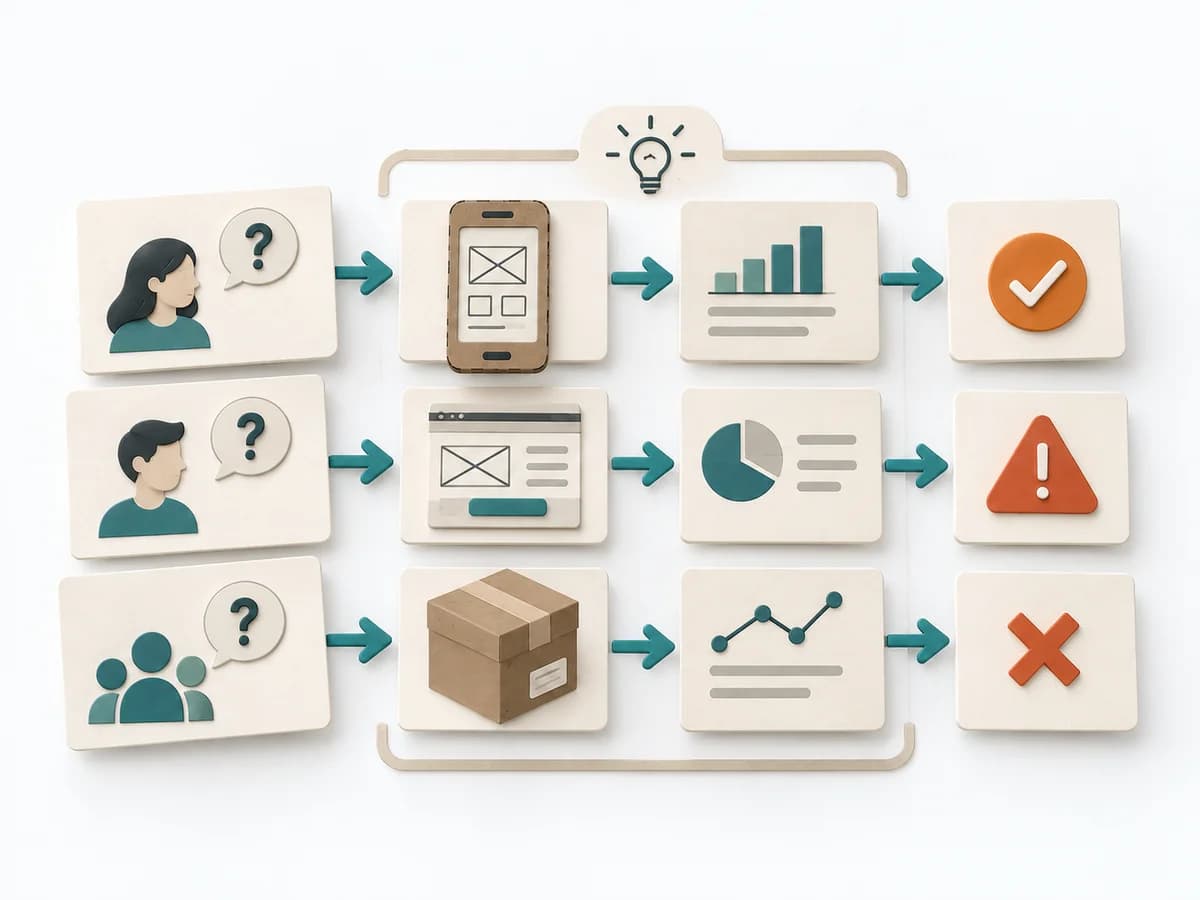
Goal
Expose critical desirability, viability, feasibility, and adaptability assumptions.
Inputs for this step
Actions
Output
Assumption portfolio
Dimension · assumption · evidence gap · decision
Quality check
Is it clear which decision each test supports?
Pitfall
The team starts with a preferred MVP type and then searches for a question. State decision and assumption first; choose test type afterwards.
Timing: 10–15 minutes
Match
Goal
Choose a test type with suitable evidence strength and realism for each top assumption.
Inputs for this step
Actions
Output
Test matrix
Assumption · test type · evidence strength · effort · limit
Quality check
Does the test measure the claimed dimension?
Pitfall
A landing-page click is treated as evidence for retention, willingness to pay, and feasibility at once. Assign one primary assumption and one suitable observable metric to each test.
Timing: 15–20 minutes
Protocol
Goal
Document population, procedure, metric, threshold, and guardrails before launch.
Inputs for this step
Actions
Output
Test protocol
Population · procedure · metric · threshold · guardrail · decision
Quality check
Can the team evaluate results without inventing new rules?
Pitfall
The test starts before threshold, minimum data, or stop rule is set. Freeze the protocol before recruiting or launching.
Timing: 15–20 minutes
Sequence
Goal
Set the next test and the condition for moving to stronger evidence.
Inputs for this step
Actions
Output
Sequenced test plan
Now · threshold · next · owner · review
Quality check
Does evidence strength increase only after a viable result?
Pitfall
Many tests run in parallel although later tests depend on earlier findings. Make dependencies explicit and sequence tests as an evidence ladder.
Timing: 10–15 minutes
What comes out at the end
Sketch: what the artifact looks like
MVP Test Matrix with protocols, guardrails, decision rules, and evidence ladder.
Retain date, author, source state, and decision status for each revision; do not overwrite earlier results.
Plan MVP Test Matrix with real scope, suitable roles, and a clear decision objective.
To be confirmed
To be confirmed
Plan the full workshop Time: 45–60 minutes for selection and protocol
Complete this worksheet on paper or in your own document during the work.
| Assumption | assumption · dimension | fake door/concierge/wizard/prototype/spike | behaviour · strength · limit | duration · cost · guardrail | pass · fail · next |
|---|---|---|---|---|---|
| Review use |
Choose test type after assumption and decision; record the evidence limit.
Strategyzer: Select the Next Best Test
Expected artifact: Assumption portfolio
Dimension · assumption · evidence gap · decision
Entry:
...
Expected artifact: Test matrix
Assumption · test type · evidence strength · effort · limit
Entry:
...
Expected artifact: Test protocol
Population · procedure · metric · threshold · guardrail · decision
Entry:
...
Expected artifact: Sequenced test plan
Now · threshold · next · owner · review
Entry:
...
...
Method guide: https://methodatlas.meierhoff-systems.de/en/methods/mvp-test-matrix/run-sheet
Concrete filled scenario, fictional example
Fictional example for orientation. Counts and timings describe this case and are not universal requirements.
Concrete filled scenario, fictional example
Fictional example: assumption 'Project leads use audit-ready exports in monthly reviews'. Selected test: concierge, because actual review use should be observed before automation. Twelve suitable teams receive manually prepared exports. Success: at least eight bring it into the review and at least six use one chart. If successful, build a clickable prototype; otherwise revisit segment or job.
Recognize symptoms and steer against them
Quick overview, the full text is in the matching phase in the flow
The team starts with a preferred MVP type and then searches for a question.
State decision and assumption first; choose test type afterwards.
A landing-page click is treated as evidence for retention, willingness to pay, and feasibility at once.
Assign one primary assumption and one suitable observable metric to each test.
The test starts before threshold, minimum data, or stop rule is set.
Freeze the protocol before recruiting or launching.
Many tests run in parallel although later tests depend on earlier findings.
Make dependencies explicit and sequence tests as an evidence ladder.
When to pause, resolve prerequisites, or choose another approach

Implements the matrix's cheapest test stage as the first real demand test.
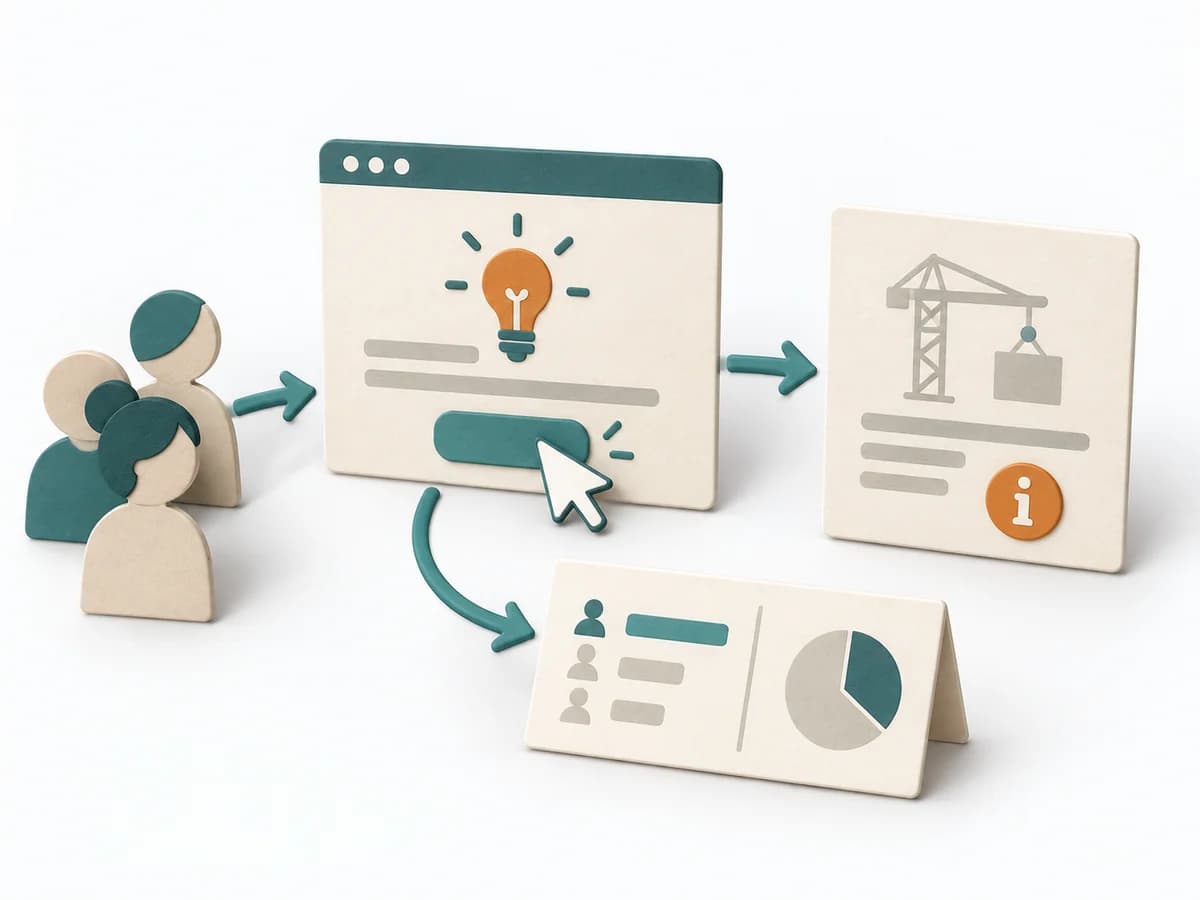
Uses a fake door as an early, evidence-rich test stage for desirability.
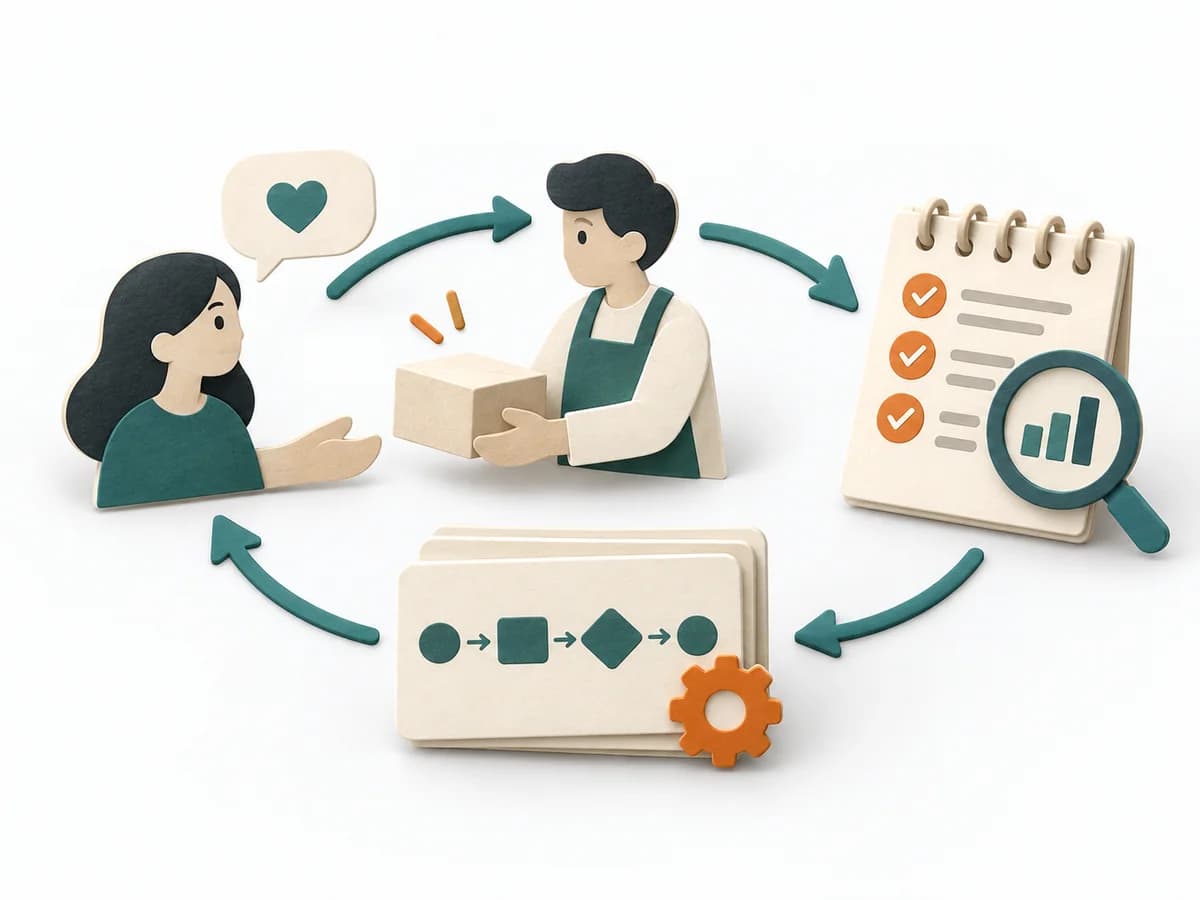
Implements a more elaborate, realistic test stage for validated assumptions.
Go to the profile for purpose, similar methods, and sources or continue to the next method in the catalog.