Complete firstFocused story
One story describes a bounded business change and its intended value.
Oversized or unclear stories need discovery or splitting first.
A practical method guide: clarify prerequisites and materials, understand the complete process, and look up outputs, pitfalls, and stop criteria.
What needs to be finished first
One story describes a bounded business change and its intended value.
Domain decisions, implementation and testing can be discussed together.
What needs to be ready before start
One story card, blue rule cards, green example cards, red questions and pens or a digital board. Colors are a convention, not a requirement.
A small cross-functional group with product or domain ownership, engineering and testing. One person facilitates and keeps the map legible.
Prepare the story, goal and known domain context. Mark prior beliefs and assumptions explicitly.
About 25 minutes per focused story; split oversized stories and schedule follow-up when rules or questions are extensive.
Place the story at the top. Agree on how to mark stories, rules, examples and questions. Keep the conversation grounded in concrete cases.
The one question this method answers
Which rules and cases must be clear so this story can be understood and tested?
Phases with goal, actions, output and pitfall
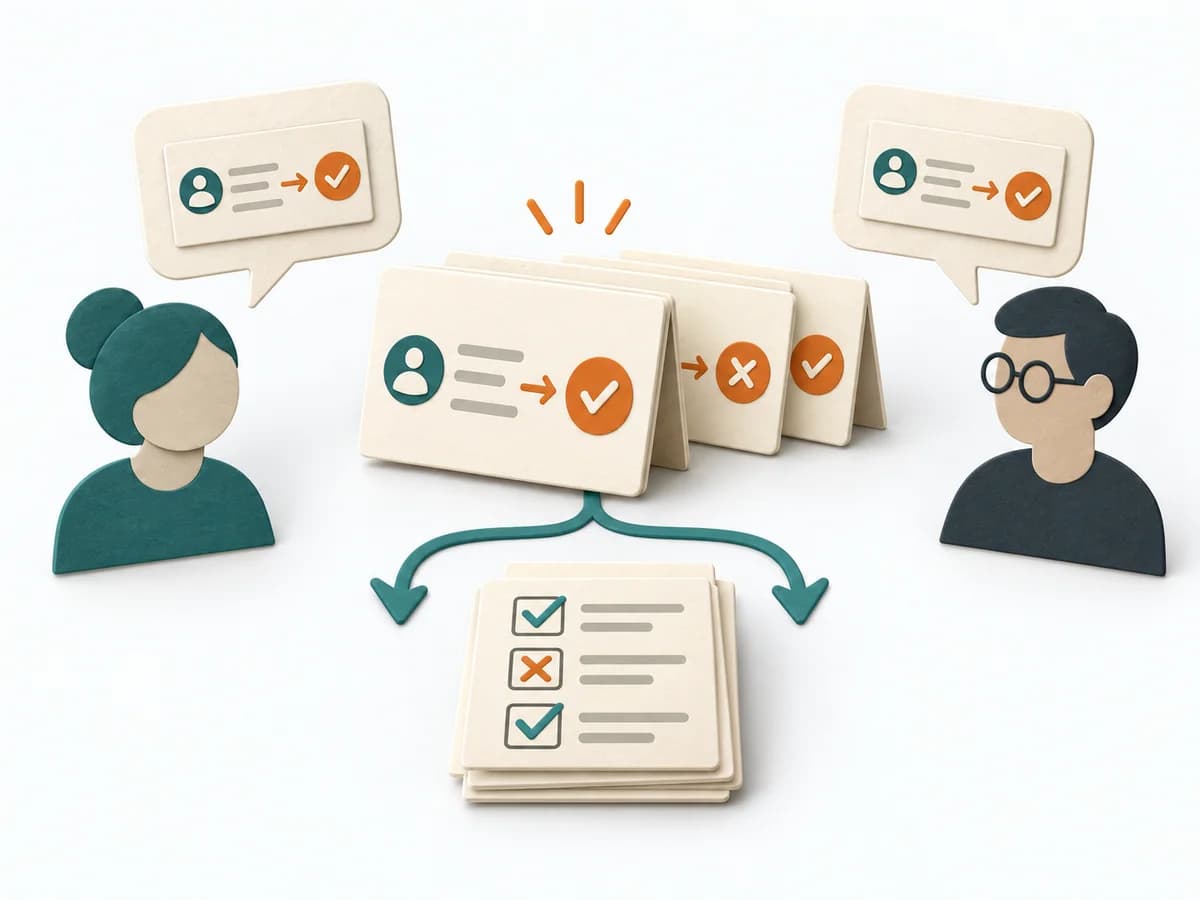
Example Mapping is a short BDD-oriented team conversation before implementation. The group starts from concrete examples, summarizes business rules and records questions, assumptions and newly discovered stories.
Fictional teaching example
One story with rules, concrete examples and unresolved questions. Card colors follow Cucumber’s documented convention.
Which single change are we clarifying?
As a member, I want to reserve a tool so it is available for my repair.
Which general business condition applies?
R1: A confirmed reservation states the tool and collection time. R2: If the tool is unavailable in the requested window, no reservation is confirmed. (Both rules fictional)
Which concrete precondition, action and outcome illustrate the rule?
F1: A person reserves on Monday for Wednesday. The confirmation names Wednesday as the collection day. (Fictional)
What remains unresolved, and who will clarify it by when?
Fictional open question: What happens if the previous loan is returned late? Add an owner and due date before implementation.
The examples are fictional. Yellow for story, blue for rule, green for example and red for open question follow Cucumber’s documented card convention; digital labels also work.
Focus

Goal
Everyone discusses the same intended behavior.
Inputs for this step
Actions
Output
A focused story with a shared context
Story · actor · intended change
Quality check
Is the story small enough for a short clarification?
Pitfall
The story bundles several independently testable changes. Split the story or do discovery first; leave the unresolved scope out of this session.
Timing: About 5 minutes.
Rules
Goal
The group states verifiable rules instead of jumping to solutions.
Inputs for this step
Actions
Output
Rule cards for the story
One rule per card · unambiguous condition
Quality check
Is each rule clear and testable?
Pitfall
The group records vague wishes or UI ideas as rules. Phrase rules as observable behavior and mark solution ideas separately.
Timing: About 8 minutes.
Examples

Goal
Examples expose boundaries, exceptions and testing needs.
Inputs for this step
Actions
Output
Rules with examples and counterexamples
Given · when · expected result
Quality check
Do the examples clarify the rule rather than merely restating it?
Pitfall
Examples remain hypothetical or cover only the happy path. Name a source for real cases when available; discuss at least one relevant counterexample.
Timing: About 12 minutes.
Questions

Goal
The map shows whether the story is clarified, too large, or still depends on unresolved decisions.
Inputs for this step
Actions
Output
Example map and agreed next action
Rules · examples · open questions
Quality check
Are open questions assigned an owner and date? Is the story clear enough, or should it be split?
Pitfall
A full-looking board hides unresolved decisions. Keep open points explicit; update the rule, example or story split only after they are answered.
Timing: About 5 minutes.
What comes out at the end
Sketch: what the artifact looks like
A versioned example map with one story, rules, examples and counterexamples, open questions and linked acceptance tests.
Record the story ID, date and participants. Track rule changes; preserve answered questions with the decision and its source.
Plan a focused conversation around one story, including decision ownership and follow-up.
To be confirmed
To be confirmed
Clarify one story together Time: About 25 minutes per story
Complete this worksheet on paper or in your own document during the work.
Which single change are we clarifying?
...
Which general business condition applies?
...
Which concrete precondition, action and outcome illustrate the rule?
...
What remains unresolved, and who will clarify it by when?
...
Blank worksheet: keep story, rules, examples and questions distinct. Record examples as concrete cases; assign an owner and date to unanswered questions.
Expected artifact: A focused story with a shared context
Story · actor · intended change
Entry:
...
Expected artifact: Rule cards for the story
One rule per card · unambiguous condition
Entry:
...
Expected artifact: Rules with examples and counterexamples
Given · when · expected result
Entry:
...
Expected artifact: Example map and agreed next action
Rules · examples · open questions
Entry:
...
...
Method guide: https://methodatlas.meierhoff-systems.de/en/methods/example-mapping/run-sheet
Concrete filled scenario, fictional example
Fictional example for orientation. Counts and timings describe this case and are not universal requirements.
Concrete filled scenario, fictional example
All details are invented; no research was conducted.
Story: As a member, I want to reserve a tool so it is available for my repair.
Rule R1 (blue): A confirmed reservation states the tool and collection time.
Example F1 (green): A person reserves on Monday for Wednesday. The confirmation names the tool and Wednesday as the collection day.
Rule R2 (blue): If the tool is unavailable in the requested window, no reservation is confirmed.
Example F2 (green): The tool is already booked for Wednesday. The system reports unavailability and confirms no reservation.
Question (red): What happens if the previous loan ends late? In this fictional session, Alex owns clarification by Friday.
Next step: Update the rule and tests after a domain decision. Fictional example cards do not provide real user evidence or establish demand.
Recognize symptoms and steer against them
Quick overview, the full text is in the matching phase in the flow
The story bundles several independently testable changes.
Split the story or do discovery first; leave the unresolved scope out of this session.
The group records vague wishes or UI ideas as rules.
Phrase rules as observable behavior and mark solution ideas separately.
Examples remain hypothetical or cover only the happy path.
Name a source for real cases when available; discuss at least one relevant counterexample.
A full-looking board hides unresolved decisions.
Keep open points explicit; update the rule, example or story split only after they are answered.
When to pause, resolve prerequisites, or choose another approach
Go to the profile for purpose, similar methods, and sources or continue to the next method in the catalog.