Complete firstBounded subject
The scope and purpose of Design Charrette are stated as a concrete question.
Without scope, charrette design package becomes arbitrary.
A practical method guide: clarify prerequisites and materials, understand the complete process, and look up outputs, pitfalls, and stop criteria.
What needs to be finished first
The scope and purpose of Design Charrette are stated as a concrete question.
Design brief, user and domain requirements, evaluation criteria and domain decision makers are available.
What needs to be ready before start
Design brief, user and domain requirements, evaluation criteria, shared workspace, source links, and decision log.
Sponsor · facilitator · multidisciplinary designers · affected users
Collect Design brief, user and domain requirements, evaluation criteria in advance and mark open assumptions.
3 hours to 2 days
Prepare parallel sketches, criteria-based critique, and iterative synthesis in timeboxes visibly and calibrate assessment terms before starting.
The one question this method answers
Which integrated design option best satisfies the agreed criteria?
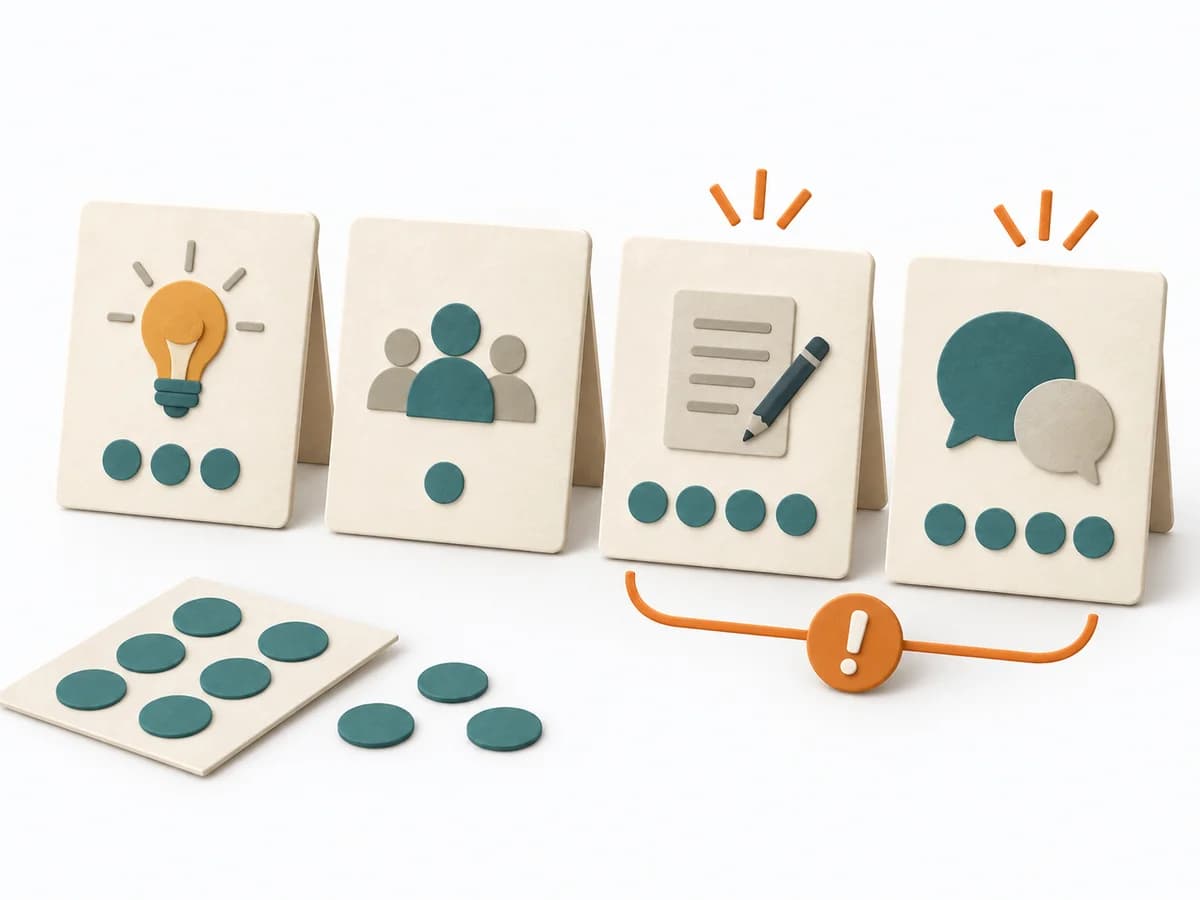
Phases with goal, actions, output and pitfall
A charrette combines a compact brief, parallel designs, structured critique, and revision. Criteria and decision authority are clarified before rounds.
Fictional worked example
parallel sketches, criteria-based critique, and iterative synthesis in timeboxes as a precise working structure with a fictional example.
Service hand-off: case summary
Service-centre hand-off.
Measure: under two minutes
<2 min; audit trail; no duplicate entry.
Option B: timeline with audit trail
B audits but duplicates entry.
Synthesis AB: timeline plus case data
B timeline + A case data; prototype test.
Brief

Goal
Produce working brief so the core question “Which integrated design option best satisfies the agreed criteria?” can be answered with stronger support.
Inputs for this step
Actions
Output
working brief
working brief · source · uncertainty · next decision
Quality check
Are conflicting criteria explicit?
Pitfall
Critique judges taste rather than criteria, or the sponsor decides during ideation. Keep criteria visible, frame critique as observation and effect, and separate the decision phase.
Timing: 10–20 minutes
Design
Goal
Produce design options so the core question “Which integrated design option best satisfies the agreed criteria?” can be answered with stronger support.
Inputs for this step
Actions
Output
design options
design options · source · uncertainty · next decision
Quality check
Are options comparable and sufficiently distinct?
Pitfall
Critique judges taste rather than criteria, or the sponsor decides during ideation. Keep criteria visible, frame critique as observation and effect, and separate the decision phase.
Timing: 10–20 minutes
Critique
Goal
Produce critique record so the core question “Which integrated design option best satisfies the agreed criteria?” can be answered with stronger support.
Inputs for this step
Actions
Output
critique record
critique record · source · uncertainty · next decision
Quality check
Does feedback link observation and effect?
Pitfall
Critique judges taste rather than criteria, or the sponsor decides during ideation. Keep criteria visible, frame critique as observation and effect, and separate the decision phase.
Timing: 10–20 minutes
Synthesize
Goal
Produce design package so the core question “Which integrated design option best satisfies the agreed criteria?” can be answered with stronger support.
Inputs for this step
Actions
Output
design package
design package · source · uncertainty · next decision
Quality check
Are decision and open risks documented?
Pitfall
Critique judges taste rather than criteria, or the sponsor decides during ideation. Keep criteria visible, frame critique as observation and effect, and separate the decision phase.
Timing: 10–20 minutes
What comes out at the end
Sketch: what the artifact looks like
Versioned charrette design package with date, sources, owners, and next review.
Retain date, source, assumption state, and decision for every version of charrette design package.
Plan Design Charrette around its domain steps and the concrete decision question.
To be confirmed
To be confirmed
Full workshop Time: 3 hours to 2 days
Complete this worksheet on paper or in your own document during the work.
...
...
...
...
Brief ...
Criteria ...
Option/Critique ...
Synthesis ...
National Charrette Institute: NCI Charrette System
Expected artifact: working brief
working brief · source · uncertainty · next decision
Entry:
...
Expected artifact: design options
design options · source · uncertainty · next decision
Entry:
...
Expected artifact: critique record
critique record · source · uncertainty · next decision
Entry:
...
Expected artifact: design package
design package · source · uncertainty · next decision
Entry:
...
...
Method guide: https://methodatlas.meierhoff-systems.de/en/methods/design-charrette/run-sheet
Concrete filled scenario, fictional example
Fictional example for orientation. Counts and timings describe this case and are not universal requirements.
Concrete filled scenario, fictional example
Criteria: hand-off under two minutes, audit trail, no duplicate entry. Three teams sketch separately. Critique finds option B supports audit but duplicates entry. Synthesis combines B's timeline with A's shared case data.
Recognize symptoms and steer against them
Quick overview, the full text is in the matching phase in the flow
Critique judges taste rather than criteria, or the sponsor decides during ideation.
Keep criteria visible, frame critique as observation and effect, and separate the decision phase.
Critique judges taste rather than criteria, or the sponsor decides during ideation.
Keep criteria visible, frame critique as observation and effect, and separate the decision phase.
Critique judges taste rather than criteria, or the sponsor decides during ideation.
Keep criteria visible, frame critique as observation and effect, and separate the decision phase.
Critique judges taste rather than criteria, or the sponsor decides during ideation.
Keep criteria visible, frame critique as observation and effect, and separate the decision phase.
When to pause, resolve prerequisites, or choose another approach
Go to the profile for purpose, similar methods, and sources or continue to the next method in the catalog.