Complete firstDecision-ready scope
Core question, decision authority, and scope are clear.
Without clear scope, the result becomes an arbitrary collection without decision value.
A practical method guide: clarify prerequisites and materials, understand the complete process, and look up outputs, pitfalls, and stop criteria.
What needs to be finished first
Core question, decision authority, and scope are clear.
Affected domain and user perspectives are represented.
What needs to be ready before start
LDJ decision board, timer, notes, and decision log.
Facilitator · decider · 3–8 affected participants
Collect existing evidence and constraints in advance.
60–90 minutes
Prepare the canonical blank structure and make timeboxes visible.
The one question this method answers
Which most important problem will we address with which solution as the next experiment?
Phases with goal, actions, output and pitfall
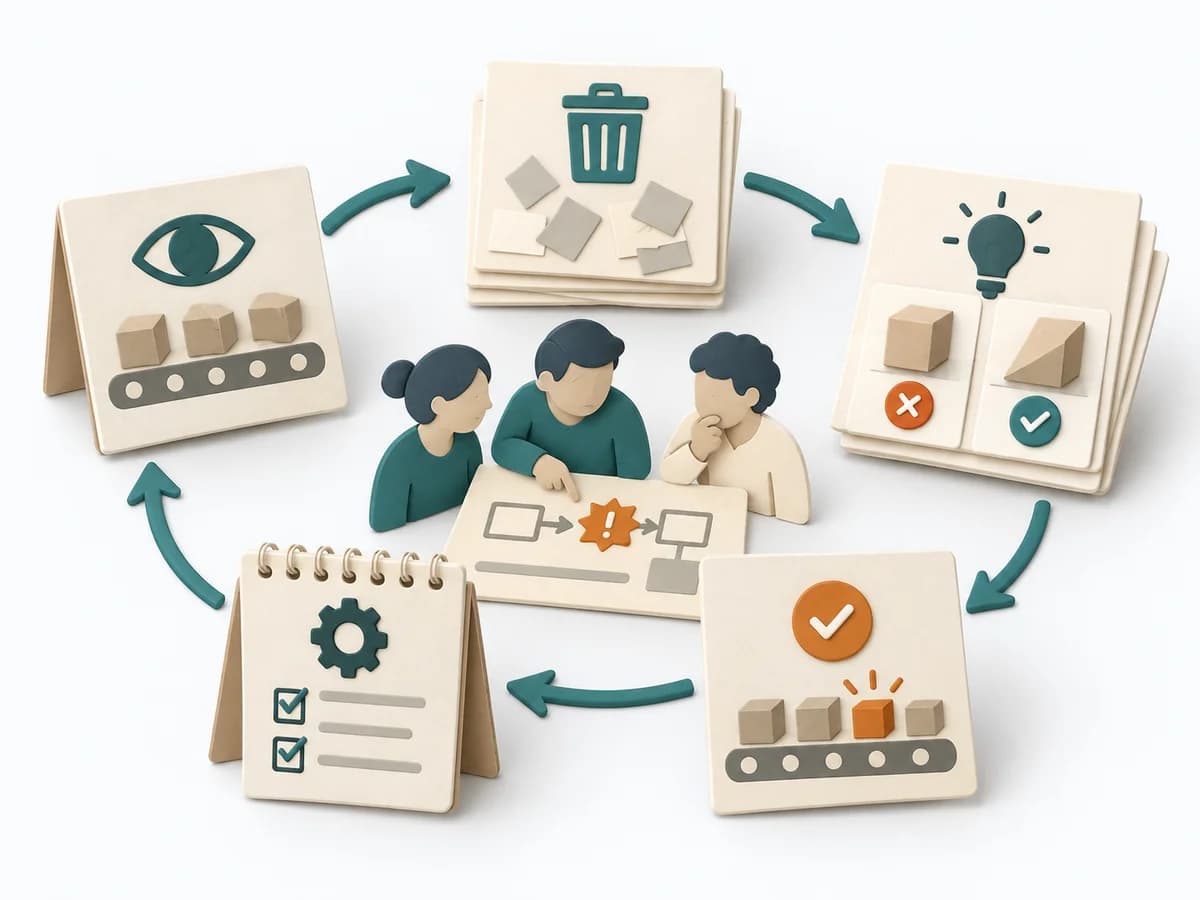
AJ&Smart's Lightning Decision Jam separates silent problem notes, dot voting, HMW reframing, silent solutions, another vote, effort-impact decision, and test planning. The decider resolves ties.
Fictional LDJ run
The complete LDJ flow remains visible in distinct columns.
Example 1
Ownership unclear after reviews; actions stall.
Example 2
Six votes; decider selects ownership gap.
Example 3
How might we visibly confirm ownership at closure?
Example 4
Owner confirms card; closure shows missing owners; auto-reminder.
Example 5
Owner confirmation: high impact, low effort.
Example 6
Two reviews; ≥80% within 24 h; no longer review duration.
Problems

Goal
Produce problem wall so “Which most important problem will we address with which solution as the next experiment?” can be answered with evidence.
Inputs for this step
Actions
Output
problem wall
problem wall with evidence, owner, and next decision.
Quality check
Are problems concrete and solution-free?
Pitfall
Discussion begins before silent collection is complete. Restart the timer and complete silently.
Timing: 10–20 minutes
Priority
Goal
Produce top problem so “Which most important problem will we address with which solution as the next experiment?” can be answered with evidence.
Inputs for this step
Actions
Output
top problem
top problem with evidence, owner, and next decision.
Quality check
Is exactly one problem selected for the next step?
Pitfall
Votes are treated as consensus or proof. Document authority and minority concerns.
Timing: 10–20 minutes
HMW question
Goal
Produce HMW question so “Which most important problem will we address with which solution as the next experiment?” can be answered with evidence.
Inputs for this step
Actions
Output
HMW question
HMW question with evidence, owner, and next decision.
Quality check
Does the question allow several solutions?
Pitfall
The HMW question already contains the favourite feature. Remove solution nouns and name desired impact.
Timing: 10–20 minutes
Solutions
Goal
Produce solution portfolio so “Which most important problem will we address with which solution as the next experiment?” can be answered with evidence.
Inputs for this step
Actions
Output
solution portfolio
solution portfolio with evidence, owner, and next decision.
Quality check
Are solutions concrete enough for effort/impact?
Pitfall
Verbally promoted ideas win through presentation skill. Equalise explanation time and vote on the note.
Timing: 10–20 minutes
Effort/impact
Goal
Produce experiment card so “Which most important problem will we address with which solution as the next experiment?” can be answered with evidence.
Inputs for this step
Actions
Output
experiment card
experiment card with evidence, owner, and next decision.
Quality check
Does the experiment define behaviour, threshold, and guardrail?
Pitfall
The winner becomes an implementation project immediately. Test small first and preset the next decision.
Timing: 10–20 minutes
What comes out at the end
Sketch: what the artifact looks like
Versioned LDJ decision board with sources, assumptions, and next step.
Retain date, scope, sources, assumptions, and decision for each version.
Plan the session around the canonical method steps and a concrete decision.
To be confirmed
To be confirmed
Full session Time: 60–90 minutes
Complete this worksheet on paper or in your own document during the work.
...
...
...
...
...
...
Silent problems ...
Top priority ...
HMW ...
Silent solutions ...
Effort/impact ...
Test ...
AJ&Smart: Lightning Decision Jam
Expected artifact: problem wall
problem wall with evidence, owner, and next decision.
Entry:
...
Expected artifact: top problem
top problem with evidence, owner, and next decision.
Entry:
...
Expected artifact: HMW question
HMW question with evidence, owner, and next decision.
Entry:
...
Expected artifact: solution portfolio
solution portfolio with evidence, owner, and next decision.
Entry:
...
Expected artifact: experiment card
experiment card with evidence, owner, and next decision.
Entry:
...
...
Method guide: https://methodatlas.meierhoff-systems.de/en/methods/decision-jam/run-sheet
Concrete filled scenario, fictional example
Fictional example for orientation. Counts and timings describe this case and are not universal requirements.
Concrete filled scenario, fictional example
Fictional example: problem 'after reviews it is unclear who owns each action' receives six votes. HMW: how might we visibly confirm ownership at closure? Solution 'owner confirms the card before closure' receives five votes and sits at high impact/low effort. Test: two reviews, success ≥80% confirmed owners within 24 hours, guardrail no increase in review duration.
Recognize symptoms and steer against them
Quick overview, the full text is in the matching phase in the flow
Discussion begins before silent collection is complete.
Restart the timer and complete silently.
Votes are treated as consensus or proof.
Document authority and minority concerns.
The HMW question already contains the favourite feature.
Remove solution nouns and name desired impact.
Verbally promoted ideas win through presentation skill.
Equalise explanation time and vote on the note.
The winner becomes an implementation project immediately.
Test small first and preset the next decision.
When to pause, resolve prerequisites, or choose another approach
Go to the profile for purpose, similar methods, and sources or continue to the next method in the catalog.