Complete firstClear boundary
Set system goal, flow unit, period, demand, and boundary; capture capacity and actual throughput in the same unit.
Without a boundary, cases, periods, or variables become mixed.
A practical method guide: clarify prerequisites and materials, understand the complete process, and look up outputs, pitfalls, and stop criteria.
What needs to be finished first
Set system goal, flow unit, period, demand, and boundary; capture capacity and actual throughput in the same unit.
System goal and boundary, throughput/demand data, process or dependency map, constraint register, and test access
What needs to be ready before start
System goal and boundary, throughput/demand data, process or dependency map, constraint register, and test access
System owner · process participants · data owners · constraint owner · facilitator
Set system goal, flow unit, period, demand, and boundary; capture capacity and actual throughput in the same unit.
90–150 minutes for one bounded system flow; measurement and test extra.
Prepare a workspace with Boundary · Register · Binding · Test · Decide; separate example from live data.
The one question this method answers
Which limit currently binds the system goal, which apparent limits are rules or assumptions, and what does a controlled relief test show?
Phases with goal, actions, output and pitfall
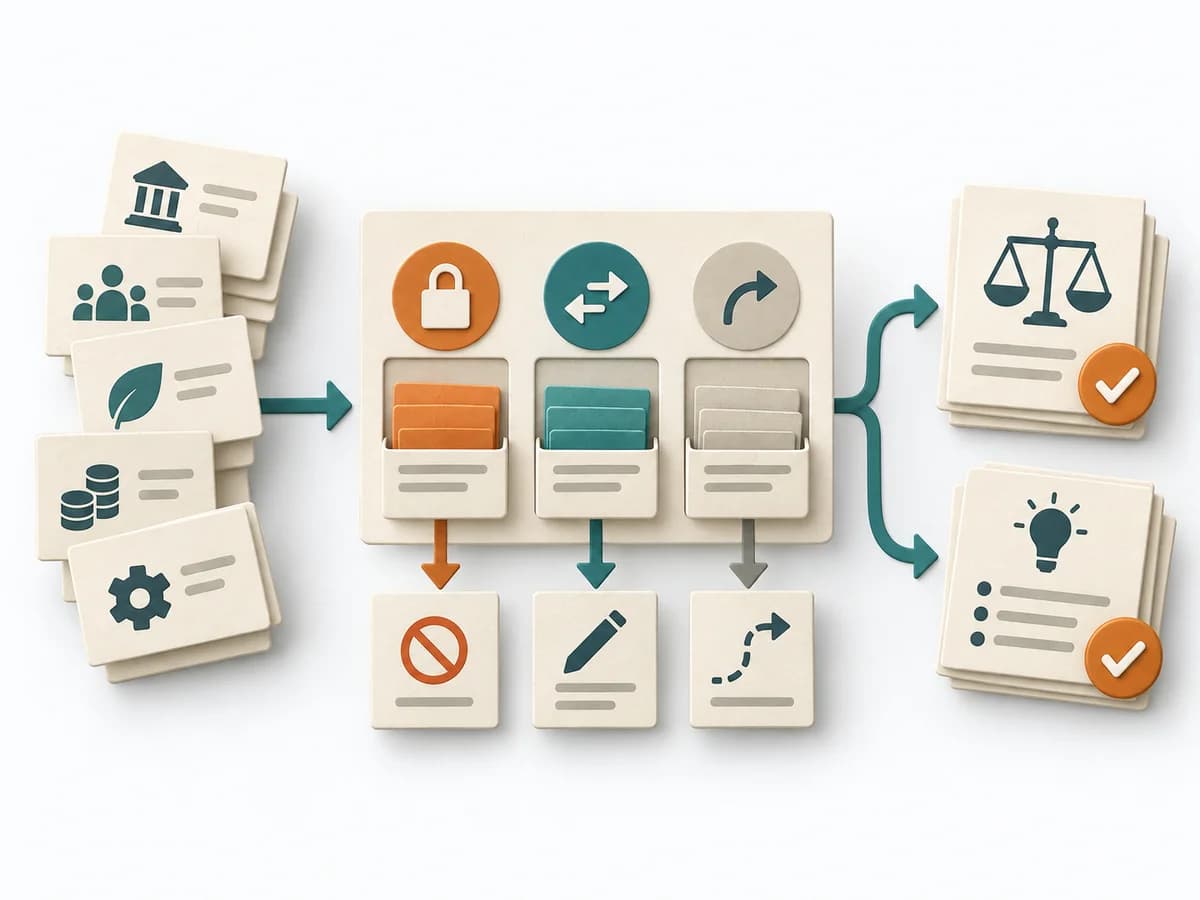
Constraint analysis classifies boundaries by their binding force and distinguishes changeable limits from conditions that must be worked around. This makes the available design space and its dependencies visible.
Fictional example
Fictional values show the actual method fields.
| Limit | Type | Upper bound | Evidence | Buffer pattern | Binding? | Relief test | Action |
|---|---|---|---|---|---|---|---|
| PreparationAdd evidence and rationale. | Capacity | 14 units/h | Time study over four Saturdays | No buffer before; 11 wait after handoff later | Yes after test | Observe after handoff relief | Protect as new constraint |
| HandoffAdd evidence and rationale. | Policy/capacity | 9 units/h with one lane | Scanner and handoff log | 11 units before; pickup idle after | Yes before test | Second lane 60 min → system 14/h | Set lane standard and owner |
| Warehouse feedAdd evidence and rationale. | Capacity | 18 units/h | Warehouse log | No persistent buffer | No | No test needed | Monitor only |
All values are fictional.
Boundary
Goal
System frame: Set system goal, flow unit, demand, period, and flow start/end.
Inputs for this step
Actions
Output
System frame
Set system goal, flow unit, demand, period, and flow start/end.
Quality check
Are demand, throughput, and capacity stated in the same unit and period?
Pitfall
Local utilisation is compared without a system goal. Set one flow unit and one end-to-end goal.
Timing: 15–20 minutes
Register
Goal
Constraint register: Capture physical, capacity, policy, and assumed limits with evidence, upper bound, and slack.
Inputs for this step
Actions
Output
Constraint register
Capture physical, capacity, policy, and assumed limits with evidence, upper bound, and slack.
Quality check
Is each limit phrased as a measurable condition rather than a problem word?
Pitfall
Every difficulty is called the constraint. State upper bound, observed throughput, and system effect for each limit.
Timing: 20–30 minutes
Binding
Goal
Binding limit: Test candidates against demand and system throughput; observe blockage before and idle time after.
Inputs for this step
Actions
Output
Binding limit
Test candidates against demand and system throughput; observe blockage before and idle time after.
Quality check
Does the limit explain system throughput and buffer position?
Pitfall
The slowest rated capacity is selected without observing flow. Measure WIP/buffer before and idle time after the candidate.
Timing: 20–30 minutes
Test
Goal
Relief finding: Protect or relieve the constraint and set a measurable prediction and stop rule beforehand.
Inputs for this step
Actions
Output
Relief finding
Protect or relieve the constraint and set a measurable prediction and stop rule beforehand.
Quality check
Does the test change only the binding condition and measure system throughput?
Pitfall
A local gain is assumed to be a system gain. Measure end-to-end throughput, quality, and the new buffer.
Timing: 20–45 minutes
Decide
Goal
Constraint plan: Record binding limit, exploit/elevate action, and next constraint search with owner and review.
Inputs for this step
Actions
Output
Constraint plan
Record binding limit, exploit/elevate action, and next constraint search with owner and review.
Quality check
Is the new binding limit and review trigger clear?
Pitfall
Analysis ends after the first gain. Check the new buffer and continue the cycle at the new constraint.
Timing: 15–25 minutes
What comes out at the end
Sketch: what the artifact looks like
Evidence-based constraint register with binding limit, buffer effect, relief test, new limit, and decision rule.
Record date, owner, source state, and review date; preserve prior versions.
Set subject, evidence, roles, flow, and review.
To be confirmed
To be confirmed
Complete run Time: 90–150 minutes for one bounded system flow; measurement and test extra.
Complete this worksheet on paper or in your own document during the work.
| Limit | Type | Upper bound | Evidence | Buffer pattern | Binding? | Relief test | Action |
|---|---|---|---|---|---|---|---|
| Preparation | |||||||
| Handoff | |||||||
| Warehouse feed |
The blank worksheet contains prompts only.
Reference · original teaching example
Expected artifact: System frame
Set system goal, flow unit, demand, period, and flow start/end.
Entry:
...
Expected artifact: Constraint register
Capture physical, capacity, policy, and assumed limits with evidence, upper bound, and slack.
Entry:
...
Expected artifact: Binding limit
Test candidates against demand and system throughput; observe blockage before and idle time after.
Entry:
...
Expected artifact: Relief finding
Protect or relieve the constraint and set a measurable prediction and stop rule beforehand.
Entry:
...
Expected artifact: Constraint plan
Record binding limit, exploit/elevate action, and next constraint search with owner and review.
Entry:
...
...
Method guide: https://methodatlas.meierhoff-systems.de/en/methods/constraint-analysis/run-sheet
Concrete filled scenario, fictional example
Fictional example for orientation. Counts and timings describe this case and are not universal requirements.
Concrete filled scenario, fictional example
| Limit | Type | Upper bound | Evidence | Buffer pattern | Binding? | Relief test | Action |
|---|---|---|---|---|---|---|---|
| Preparation | Capacity | 14 units/h | Time study over four Saturdays | No buffer before; 11 wait after handoff later | Yes after test | Observe after handoff relief | Protect as new constraint |
| Handoff | Policy/capacity | 9 units/h with one lane | Scanner and handoff log | 11 units before; pickup idle after | Yes before test | Second lane 60 min → system 14/h | Set lane standard and owner |
| Warehouse feed | Capacity | 18 units/h | Warehouse log | No persistent buffer | No | No test needed | Monitor only |
Recognize symptoms and steer against them
Quick overview, the full text is in the matching phase in the flow
Local utilisation is compared without a system goal.
Set one flow unit and one end-to-end goal.
Every difficulty is called the constraint.
State upper bound, observed throughput, and system effect for each limit.
The slowest rated capacity is selected without observing flow.
Measure WIP/buffer before and idle time after the candidate.
A local gain is assumed to be a system gain.
Measure end-to-end throughput, quality, and the new buffer.
Analysis ends after the first gain.
Check the new buffer and continue the cycle at the new constraint.
When to pause, resolve prerequisites, or choose another approach
Go to the profile for purpose, similar methods, and sources or continue to the next method in the catalog.