Complete firstConcrete initiative
The audience, desired outcome and solution or strategy under review are named.
If the scope is too broad, select one decision object first.
A practical method guide: clarify prerequisites and materials, understand the complete process, and look up outputs, pitfalls, and stop criteria.
What needs to be finished first
The audience, desired outcome and solution or strategy under review are named.
Existing data and people for potential tests are known.
What needs to be ready before start
Decision or concept sketch, existing research, assumption cards and an impact-uncertainty matrix.
Initiative owner, domain experts for value, feasibility and operations, plus a facilitator.
Audience, desired outcome, solution idea, commercial and operational conditions and available evidence.
60–90 minutes for surfacing and prioritisation; tests follow separately
Prepare collection areas for desirability, viability, feasibility and usability plus a prioritisation matrix.
The one question this method answers
Which unproven assumption would endanger the initiative most if it were false?
Phases with goal, actions, output and pitfall
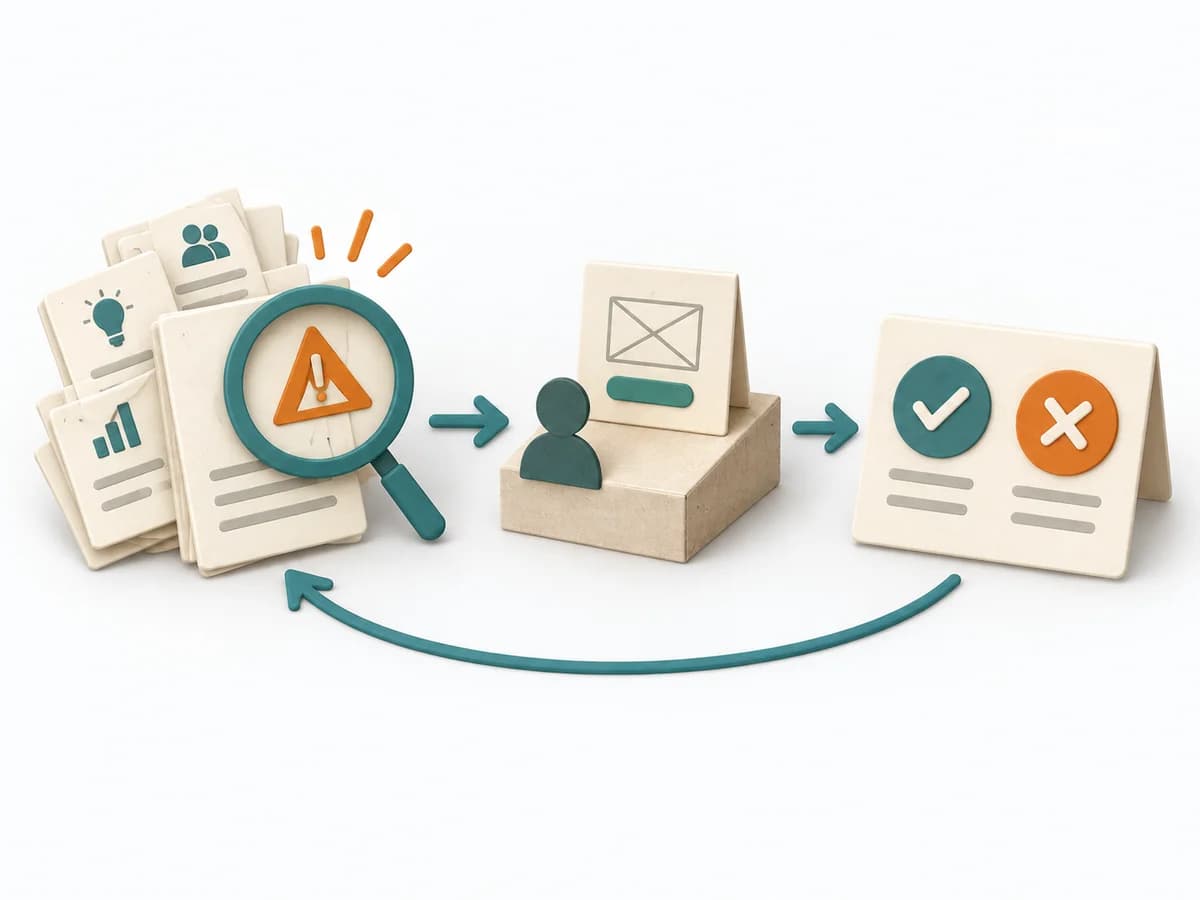
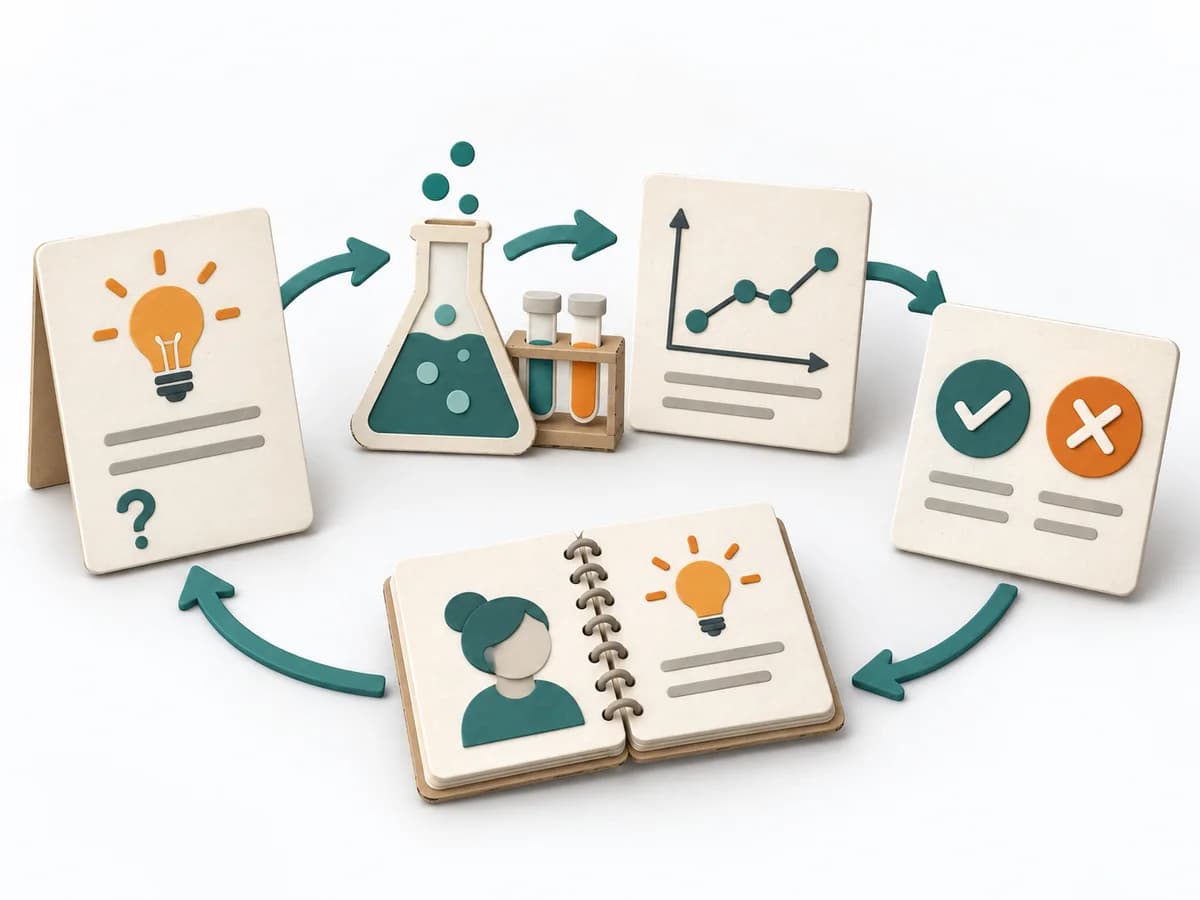
Assumption Surfacing identifies statements that must be true for an initiative to succeed. The team separates assumptions from evidence, scores impact and uncertainty, then selects the riskiest assumptions for testing.
Fictional example
The table separates assumption, evidence, impact, uncertainty and next learning move.
| Item | Assumption | Evidence status | Impact | Uncertainty | Next test |
|---|---|---|---|---|---|
| A-07State a falsifiable assumption and add scores plus the learning move. | 60% of weekend visitors want audio on their own phone. | No direct evidence | 5/5: production decision affected | 5/5: internal belief only | 30 interviews plus QR prototype; threshold 18 interested and 25% starts |
Scores are fictional judgements on a 1–5 scale, not measured values.
Frame

Goal
Shared test frame
Inputs for this step
Actions
Output
Test frame
Initiative, success, scope and decision
Quality check
Is it clear what could change if an assumption is false?
Pitfall
Participants are evaluating different initiatives. Fix one outcome and one variant as the scope.
Timing: 10–15 minutes
Surface
Goal
Broad assumption register
Inputs for this step
Actions
Output
Assumption cards
Statement, category and current evidence
Quality check
Could observable evidence disprove the statement? Does each card contain one assumption?
Pitfall
Opinions are phrased as established facts. Name the evidence or mark the statement as an assumption.
Timing: 20–25 minutes
Score
Goal
Risk matrix
Inputs for this step
Actions
Output
Scored assumption matrix
Impact, uncertainty and rationale
Quality check
Were impact and uncertainty scored independently? Is high confidence backed by evidence?
Pitfall
Hierarchy or volume replaces evidence. Collect individual ratings and resolve differences through evidence.
Timing: 15–20 minutes
Prioritise
Goal
Focused learning agenda
Inputs for this step
Actions
Output
Prioritised assumptions
Rank, decision link and owner
Quality check
Would a negative result trigger a change? Is the set small enough for the next learning cycle?
Pitfall
Easy tests displace consequential assumptions. Prioritise decision risk before ease of testing.
Timing: 10–15 minutes
Test
Goal
Executable test plan
Inputs for this step
Actions
Output
Assumption test plan
Method, signal, threshold, owner and consequence
Quality check
Does the test address exactly one assumption? Are responses to support and disproof predetermined?
Pitfall
The test gathers feedback without a decision threshold. Define which result triggers which action before starting.
Timing: 15–20 minutes
What comes out at the end
Sketch: what the artifact looks like
Prioritised assumption register with statement, category, evidence status, impact, uncertainty, test and owner.
Give every assumption a stable ID; append dated tests, evidence, status and decision consequences.
Bound the initiative and success so participants can complete the sentence “For this to work, it must be true that …”.
To be confirmed
To be confirmed
Complete workflow Time: 60–90 minutes for surfacing and prioritisation; tests follow separately
Complete this worksheet on paper or in your own document during the work.
| Item | Assumption | Available evidence | Impact if false | Uncertainty | Test, threshold and consequence |
|---|---|---|---|---|---|
| A-07 |
Use one assumption per row. Justify impact and uncertainty separately; examples stay out of the blank worksheet.
RAND: Assumption-Based Planning
Expected artifact: Test frame
Initiative, success, scope and decision
Entry:
...
Expected artifact: Assumption cards
Statement, category and current evidence
Entry:
...
Expected artifact: Scored assumption matrix
Impact, uncertainty and rationale
Entry:
...
Expected artifact: Prioritised assumptions
Rank, decision link and owner
Entry:
...
Expected artifact: Assumption test plan
Method, signal, threshold, owner and consequence
Entry:
...
...
Method guide: https://methodatlas.meierhoff-systems.de/en/methods/assumption-surfacing/run-sheet
Concrete filled scenario, fictional example
Fictional example for orientation. Counts and timings describe this case and are not universal requirements.
Concrete filled scenario, fictional example
Initiative: Museum app for self-guided special exhibitions.
Assumption A-07: At least 60% of weekend visitors want explanations on their own phone. Category: desirability. Impact: high. Uncertainty: high. Current evidence: none.
Test: Interview 30 visitors at the exit and observe a QR prototype at the entrance. Threshold: At least 18 of 30 express interest and at least 25% of approached visitors start the prototype. Consequence: Below both thresholds, do not commission audio production; investigate the need and access barrier. Owner: Nila, due 15 October.
Recognize symptoms and steer against them
Quick overview, the full text is in the matching phase in the flow
Participants are evaluating different initiatives.
Fix one outcome and one variant as the scope.
Opinions are phrased as established facts.
Name the evidence or mark the statement as an assumption.
Hierarchy or volume replaces evidence.
Collect individual ratings and resolve differences through evidence.
Easy tests displace consequential assumptions.
Prioritise decision risk before ease of testing.
The test gathers feedback without a decision threshold.
Define which result triggers which action before starting.
When to pause, resolve prerequisites, or choose another approach
Go to the profile for purpose, similar methods, and sources or continue to the next method in the catalog.