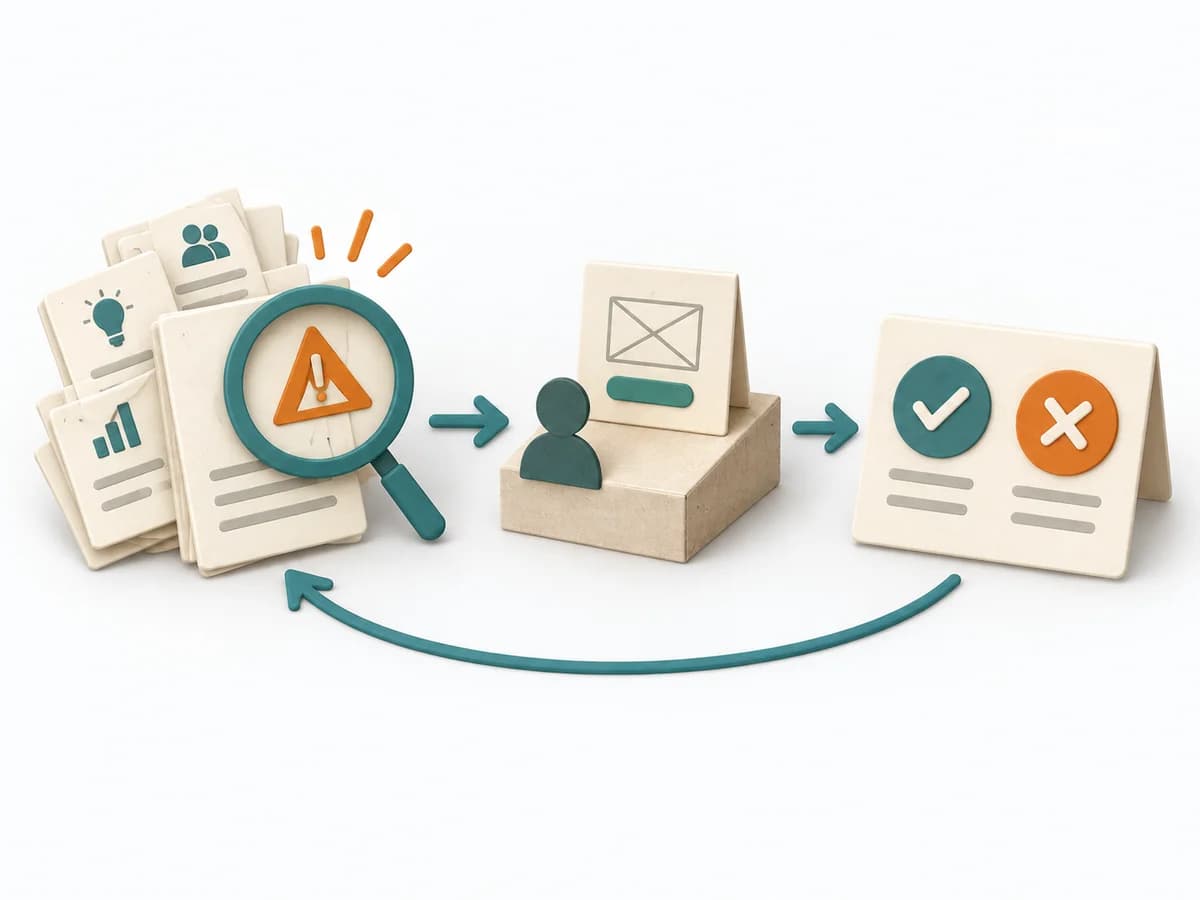
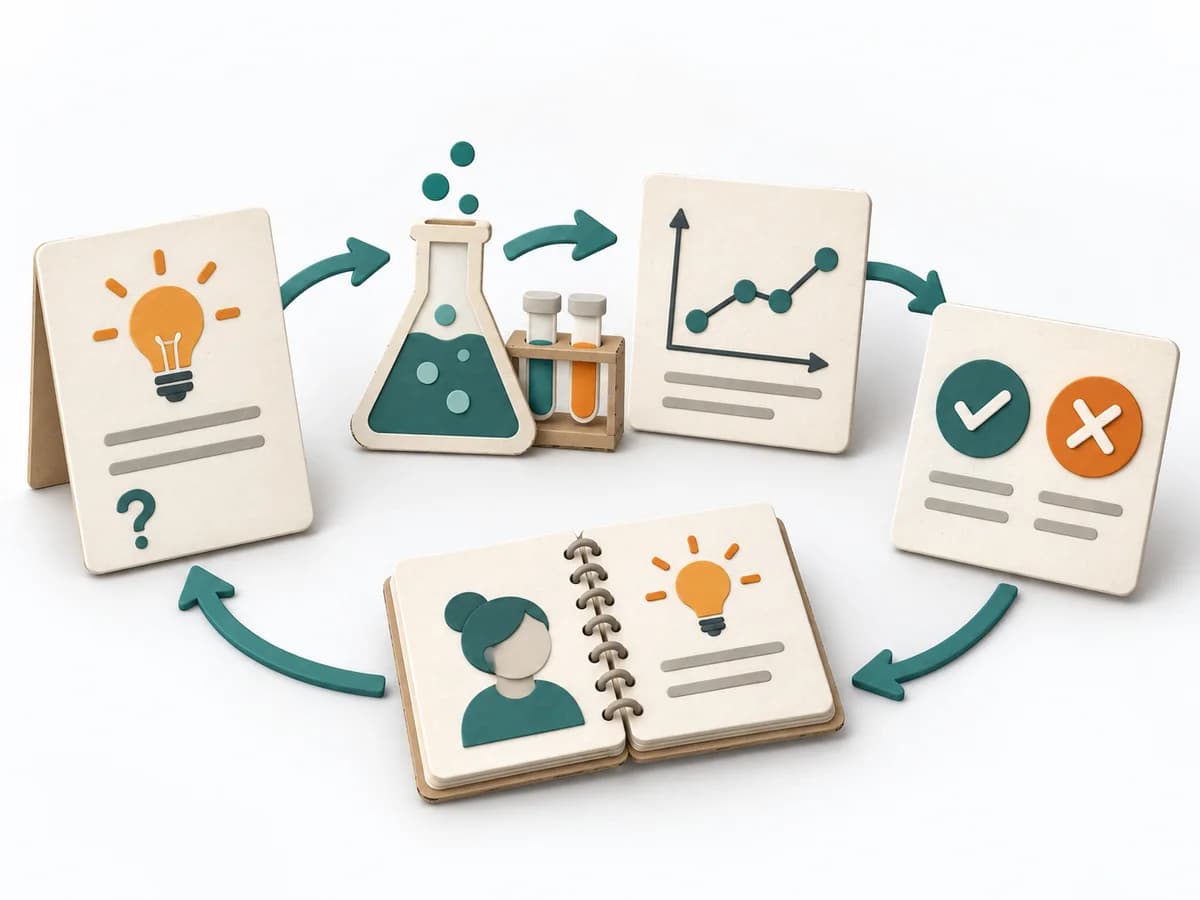
Plan my session
Plan a concrete work block with agenda, roles, preparation, and a copyable result artifact.
Session: Assumption Surfacing
The plan translates the method into a concrete facilitated work block. Your inputs flow directly into the session brief and work artifact.
Method session with 2-8. The plan uses the existing method logic and the runsheet.
RunsheetUse the session for shared understanding. Contributions are collected visibly, assumptions are aligned, and open differences remain traceable in the artifact.
The session works directly toward Assumption List. After the session, the artifact should be shareable, reviewable, or reusable.
- 1
Phase 1: Clarify the initiative
5-10 minRead the initiative or decision aloud and clear up misunderstandings. Agree on one sentence that will not change for the rest of the workshop. Hint: If the initiative still changes during the workshop, the set of assumptions changes with it. Fix it first.
FacilitatorAssumption List - 2
Phase 2: Collect assumptions
20-30 minFor each category (users, market, technology, business model, organization), do 5 min of solo writing, then place the notes on the board. Aim for at least three assumptions per category. Hint: Assumptions often start with 'of course', 'naturally', or 'everyone knows'. Saying those phrases out loud helps reveal them.
FacilitatorCritical Assumptions - 3
Phase 3: Rate importance and uncertainty
15-20 minFor each assumption, make two ratings: how important if wrong (1-5)? How uncertain (1-5)? Place the assumptions in the grid. Mark the top quadrant (high x high). Hint: Uncertain is not the same as unknown. If we believe it is true but do not have evidence, it is uncertain. Gut feeling is not evidence.
FacilitatorLearning Plan - 4
Phase 4: Choose critical assumptions
10-15 minSelect the top 3 assumptions from the 'important and uncertain' quadrant. For each one, ask: what would we do if it were false? Hint: If the answer is 'then the initiative fails', testing before implementation is mandatory. If the answer is 'then we adapt', testing is useful but not mandatory.
FacilitatorAssumption List - 5
Phase 5: Learning plan
10-15 minChoose one test per critical assumption: interview, smoke test, data analysis, spike, expert review. Note owner, date, and success criterion. Hint: Tests must be cheaper than being wrong about the assumption. Anyone proposing a 6-week pilot for an assumption that could be tested in a 30-minute interview is optimizing badly.
OwnerCritical Assumptions - 6
Publish artifact
10 minCheck the artifact for completeness, define location, set version or status, and name review recipients.
OwnerAssumption List
Session Brief
For invitations, boards, tickets, PR descriptions, or workshop notes.
session-brief.md
Session Brief: Assumption Surfacing
Goal
Artifact: Assumption List
Working Question
Which implicit assumptions hold up the initiative, and which of them are so important and uncertain that we need to test them before implementation?
Context
Initiative in one sentence; existing arguments and rationales; known data or research; time horizon and budget for assumption tests.
Setup
- Format: Method session
- Duration: 45-90 min
- Mode: Workshop or async
- Participants: One facilitator who separates assumptions sharply and leads the rating; two to eight participants with different perspectives; one scribe for the learning plan.
- Owner: One facilitator who separates assumptions sharply and leads the rating
- Participation mode: Team round, shared work and alignment
- Outcome logic: Finish artifact
Participation Logic
Use the session for shared understanding. Contributions are collected visibly, assumptions are aligned, and open differences remain traceable in the artifact.
Outcome Logic
The session works directly toward Assumption List. After the session, the artifact should be shareable, reviewable, or reusable.
Input
Whiteboard or Miro board with a two-axis grid (importance, uncertainty); sticky notes; pens; timer; prepared list of typical assumption categories (users, market, technology, business model, organization).
Preparation
Put the initiative at the top of the board. Prepare the two-axis grid (X: uncertainty, Y: importance). Make the assumption categories visible. Rule: an assumption is anything we believe without knowing.
Agenda
-
Phase 1: Clarify the initiative (5-10 min) Owner: Facilitator Action: Read the initiative or decision aloud and clear up misunderstandings. Agree on one sentence that will not change for the rest of the workshop. Hint: If the initiative still changes during the workshop, the set of assumptions changes with it. Fix it first. Output: Assumption List
-
Phase 2: Collect assumptions (20-30 min) Owner: Facilitator Action: For each category (users, market, technology, business model, organization), do 5 min of solo writing, then place the notes on the board. Aim for at least three assumptions per category. Hint: Assumptions often start with 'of course', 'naturally', or 'everyone knows'. Saying those phrases out loud helps reveal them. Output: Critical Assumptions
-
Phase 3: Rate importance and uncertainty (15-20 min) Owner: Facilitator Action: For each assumption, make two ratings: how important if wrong (1-5)? How uncertain (1-5)? Place the assumptions in the grid. Mark the top quadrant (high x high). Hint: Uncertain is not the same as unknown. If we believe it is true but do not have evidence, it is uncertain. Gut feeling is not evidence. Output: Learning Plan
-
Phase 4: Choose critical assumptions (10-15 min) Owner: Facilitator Action: Select the top 3 assumptions from the 'important and uncertain' quadrant. For each one, ask: what would we do if it were false? Hint: If the answer is 'then the initiative fails', testing before implementation is mandatory. If the answer is 'then we adapt', testing is useful but not mandatory. Output: Assumption List
-
Phase 5: Learning plan (10-15 min) Owner: Owner Action: Choose one test per critical assumption: interview, smoke test, data analysis, spike, expert review. Note owner, date, and success criterion. Hint: Tests must be cheaper than being wrong about the assumption. Anyone proposing a 6-week pilot for an assumption that could be tested in a 30-minute interview is optimizing badly. Output: Critical Assumptions
-
Publish artifact (10 min) Owner: Owner Action: Check the artifact for completeness, define location, set version or status, and name review recipients. Output: Assumption List
Closeout
- Update result artifact: Assumption List
- Define location, version, and review recipients.
- Define owner, next step, and review date.
Work artifact
Pre-filled starting point based on the matching template.
work-artifact.md
Assumption List: Assumption Surfacing
Working Question
Which implicit assumptions hold up the initiative, and which of them are so important and uncertain that we need to test them before implementation?
Context
Initiative in one sentence; existing arguments and rationales; known data or research; time horizon and budget for assumption tests.
Participants
- Owner: One facilitator who separates assumptions sharply and leads the rating
- Participants: One facilitator who separates assumptions sharply and leads the rating; two to eight participants with different perspectives; one scribe for the learning plan.
Input
Whiteboard or Miro board with a two-axis grid (importance, uncertainty); sticky notes; pens; timer; prepared list of typical assumption categories (users, market, technology, business model, organization).
Template
Assumption Surfacing Working Template
Goal
Makes implicit assumptions behind ideas, decisions, or strategies visible.
Context
When and for what do we use this method?
Input
Which data, observations, decisions, or materials are available?
Execution
Short notes along the runsheet.
Output artifacts
- Assumption List:
- Critical Assumptions:
- Learning Plan:
Assumptions and open questions
- ...
Decision / Next step
Owner, date, and success signal.
Completion Check
- Assumption List is complete enough for review:
- Location:
- Version / status:
- Review by:
- Next step:
Next Step
- Review result
- Mark open questions
- Schedule review or decision
Assumption Surfacing Working Template
View templateCompact working template for Assumption Surfacing with context, input, output artifacts, and next step.markdown
assumption-surfacing-working-template.md
Compact working template for Assumption Surfacing with context, input, output artifacts, and next step.
Assumption Surfacing Working Template
Goal
Makes implicit assumptions behind ideas, decisions, or strategies visible.
Context
When and for what do we use this method?
Input
Which data, observations, decisions, or materials are available?
Execution
Short notes along the runsheet.
Output artifacts
- Assumption List:
- Critical Assumptions:
- Learning Plan:
Assumptions and open questions
- ...
Decision / Next step
Owner, date, and success signal.
- Working question, owner, and target artifact are visible.
- The result fits Assumption List.
- One entry per initiative with date. After each assumption test, update the assumption status: confirmed, disproved, or modified. Keep old assumptions and set a status instead of deleting them.
- Open questions are noted as follow-ups.
- The next review or decision point is scheduled.