Complete firstConcrete frame
Situation, purpose, and sources are named.
Without a frame, the artifact is arbitrary.
A practical method guide: clarify prerequisites and materials, understand the complete process, and look up outputs, pitfalls, and stop criteria.
What needs to be finished first
Situation, purpose, and sources are named.
What needs to be ready before start
Individual sourced notes, a free surface, cluster and outlier markers, and versioned snapshots.
Facilitation, research or subject experts, and multiple perspectives; actively balance dominance.
Prepare the question, complete raw material, source markers, and clustering boundaries. Split compound statements before the session.
45–90 minutes for up to about 30 notes; split larger sets into rounds.
One movable note contains one observation or statement. Clusters first emerge from relationships in the material; preset categories stay off the workspace.
The one question this method answers
What patterns emerge from individual notes, which outliers matter, and what question follows?
Phases with goal, actions, output and pitfall
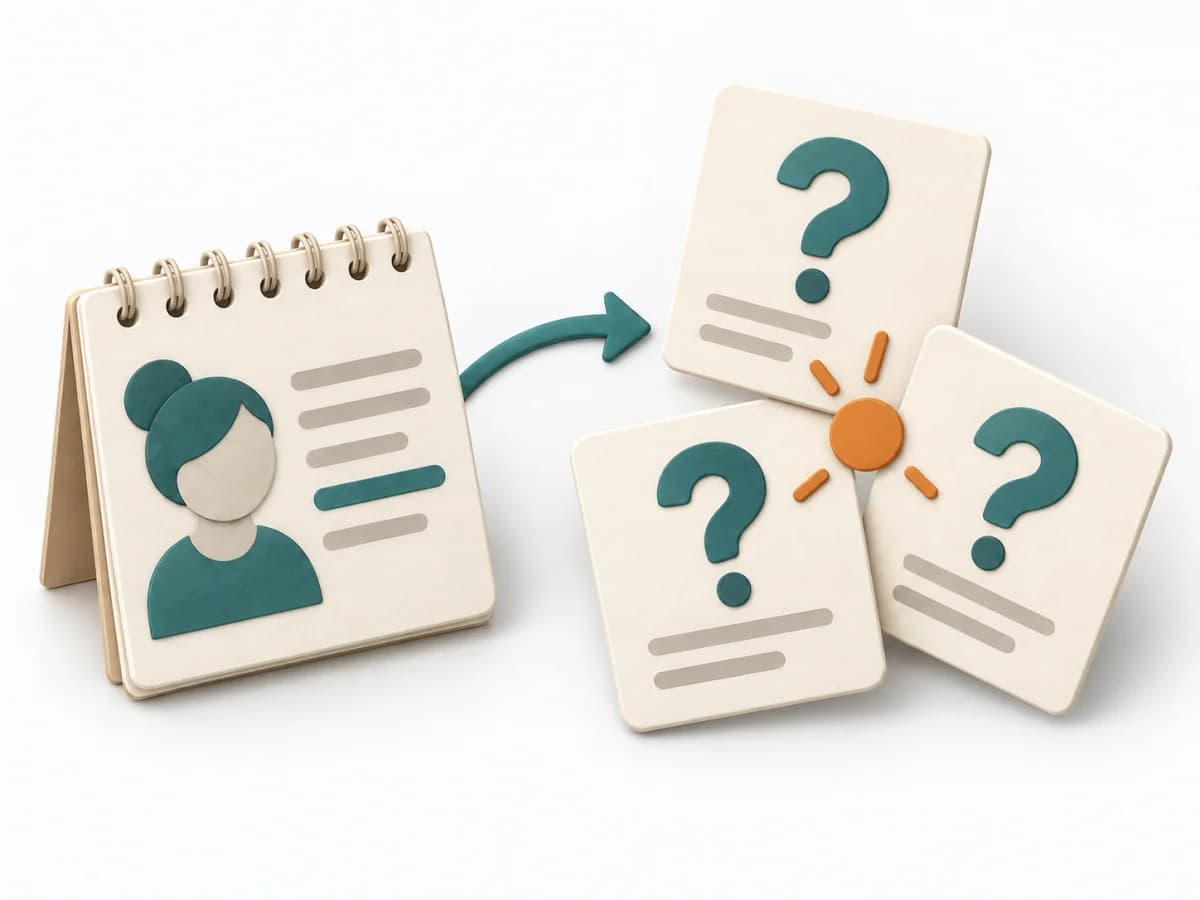
Affinity Diagramming groups individual observations by shared relationships. Named clusters, visible outliers, and sources make the emerging structure traceable and revisable in review.
Fictional teaching example
Sourced notes, inductive clusters, and open questions.
| Work row | Source or case | Observation or statement | Provisional pattern | Open question or follow-up action |
|---|---|---|---|---|
| Working noteOne note with context. | F1: calendar note | F1: Saturday slot missing | Availability before travel | Question open |
| Cluster reviewTest the label and record counterexamples and gaps. | F2: fictional interview note | Borrows spontaneously without booking; counterexample to F1 | Access needs planned and spontaneous paths | When does walk-in borrowing suffice, and when is booking confirmation needed? |
Keep classifications traceable and revisable.
Prepare material

Goal
Each note can be moved and checked independently.
Inputs for this step
Actions
Output
Note · context · source
Evidence, context, and source
Quality check
Can each note stand on its own?
Pitfall
Preset categories steer the grouping. Start with the notes and discover relationships.
Timing: 10–20 minutes
Cluster inductively
Goal
Clusters emerge from the material.
Inputs for this step
Actions
Output
Notes · provisional cluster · outlier
Evidence, context, and source
Quality check
Are clusters grounded in note relationships?
Pitfall
A cluster hides differences between notes. Split mixed clusters and keep outliers visible.
Timing: 15–30 minutes
Review clusters
Goal
Labels fit the notes and remain revisable.
Inputs for this step
Actions
Output
Label · supporting notes · counterexample
Evidence, context, and source
Quality check
Do labels survive a counterexample review?
Pitfall
A label reflects one note only. Review the label against every note and counterexample.
Timing: 10–20 minutes
Derive questions
Goal
The synthesis leads to explicit next questions.
Inputs for this step
Actions
Output
Pattern · source · open question · action
Evidence, context, and source
Quality check
Is the next question traceable to the cluster?
Pitfall
Cluster size is treated as priority. Plan prioritisation with explicit criteria afterwards.
Timing: 10–20 minutes
What comes out at the end
Sketch: what the artifact looks like
Affinity diagram with raw notes, inductive clusters, labels, outliers, and open questions.
Preserve raw notes and save a dated snapshot after each clustering round. Keep renamed and dissolved clusters traceable.
Turn source material into movable notes and prepare an inductive clustering round.
To be confirmed
To be confirmed
Create one affinity diagram Time: 45–90 minutes
Complete this worksheet on paper or in your own document during the work.
| Work row | Source or case | Observation or statement | Provisional pattern | Open question or follow-up action |
|---|---|---|---|---|
| Working note | ||||
| Cluster review |
Blank worksheet: enter your own material.
Expected artifact: Note · context · source
Evidence, context, and source
Entry:
...
Expected artifact: Notes · provisional cluster · outlier
Evidence, context, and source
Entry:
...
Expected artifact: Label · supporting notes · counterexample
Evidence, context, and source
Entry:
...
Expected artifact: Pattern · source · open question · action
Evidence, context, and source
Entry:
...
...
Method guide: https://methodatlas.meierhoff-systems.de/en/methods/affinity-diagramming/run-sheet
Concrete filled scenario, fictional example
Fictional example for orientation. Counts and timings describe this case and are not universal requirements.
Concrete filled scenario, fictional example
All details are invented and are not research. Four notes are grouped without preset themes.
The outlier stays visible. A next question is: What information do households need before pickup and return? Frequency is untested.
Recognize symptoms and steer against them
Quick overview, the full text is in the matching phase in the flow
Preset categories steer the grouping.
Start with the notes and discover relationships.
A cluster hides differences between notes.
Split mixed clusters and keep outliers visible.
A label reflects one note only.
Review the label against every note and counterexample.
Cluster size is treated as priority.
Plan prioritisation with explicit criteria afterwards.
When to pause, resolve prerequisites, or choose another approach
Go to the profile for purpose, similar methods, and sources or continue to the next method in the catalog.