Complete firstSmall candidate story
User, goal, and value are understandable and scope can be bounded.
An epic cannot be clarified in a short criteria workshop.
A practical method guide: clarify prerequisites and materials, understand the complete process, and look up outputs, pitfalls, and stop criteria.
What needs to be finished first
User, goal, and value are understandable and scope can be bounded.
Product/Domain, Development, and Test are represented; open domain questions have a decision maker.
What needs to be ready before start
Story card, four card colours for story/rule/example/question, timer, and backlog access.
Product/domain · developer · tester · optional facilitator
Select one story, gather known rules and incidents, and invite the relevant Three Amigos.
25–40 minutes per small story
Place story at top, rules below, concrete examples under each rule, and unanswered questions separately.
The one question this method answers
Which rules and examples must hold for this story to be accepted from a business perspective?
Phases with goal, actions, output and pitfall
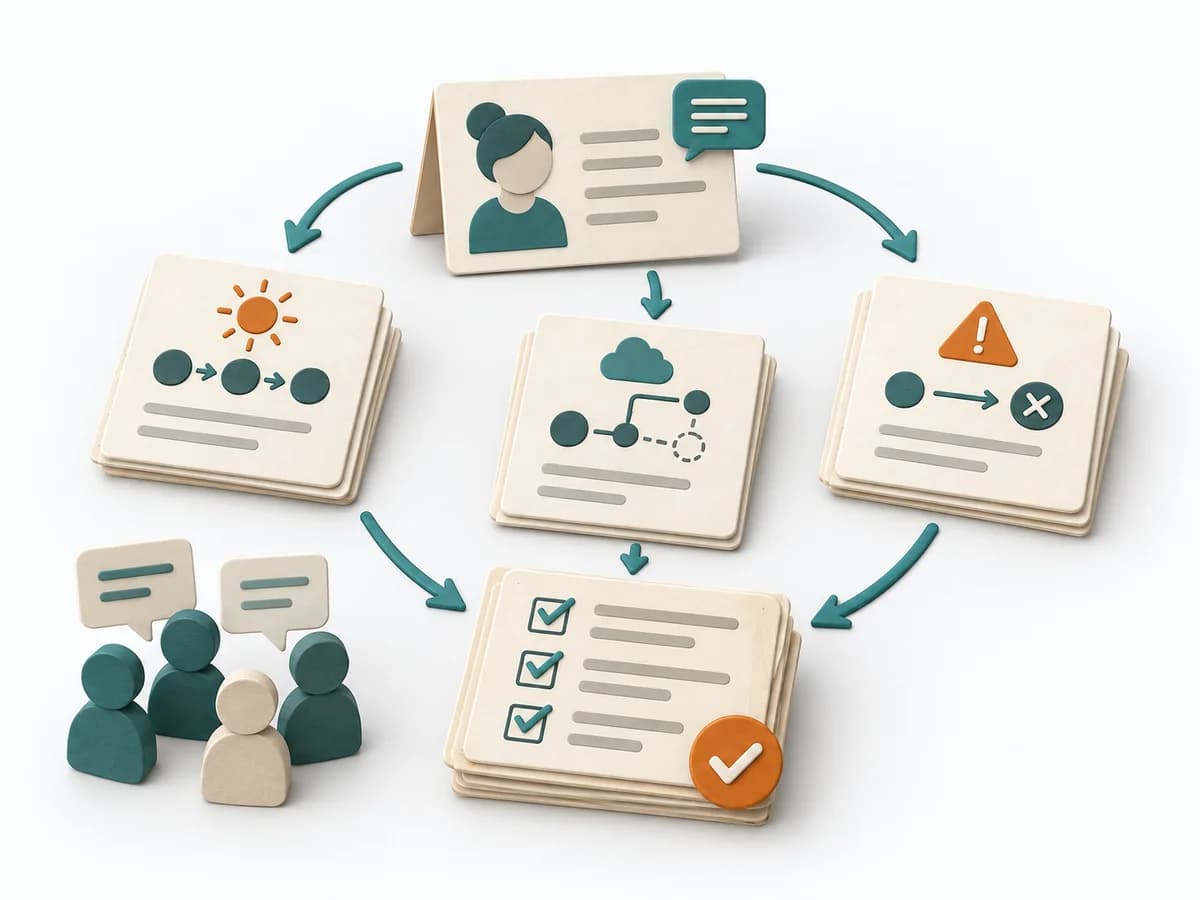
The workshop uses a Three Amigos perspective and Example Mapping: story, rules, examples, and questions remain distinct. Acceptance criteria describe observable business behaviour rather than premature UI steps.
Fictional worked example
Keep story, rules, examples, questions, and readiness decision as distinct information types.
Who wants to achieve what, why, and what is outside scope?
As a customer, I cancel an appointment online so I can plan without a phone call.
Which business rules and constraints apply?
Cancellation is free until and including 24 hours before start; later cancellation costs €20.
Which typical, boundary, and negative cases illustrate each rule?
25h before: full refund. Exactly 24h: full refund. 23:59h: €20 fee.
Which outcome is undecided, and who resolves it?
Which timezone applies to international appointments? Owner Product, due 18 June.
Ready, rework, or defer? Which slices or follow-ups result?
Rework: resolve timezone and update criteria before implementation.
Questions are not acceptance criteria. They stay open until an authorised person makes the business decision.
Story
Goal
Select a small story with audience, value, and clear scope boundary.
Inputs for this step
Actions
Output
Focused story
Who · goal · value · scope
Quality check
Can the group discuss the whole story in a short workshop?
Pitfall
A large epic is treated as a story and creates many unrelated rules. Slice along a business rule or user outcome.
Timing: 5 minutes
Rules
Goal
Name the business rules and constraints that govern the story.
Inputs for this step
Actions
Output
Rule set
Story · rules · scope
Quality check
Does each rule describe business behaviour or a constraint?
Pitfall
Criteria are written as technical tasks or UI design decisions. Ask for the observable outcome and keep implementation decisions separate.
Timing: 5–10 minutes
Examples
Goal
Explore happy path, boundaries, negative cases, and relevant exceptions.
Inputs for this step
Actions
Output
Example map
Rules · examples · questions
Quality check
Does every example have concrete input and expected outcome?
Pitfall
The group invents an expected result although a business decision is missing. Create a question with an owner and keep the example open until resolved.
Timing: 10–15 minutes
Decide
Goal
Decide together whether the story is small and clear enough to implement.
Inputs for this step
Actions
Output
Readiness decision
Status · questions · owners · sliced scope
Quality check
Do Product, Development, and Test share the acceptance understanding?
Pitfall
The timebox ending is treated as ready while core questions remain unanswered. Use an explicit readiness vote or rule and treat uncertainty as rework.
Timing: 5–10 minutes
What comes out at the end
Sketch: what the artifact looks like
Acceptance Criteria Map plus readiness status, question owners, and sliced follow-up stories.
Retain date, author, source state, and decision status for each revision; do not overwrite earlier results.
Plan Acceptance Criteria Workshop with real scope, suitable roles, and a clear decision objective.
To be confirmed
To be confirmed
Plan the full workshop Time: 25–40 minutes per small story
Complete this worksheet on paper or in your own document during the work.
Who wants to achieve what, why, and what is outside scope?
...
Which business rules and constraints apply?
...
Which typical, boundary, and negative cases illustrate each rule?
...
Which outcome is undecided, and who resolves it?
...
Ready, rework, or defer? Which slices or follow-ups result?
...
Complete story, rules, examples, questions, and decision separately.
Cucumber: Introducing Example Mapping
Expected artifact: Focused story
Who · goal · value · scope
Entry:
...
Expected artifact: Rule set
Story · rules · scope
Entry:
...
Expected artifact: Example map
Rules · examples · questions
Entry:
...
Expected artifact: Readiness decision
Status · questions · owners · sliced scope
Entry:
...
...
Method guide: https://methodatlas.meierhoff-systems.de/en/methods/acceptance-criteria-workshop/run-sheet
Concrete filled scenario, fictional example
Fictional example for orientation. Counts and timings describe this case and are not universal requirements.
Concrete filled scenario, fictional example
Fictional story: 'As a customer I cancel an appointment online.' Rule: free cancellation until and including 24 hours before start. Examples: 25 hours before full refund; exactly 24 hours full refund; 23:59 hours before €20 fee. Open question: timezone for international appointments. Decision: not ready until timezone is resolved.
Recognize symptoms and steer against them
Quick overview, the full text is in the matching phase in the flow
A large epic is treated as a story and creates many unrelated rules.
Slice along a business rule or user outcome.
Criteria are written as technical tasks or UI design decisions.
Ask for the observable outcome and keep implementation decisions separate.
The group invents an expected result although a business decision is missing.
Create a question with an owner and keep the example open until resolved.
The timebox ending is treated as ready while core questions remain unanswered.
Use an explicit readiness vote or rule and treat uncertainty as rework.
When to pause, resolve prerequisites, or choose another approach
Go to the profile for purpose, similar methods, and sources or continue to the next method in the catalog.